


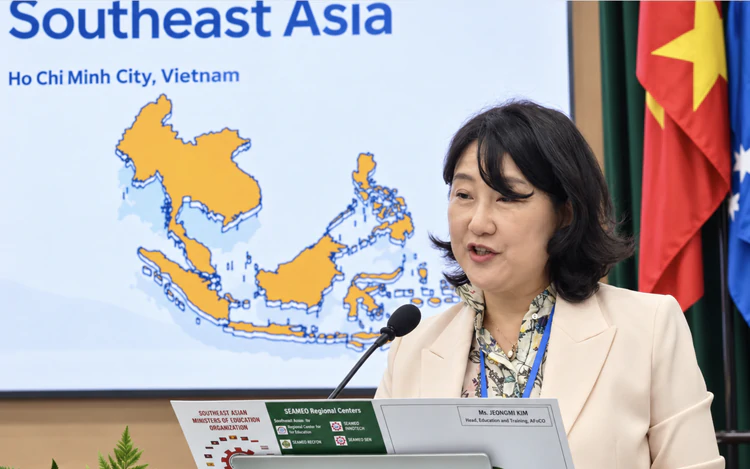
Jeongmin Eom, head of the Office of Education and Training at the UNESCO Asia-Pacific Center of Education for International Understanding (UNESCO APCEIU). Photo: Trong Nhan / Tuoi Tre
Jeongmin Eom, head of the Office of Education and Training at the UNESCO Asia-Pacific Center of Education for International Understanding (UNESCO APCEIU), made the recommendation as she spoke to Tuoi Tre (Youth) online newspaper on the sidelines of a conference held in Ho Chi Minh City on Tuesday.
The regional conference on global citizenship education in Southeast Asia was organized by the Southeast Asian Ministers of Education Organization Regional Training Center (SEAMEO RETRAC) and UNESCO APCEIU.
She highly valued Vietnam’s education, stressing that Vietnam has favorable foundations, including a high literacy rate, a society that places great importance on education, and schools that focus strongly on teaching capacity.
However, Vietnamese education could broaden its goals beyond academic achievement, she said.
Students need to retain a sense of identity rooted in their own culture while remaining open to others, developing empathy and recognizing their responsibilities to the wider community.
She noted that students need opportunities to work on projects, investigate issues on their own, discuss and collaborate with others, make decisions and try to create small changes in their communities.
They need sufficient time to explore an issue in depth, develop their own solutions and then put them into practice.
“The education system needs to change to create more space for meaningful learning, moving beyond an approach that places too much emphasis on examinations and academic achievement,” Eom said.
She also said teachers in the coming years should develop skills that go beyond knowing how to use technology.
Teachers must be able to design and organize learning activities and use technology, including AI, to help students delve into issues, collaborate, create and develop critical thinking skills.
Other competencies include project-based learning, experiential learning, differentiated instruction and assessment methods that focus more on students’ competencies rather than simply testing their knowledge.
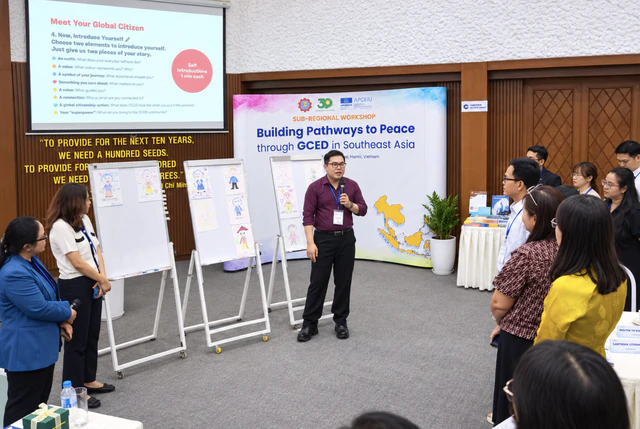
Local and international education experts attend a conference in Vietnam. Photo: Trong Nhan / Tuoi Tre
Teachers also need to engage in continuous learning, reflect on their own teaching practices and work more closely with colleagues.
The development of AI also reminds educators that schools need to make room for activities that are less dependent on technology and are more closely connected to nature, real-life relationships and communities, she said.
Vietnam could also make better use of international cooperation networks to expand educational collaboration across the region.
Fighting bullying is part of education
Dr. Ananto Kusuma Seta, former executive chair of the Indonesian National Commission for UNESCO, gave concrete examples of how global citizenship values can be incorporated into everyday school life.
He mentioned simple practices at the beginning of the school day, such as encouraging students to reflect on themselves, make a commitment to prevent bullying, listen to others and respect differing opinions.
Behaviors repeated every day will gradually become part of school culture.
Seta also hinted at small-group projects.
Working together to complete a task enables students to learn subject knowledge while also practising how to exchange ideas, present their views, respond politely, collaborate and respect others.
In his view, education needs the participation of families and communities.
Schools should also pay attention to how students behave when assessing their development, rather than relying solely on grades and academic results.








Max: 1500 characters
There are no comments yet. Be the first to comment.