



Residents visit the Public Administrative Service Center in Nong Tien Ward, Tuyen Quang Province, northern Vietnam. Photo: Vietnam News Agency
Promoting strategic technologies is a key priority to strengthen technological capabilities, drive growth and develop widely applicable products and solutions. Meanwhile, digital transformation is reaching disadvantaged, remote and mountainous areas, bringing infrastructure and services closer to residents and improving their quality of life.
Policy support drives technological innovation
Localities are shifting from funding research alone towards building capacity to master foundational technologies with broad socio-economic impacts.
In Ho Chi Minh City, the scheme to establish and develop internationally standard research centres, known as the Centers of Excellence (CoE) scheme, is providing long-term funding for research in advanced materials, semiconductor chips, sensors, artificial intelligence (AI), the Internet of Things (IoT), digital transformation and green transition.
The Advanced Materials Technology Institute (AMTI) at Vietnam National University-Ho Chi Minh City has received VND85 billion (US$3.27 million) to conduct research aimed at international publications, patents and applications in energy, the environment and healthcare.
Associate Professor Dr Doan Le Hoang Tan, Deputy Director of AMTI, said the five-year investment would enable researchers to develop projects through to completion and technology transfer, helping the institute gradually master advanced materials technologies and apply them in practice.
Meanwhile, the Research and Development Center at the Saigon Hi-Tech Park has received nearly VND96 billion ($3.7 million) to develop into a center of excellence in digital transformation and green transition.
Its director, Dr Trinh Xuan Thang, said the centre was focusing on semiconductor chip fabrication and sensor manufacturing integrated with AI and IoT to develop smart sensor networks. Green transition research includes environmentally friendly materials, functional foods and fuel cells.
Long-term investment enables research teams to advance technologies beyond initial findings towards practical applications.
Ho Chi Minh City is also prioritising infrastructure, human resource development, international cooperation and the transfer and commercialisation of research results.
In the central city of Da Nang, Resolution No. 33/2026 of the municipal People's Council provides businesses with up to VND3 billion ($115,940) each per year for technological innovation, covering a maximum of two projects per business.
For strategic technology projects involving semiconductors, AI, IoT, digital twins and robotics, support for equipment purchases can reach 50%, rising to 70% for projects with technology transfer contracts.
Le Thi Thuc, Deputy Director of the Da Nang Department of Science and Technology, said the policy aimed to encourage businesses to invest more in research, application and innovation. By sharing costs for research, testing, technology transfer and investment, the city hopes to reduce initial financial barriers, improve business competitiveness and create a stronger market for innovative products.
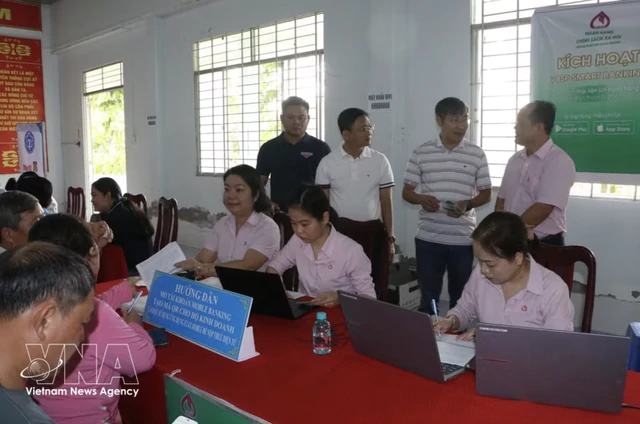
Residents join Digital Transformation Day linked to the development of smart hamlets in Tan Hoa Commune, Can Tho City, southern Vietnam. Photo: Vietnam News Agency
Digital services reach local communities
While strategic technology development strengthens national technological capacity, bringing digital services to grassroots communities allows residents to benefit directly from these advances.
In Minh Ngoc Commune, Tuyen Quang Province, northern Vietnam, where settlements are scattered and some highland villages have limited internet access, local officials visit communities to help residents use online public services and electronic identification applications.
Youth union members, police officers, village heads and respected community members provide hands-on guidance, particularly for older people unfamiliar with smartphones. Officials return to help those who need further assistance.
The approach has improved administrative services. After more than a year of operation, the commune Public Administration Service Center had received nearly 3,000 applications, of which only eight were submitted in person.
The digitisation rate for incoming dossiers reached 99.91%, while 100% of processing results were digitised. The centre scored 97.7 out of 100 in the public service performance index.
The figures demonstrate that technology delivers practical benefits when people can use it confidently and conveniently.
In Minh Ngoc, digital transformation starts with simple steps, including a smartphone, an electronic identification account and direct assistance from local officials.
In the border areas of Nghe An Province, north-central Vietnam, digital technology is creating new channels of communication between residents and authorities.
The Nghe An Border Guard has introduced QR codes at community centers and public gathering points, allowing residents to report information quickly and securely.
Under the anonymous electronic mailbox model, residents can scan a QR code using their phones to submit reports, photographs or information about suspected offences. Border guard officers then receive, classify, verify and handle the information in accordance with regulations.
The initiative, including its implementation at the Chau Khe Border Guard Station, not only encourages people to report crime but also helps officers monitor local conditions and respond promptly to incidents, contributing to security and public order in border areas.
It also familiarises residents with digital tools and helps improve their technology skills.
Experiences across these localities show that the effectiveness of science, technology and digital transformation should be measured not only by the number of projects, devices or platforms developed, but also by the tangible benefits they bring to people's lives.
With resources directed towards the right priorities, research institutions and businesses can strengthen their technological capabilities, while residents in both urban centres and disadvantaged areas gain easier access to digital services.
These practical efforts are helping translate the objectives of Resolution No. 57 into reality.








Max: 1500 characters
There are no comments yet. Be the first to comment.