


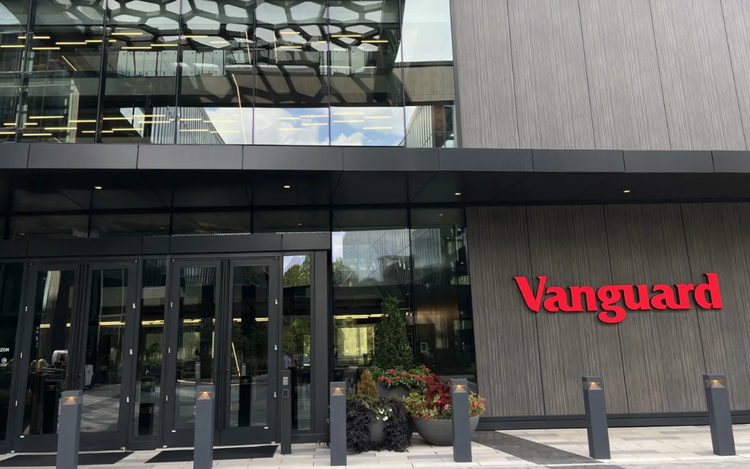
The main entrance for visitors to Vanguard’s headquarters in the United States. Photo: Axios
The Vietnamese stock market moved from frontier-market status to secondary emerging-market status under FTSE Russell’s classification on September 21.
The upgrade is being implemented in several stages.
Just days before the new classification took effect, representatives from BlackRock and Vanguard joined a delegation of global investment institutions meeting with Vietnamese government leaders and attending an FTSE Russell event.
BlackRock, a U.S. asset-management giant, oversees more than US$15 trillion in assets, according to figures released by the Vietnamese government following a meeting with the delegation on September 17.
Vanguard is also one of the world’s largest asset managers, with some $13 trillion in assets.
More significantly, the figures are beginning to move from potential to concrete capital-allocation plans.
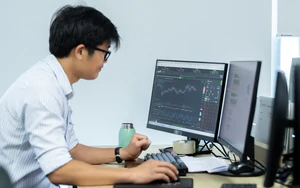
Duncan Burns, head of investment management and global equities for Asia-Pacific at Vanguard, said the group plans to invest about $2.5 billion in Vietnam within one year through its investment portfolios.
Also, BlackRock is a New York-founded U.S. investment-management group widely regarded as the world’s largest asset manager.
It also had a presence in Vietnam during events surrounding the market upgrade.
One of BlackRock’s best-known brands is iShares, which offers roughly 1,700 exchange-traded funds with total assets of about $5.5 trillion.
BlackRock manages capital for a broad range of clients, including pension funds, financial institutions, corporations, and individual investors.
FTSE Russell estimates that foreign capital inflows into Vietnam could reach nearly $6 billion although the actual amount will depend on fund sizes, portfolio rebalancing, and decisions by active investors.
Beyond BlackRock and Vanguard
During Vietnamese Party General Secretary and State President To Lam’s recent working visit to the United States, he met with senior executives of JPMorgan Chase, one of the world’s leading financial institutions.
The top Vietnamese leader urged JPMorgan Chase to support the Vietnamese government, commercial banks, and businesses in gaining more effective access to international sources of capital, including international bond issuance, export credit, and other international channels to support the country’s development objectives.
He also hinted at sharing international experience in public-debt management and state foreign-exchange reserve management, helping Vietnam work toward its goal of achieving investment-grade credit ratings in the coming period.
Troy Rohrbaugh, co-president of JPMorgan Chase, said international investors viewed Vietnam’s macroeconomic stability and long-term growth potential positively.
JPMorgan Chase was ready to support Vietnam and continue sharing international experience as the country develops its financial and capital markets and promotes deeper integration of its domestic financial system with global markets, he said.
The story of U.S. capital entering Vietnam is therefore broader than traditional foreign direct investment.
It can include capital from U.S. companies building factories and research centers, private-equity investment, international loans, and bond financing, as well as money belonging to millions of global investors that is managed and allocated by institutions such as Vanguard and BlackRock through the stock market.
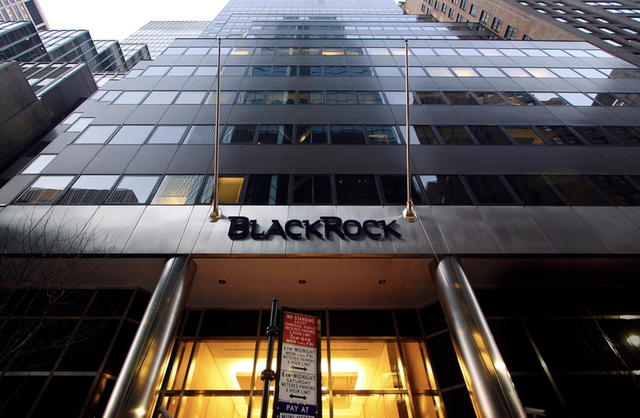
BlackRock’s headquarters in New York. Photo: AP
Attracting foreign capital is only first step
The market upgrade opens the door, but the volume of capital attracted and its staying power will depend on the quality of the market behind that door.
Bui Hoang Hai, vice-chairman of the State Securities Commission of Vietnam, said that following the upgrade, Vietnam would still need to improve investment products, foreign-exchange hedging instruments, corporate governance, transparency, and the availability of information in English.
Vu Chi Dung, head of the commission’s Legal and International Affairs Department, also noted that international capital would not arrive in a single wave.
Large institutions typically allocate an initial portion of capital to assess market liquidity, operational capacity, and supply and demand before increasing their exposure.
Further phases are expected to extend into 2027 and 2028.
This explains why, after the upgrade, the real challenge is no longer simply to ‘attract capital.’
Vietnam must build a market large, transparent and well supplied with quality investment assets enough to absorb long-term capital.
The new stage of development would place higher demands on market infrastructure, governance capacity, and international integration, said Nguyen Son from Vietnam Securities Depository and Clearing Corporation.
One issue of particular interest to foreign investors entering Vietnam is the country’s settlement, clearing and risk-management framework in line with international practices.
Son said that a key priority in the coming period is to complete the central counterparty (CCP) model for the cash equity market, with a roadmap targeting operation in the first quarter of 2027.
The move is expected to strengthen risk management, improve post-trade infrastructure, and better meet the requirements of international investors.
Hoang Hai Anh, vice-chairwoman of the Vietnam Association of Securities Business, told Tuoi Tre (Youth) online newspaper that for international capital to enter Vietnam and remain for the long term, the country needs a clear strategy for market development and positioning.
She pointed to regional examples of markets developing distinctive strengths.
Singapore has positioned itself as a gateway for international capital into Asia, Malaysia has developed a strong Islamic-finance sector, while Thailand has focused on strengthening market liquidity.
“Vietnam also needs to find its own market positioning,” she said.
Apart from trading infrastructure, the more fundamental challenge is to improve the capacity and quality of listed companies.
She compared market infrastructure to roads and traffic signs: good roads are essential, but the quality of the system also depends on the vehicles using it and the people operating within it.
For Vietnam’s stock market, that means improving corporate governance, transparency and the competitiveness of listed companies alongside continued investment in market infrastructure.








Max: 1500 characters
There are no comments yet. Be the first to comment.