


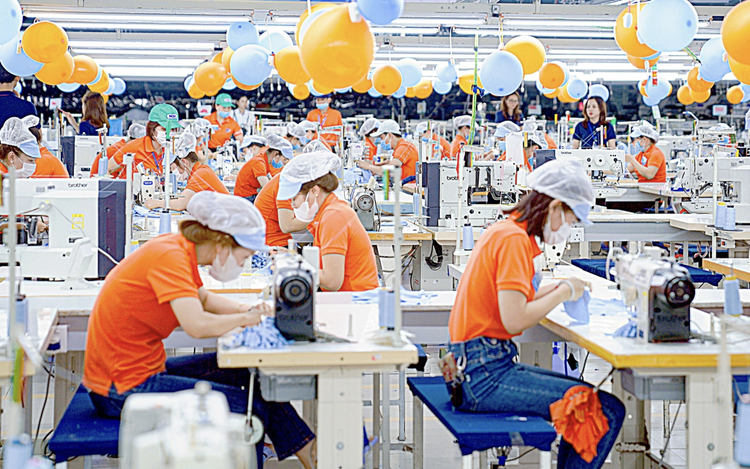
Employees are at work at a garment firm in Vietnam. Photo: P. Son
The United States began collecting a temporary new 10-percent global import tariff on Tuesday
Although the revised rate remains a cost burden, exporters said the reduction to 10 percent from previously higher levels is welcome news at the start of the new year.
Nguyen Duc Thang, CEO of Dap Cau Garment Corporation Joint Stock Company, which specializes in apparel exports to the U.S., told Tuoi Tre (Youth) newspaper that both order volumes and unit prices had dropped sharply 15-20 percent since October last year when tariff measures took effect.
The decline left production lines underutilized.
Buyers scaled back to smaller and more sporadic orders over the past four months, forcing the company to accept nearly every contract available, even at minimal or no profit, to maintain operations and protect workers’ livelihoods.
With the U.S. lowering the tariff to 10 percent across all countries, Thang believed Vietnamese garments now hold a stronger competitive position compared with many rivals.
“Vietnam has an edge over several Southeast Asian competitors thanks to skilled labor, quality products, fast delivery times, and flexible pricing,” he said.
Pham Quang Anh, director of Dony Garment Production Company, said the U.S. accounts for about 40 percent of his company’s output, roughly 600,000 pieces annually out of 1.6 million.
The key issue is not whether tariffs are 10 percent or 20 percent, but how Vietnam’s rate compares with competing countries, he stressed.
“If Vietnam’s tariff is lower, we retain our advantage,” he said.
“But the biggest challenge is not cost, it’s policy instability in the 2025-26 period.”
He noted that uncertainty has made U.S. customers more cautious, favoring short-term orders over long-term contracts, complicating production planning and investment decisions.
As a result, his company is avoiding aggressive expansion, instead integrating resources and partnering with other factories to fulfill large orders when needed.
Dang Phuc Nguyen, general secretary of the Vietnam Fruit and Vegetable Association, said the uniform 10-percent tariff is good news for Vietnamese fruit exports.
Previously, several Vietnamese fruits faced tariffs of up to 20 percent when entering the U.S., slightly higher than the 19 percent imposed on some competitors.
With the new rate equalized at 10 percent, Vietnamese products, already improving in quality, are better positioned to compete.
“Product quality is steadily rising, exports are growing, and we now supply year-round produce such as durian,” Nguyen said.
“Processing capacity is also expanding, while the U.S. is a major market for processed goods like frozen durian, canned products, and fruit juices.”
However, he cautioned that the 150-day duration underscores the unpredictability of U.S. trade policy.
Beyond tariffs, technical barriers such as stricter quality standards, green production requirements and tighter management of planting area codes pose increasing challenges.
“To compete effectively, we must continue upgrading quality and fully leverage free trade agreements,” he added.
Strategic shift: From quantity to quality
Mac Quoc Anh, vice-chairman and general secretary of the Hanoi Association of Small and Medium Enterprises, viewed the new tariff policy within the broader context of Washington’s trade restructuring strategy aimed at reducing trade deficits, revitalizing domestic manufacturing and securing supply chains.
When the U.S. imposes broad import tariffs, ASEAN economies are directly affected.
He explained that the region has become a key alternative manufacturing hub amid the U.S.-China trade tensions.
Higher import tariffs typically raise prices in the U.S. market, weaken export competitiveness and compress profit margins.
Yet if the adjusted tariff is lower than previously threatened reciprocal levels, it could ease short-term pressure on Vietnam. Still, risks remain.
On August 1, 2025, Trump signed an executive order revising reciprocal tariff rates for 69 countries and territories listed in Annex I, including Vietnam, cutting the tariff on Vietnamese imports from 46 percent to 20 percent.
As one of the countries with a significant trade surplus with the U.S., Vietnam could face heightened scrutiny through trade remedy investigations, origin verification and anti-circumvention measures.
Key sectors such as electronics, textiles, footwear, and furniture would be particularly vulnerable to broader probes or higher duties.
“If the tariff is standardized at a reasonable level, Vietnam may be better off than under earlier scenarios,” Anh said.
However, surplus countries must shift from a ‘volume growth’ strategy to a ‘value growth’ strategy.
He urged Vietnamese firms to diversify export markets through agreements such as the Comprehensive and Progressive Agreement for Trans-Pacific Partnership, the EU-Vietnam Free Trade Agreement, and the Regional Comprehensive Economic Partnership.
They should reduce reliance on a single market, increase localization rates, and enhance supply chain transparency and traceability to mitigate trade defense risks.
Investment in automation, digital transformation, and ESG standards will also be critical to raising added value and brand strength, Anh said.
Wood industry: Relief, but no breakthrough
Nguyen Chanh Phuong, vice-chairman of the Handicraft and Wood Industry Association of Ho Chi Minh City, described the temporary reduction of additional import duties on many wood products to 10 percent, down from 20-25 percent, as a positive signal.
Products such as logs, wooden boards and many furniture items started facing the 10-percent rate during the 150-day window on February 24.
This could ease cost pressures and slightly improve competitiveness, he said.
However, he stressed that the 10-percent rate alone is unlikely to create an immediate breakthrough.
Stability matters more than the nominal rate.
The U.S. administration could still deploy other legal tools, particularly trade remedy investigations.
Hardwood and decorative plywood products are already facing preliminary anti-subsidy duties averaging above 15 percent, with potential anti-dumping rates even higher.
If both the 10-percent tariff and trade remedy duties apply simultaneously, exporters could face compounded levies in 2026.
“The U.S. market remains unpredictable,” he said.
“Businesses must focus on sustainable development – absolute transparency of origin, strict compliance with legal timber sourcing regulations, labor standards and avoiding any trade fraud related to transshipment or origin falsification.”
Decoding latest U.S. tariff measures
After the Supreme Court of the United States struck down the International Emergency Economic Powers Act (IEEPA)-related tariffs imposed by U.S President Donald Trump in April 2025, the U.S. president imposed a new rate on almost all imports under Section 122 of the 1974 Trade Act.
While the maximum potential rate under Section 122 could reach 15 percent, the order issued on February 20, effective February 24, maintains the 10-percent rate.
By law, Section 122 tariffs are temporary and cannot exceed 150 days, meaning the measure is set to expire in July 2026 unless extended or replaced.








Max: 1500 characters
There are no comments yet. Be the first to comment.