


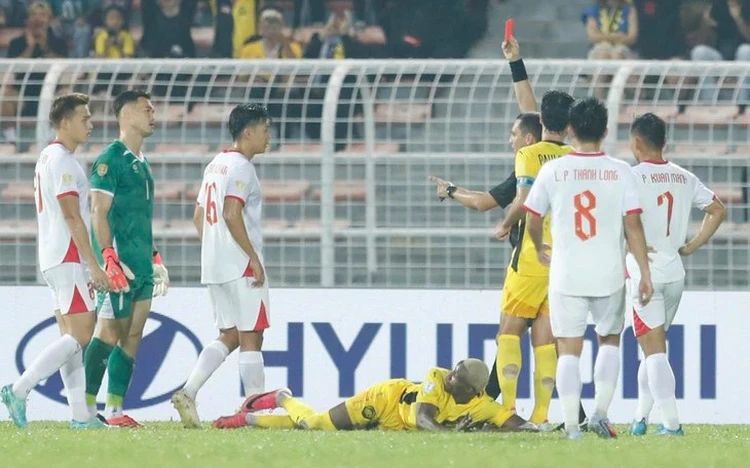
A heart-stopping moment for Patrik Le Giang and Vietnam. Photo: Anh Khoa
In Kuala Lumpur on Sunday night, the defending champions secured a crucial 2-0 away victory, courtesy of a strike from Nguyen Xuan Son and an unfortunate own goal by Faris Danish.
Yet, it was goalkeeper Patrik Le Giang who stole the show.
Named the match's highest-rated player by Sofascore, Le Giang anchored Vietnam's defense and stood at the heart of the night's biggest talking points—first dramatically seeing his red card overturned by VAR, before delivering a masterclass of high-caliber saves to keep a clean sheet.

Breathless minutes in KL
The flashpoint occurred in the 61st minute. In a high-stakes moment with Vietnam leading 1-0, Patrik Le Giang was initially shown a red card by referee Rustam Lutfullin of Uzbekistan for an alleged foul or handball outside the penalty area.
The incident sent shockwaves through Vietnamese supporters, as Le Giang remains the indispensable anchor of the defense.
A red card would have ruled him out of the second leg, crippling coach Kim Sang-sik's tactical game plan at a critical moment when Vietnam was enduring a heavy onslaught from Malaysia's wing attacks.
However, after a lengthy consultation with the pitch-side monitor, the decision was spectacularly overturned. From that point on, despite the intense pressure from the hosts, Kim Sang-sik's side stood firm before Nguyen Quang Hai forced an 86th-minute own goal to seal the 2-0 win.
The decision to rescind the card became the immediate "center of attention," leaving the home crowd in disbelief.
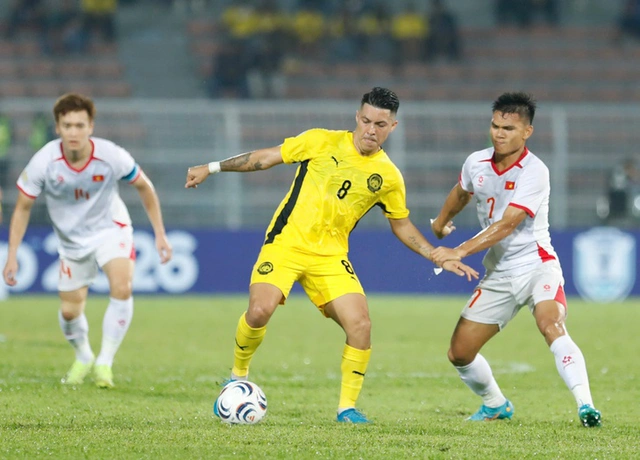
Malaysia's naturalized midfielder Sergio Aguero held in check by Vietnam's defense. Photo: Anh Khoa
Najmi Iman, writing for newswire Stadium Astro, described the scene as "drama" and noted that replays appeared to show Le Giang handling the ball outside the box.
The outcry from the Malaysian side was swift and focused on the quality of the technology provided.
New Straits Times recorded approximately 8,000 spectators at the stadium chanting "VAR, VAR" in protest as the officials deliberated.
The Malaysian media did not hold back. Semuanya BOLA reacted sharply, mocking the technical standards: "It's amazing that in 2026 we are still seeing camera angles and VAR like this."
Similarly, MakanBola questioned why the referee was only provided with a single camera angle to make such a season-defining decision.
Lee Seng Foo, a prominent journalist for Stadium Astro, took to social media to ask, "Why didn't VAR show the Vietnam goalkeeper's handball outside the penalty box?".
The Malay Mail and Bernama further criticized the lack of transparency, stating that the refereeing team provided no public explanation as to why the initial red card was reversed.
Why the red card was overturned
Speaking with Tuoi Tre (Youth) online newspaper, a V-League referee clarified that the official initially misread the play, either suspecting a studs-up challenge on Mohamadou Sumareh's shin or a Denial of an Obvious Goal-Scoring Opportunity (DOGSO).
However, VAR intervention revealed that defender Van Vi had already made a clean tackle on the ball first.
Under International Football Association Board (IFAB) rules, a DOGSO penalty requires four strict criteria: play direction, distance to goal, ball control likelihood, and defender coverage.
Because Van Vi actively neutralized the threat and Le Giang made no illegal contact, the situation fell short of a red-card offense.
"With Van Vi effectively controlling the situation, the criteria for a clear goal-scoring opportunity were simply not met," the referee noted, confirming that the decision to rescind the red card was entirely accurate.

Goalkeeper Patrik Le Giang named the highest-rated player by Sofascore in the Vietnam-Malaysia clash. Photo: Anh Khoa
New changes, new debate
While the VAR decision sparked fury, the consensus on the pitch was more measured.
Most Malaysian news outlets, while frustrated with the officiating, conceded that Vietnam deserved their 2-0 victory based on performance.
For the Malaysian Tigers, the "war is not over yet," as they face a steep climb in the second leg in Hanoi on Wednesday. However, for the AFF, the focus remains on the integrity of their new technology.

Xuan Son (center) continues his scoring streak against Malaysia. Photo: Anh Khoa
The VAR controversy comes as the ASEAN Football Federation (AFF) implemented several new IFAB rules for 2026, designed to align the region with 2026 FIFA World Cup standards. The rules were intended to reduce time-wasting and improve sportsmanship.
Under these updated regulations, VAR's powers were expanded to review not just direct red cards, but also mistakes related to second yellow cards and wrongly awarded corner kicks.
Other new rules scattered throughout the tournament include 10-second substitutions, 5-second restarts, and mandatory one-minute off-field medical treatment periods.
The goal of these new rules was to increase "actual playing time" and reduce unsporting behavior.
But as the drama in Kuala Lumpur proved, even the most advanced tools can still leave an entire region asking for more clarity.









Max: 1500 characters
There are no comments yet. Be the first to comment.