


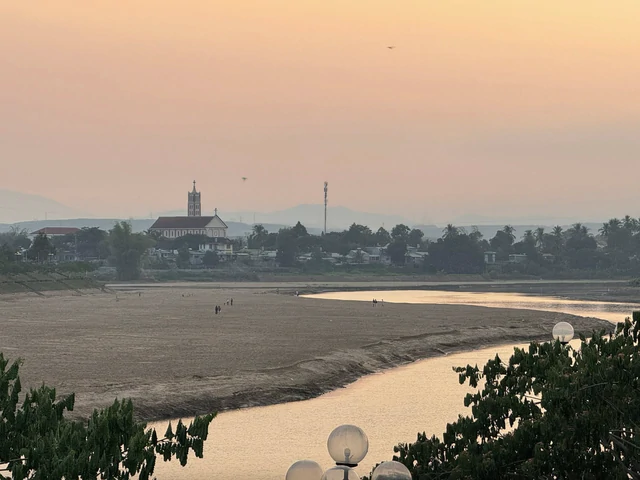
The Dak Bla River running through the western urban area of Quang Ngai Province in central Vietnam has dwindled to a small stream. Photo taken in April 2026. Photo: L.T.K.T. / Tuoi Tre
According to the National Center for Hydro-Meteorological Forecasting, El Nino reached a very strong intensity in mid-September and is forecast to peak in the final months of 2026.
The phenomenon is expected to remain very strong until around March 2027, with the possibility that it could persist into the first half of next summer.
The weather agency warned that the impacts will become more apparent in the coming months, particularly in the south-central, Central Highlands, and southern regions.
River flows fall by up to 75 percent
Ngo Manh Ha, deputy director of the Department of Water Resources Management under the Ministry of Agriculture and Environment, said most rivers and streams had begun to show signs of El Nino's impact since May.
Water resources have been below long-term averages, with the decline becoming more pronounced from June to August.
During that period, flows in most rivers and streams across Vietnam's 12 major river basins were 10-75 percent below long-term averages.
According to Ha, the current water shortage is similar to conditions seen in 2015 and 2019, when Vietnam was strongly affected by El Nino.
The risk of water shortages is emerging toward the end of the flood season, with many rivers, streams, and reservoirs facing insufficient stored water.
About 74 percent of hydropower reservoirs are short of 15-80 percent of their storage capacity, while 40 percent of irrigation reservoirs are short of 20-87 percent.
Combined with declining dry-season flows, water shortages could reach 15-78 percent below long-term averages, raising concerns over water security nationwide.
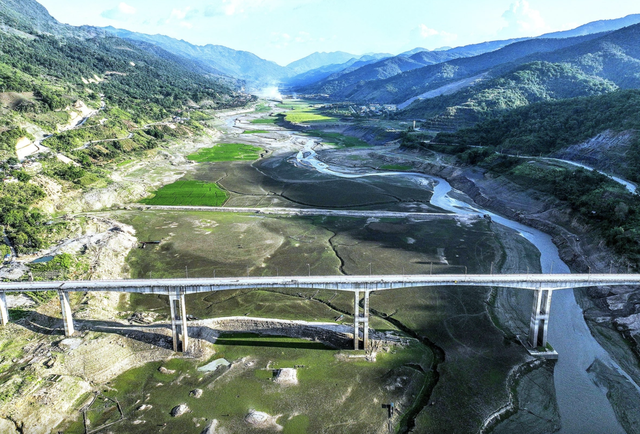
The Son La hydropower reservoir in the Muong Lay area of Dien Bien Province in northern Vietnam was reduced to a dry riverbed in June 2023. Photo: Nguyen Khanh / Tuoi Tre
29 million people face water shortage risks
In northern and north-central Vietnam, about 29 million people could face water shortages for household use, production, business, and services as river flows and water levels decline and saltwater intrusion increases.
The affected area covers the Bang Giang-Ky Cung, Red-Thai Binh, Ma, and Ca river basins.
Water shortages could affect about 800,000 hectares of farmland, including around 500,000 hectares in the Red River basin.
Irrigation systems including Bac Hung Hai, Bac Duong, Nhue, and Day could also face difficulties in drawing water from the Red River.
The situation could also threaten energy security and power system safety, as most hydropower reservoirs are at risk of failing to reach adequate storage levels, with deficits of 15-80 percent of their capacity.
Dry-season flows are forecast to fall 56 percent in the Chu River, 47 percent in the Da River, and 46 percent in the Ca River.
South-central Vietnam is highly vulnerable because its rivers are short and steep, while water storage and regulation infrastructure remain limited.
Flows are down 73 percent in the Kon River, 67 percent in the Ba River, and 53 percent in the Thu Bon River.
The situation could threaten water supplies for households and production, particularly in Da Nang.
The city's Cau Do water plant has a capacity of 366,000 cubic meters per day, while the Hoa Lien plant can produce 120,000 cubic meters per day.
Both rely heavily on water regulation from major reservoirs and the An Trach weir system.
Agricultural production is also at risk, as irrigation systems cover only 23 percent of farmland in the Ba River basin and 35 percent in the Vu Gia-Thu Bon basin.
Economic zones including Chu Lai, Nam Giang, Dung Quat, and southeastern Dak Lak could also face water shortages affecting production.
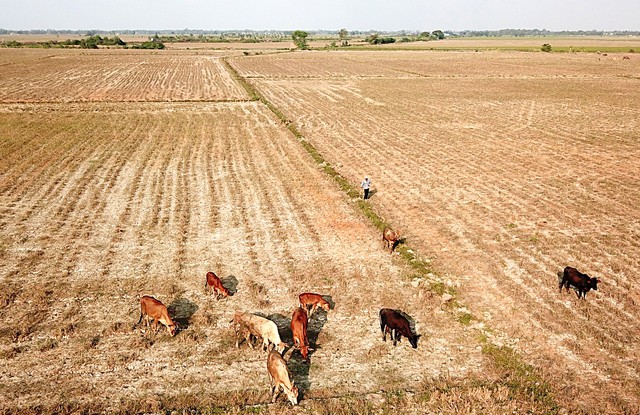
Drought has left many rice fields in Tran De, Soc Trang, without enough water for cultivation, while saltwater has intruded into areas where water remains. Photo taken in April 2024. Photo: Chi Quoc / Tuoi Tre
Mekong Delta highly vulnerable to El Nino
The Central Highlands faces significant risks to agricultural production, particularly perennial and industrial crops outside areas served by irrigation systems.
Only 17-19 percent of perennial-crop areas are expected to have reliable access to water.
Water supplies for households, production, business, and services could also be affected because water plants in the region mainly rely on reservoirs, rivers, and streams.
In southeastern Vietnam, the Dong Nai River basin and surrounding areas face the country's highest dry-season water stress due to high demand.
The region has Vietnam's largest urban water supply system, with a combined capacity of about 5.21 million cubic meters per day.
About 91 percent of urban water supply capacity there depends directly or indirectly on upstream reservoirs.
Agricultural production, particularly areas supplied by the Dau Tieng-Phuoc Hoa system, also faces water shortage risks.
The Mekong Delta is considered the most sensitive region to El Nino because nearly 95 percent of its water supply depends on upstream flows of the Mekong River, while the downstream region lacks large reservoirs for water regulation.
Urban water supplies could therefore be directly threatened, with 87 percent of water extraction capacity coming from independent rivers without regulating infrastructure.
Agricultural production could also be affected if flows in the Tien and Hau Rivers fall 40-60 percent, while saltwater intrusion at a concentration of four grams per liter reaches 40-70 kilometers inland.
If drought and water shortages occur, coastal communes served by irrigation systems including Nam Mang Thit, Bac Ben Tre, Nam Ben Tre, and Go Cong could be among the hardest hit, particularly the Go Cong system.
Water shortages in both quantity and quality could also occur in coastal areas and parts of Tay Ninh Province, Vinh Long Province, and Can Tho City.








Max: 1500 characters
There are no comments yet. Be the first to comment.