


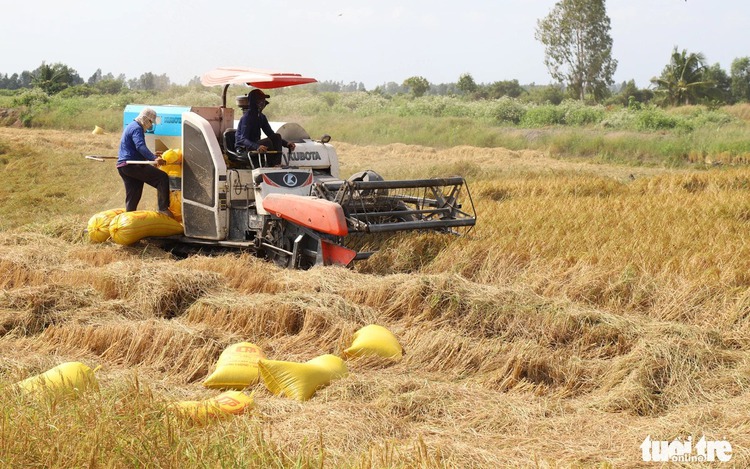
Farmers harvest rice in Ca Mau Province, located in Vietnam’s Mekong Delta. Photo: Chi Quoc / Tuoi Tre
This goal is outlined in the Politburo’s recently issued Conclusion 219, which focuses on continuing the implementation of Resolution 19/2022 of the 13th Party Central Committee on agriculture, farmers, and rural development, while maintaining a long-term vision toward 2045.
The Politburo emphasizes that agriculture, farmers, including fishers and salt producers, and rural areas must remain strategic pillars for macroeconomic stability and sustainable growth.
Farmers are recognized as key drivers of innovation and essential contributors to the sector’s modernization.
Policies must support the growth of agricultural enterprises so that by 2030, a number of strong agricultural businesses can actively participate in global value chains, build national brands for key product lines, and take a leading role regionally and globally.
Achieving this goal requires a shift toward commodity-based production and the restructuring of agriculture along green, organic, low-emission, and circular models that protect the environment.
Crop, livestock, and product development should align with market demand, leverage local advantages, and preserve high-quality rice-growing land, while promoting specialized, professional production through collaboration among farmers, enterprises, and authorities.
Measures are required to boost agricultural exports, expand market access, enhance competitiveness and value-added production, and strengthen the international reputation of Vietnamese agricultural products.
High-tech applications and comprehensive digital transformation must be prioritized, with advanced models piloted across production, storage, processing, logistics, and trade.
Sustainable management of fisheries and forestry resources is essential to meet international standards while safeguarding Vietnam’s sovereignty over its seas and islands.
Policies should also encourage investment in green, ecological, and circular agriculture, particularly in strategic, remote, and border areas.
Farmers are encouraged to join cooperatives, associations, and production networks to participate in large-scale commodity chains, supported by training and technology transfer to develop a modern, professional mindset.
Environmental protection needs to be strengthened to create greener, cleaner, and more resilient rural areas through improved waste management, river pollution control, ecosystem restoration, and enhanced weather and disaster forecasting.
The Politburo calls for a balanced approach that links agricultural and rural development with ecological protection, sustainable resource management, and proactive measures to address climate change.
Agricultural development must be closely coordinated with urban planning to ensure synchronized governance under an effective two-tier local management system.
Rural development should focus on creating modern, prosperous, and culturally vibrant villages that integrate ecological protection, urban-rural planning, and domestic and international value chains.
Capacity for weather forecasting and early warning of incidents and disasters needs to be strengthened to enable proactive adaptation, prevention, and mitigation of losses in agricultural production and rural livelihoods.
The Politburo also requires that, within the next year, the government complete the review and institutionalization of Party directives into laws and guiding documents, balancing the long-term interests of the state, enterprises, and farmers.
In addition, state budget investment in agriculture and rural development for 2021-30 should be double that of the previous decade.








Max: 1500 characters
There are no comments yet. Be the first to comment.