



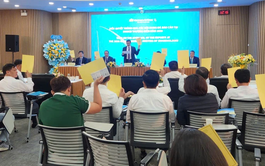
New Vietjet cabin crew express gratitude to their families at a graduation ceremony following the training period - Photo: TAI NGUYEN / Tuoi Tre
At a cabin crew graduation ceremony for classes 201 and 202 at Vietjet in early July, parents were invited to watch their children receive certificates after completing their training.
The event shows how airlines are seeking new ways to build engagement with employees as early as the training stage, rather than relying on pay and benefits alone.
In aviation, flight attendants do more than serve passengers in the cabin. They directly affect service quality, brand image, and an airline's ability to keep its operations running smoothly.
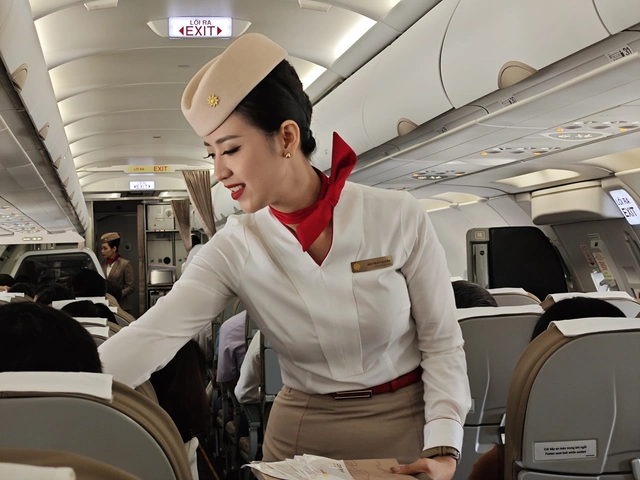
Sun PhuQuoc Airways is recruiting 1,000 flight attendants this year to meet the need to expand operating frequency - Photo: Cong Trung / Tuoi Tre
Airlines race to expand fleets
As airlines add more routes, increase flight frequency, and bring in new aircraft, demand for flight attendants rises accordingly.
Cabin crew with experience, strong foreign language skills, familiarity with operating procedures, and the ability to start flying sooner are the most sought-after.
Airlines say hiring new staff is only half the battle as they must also train and certify recruits, schedule flights, monitor performance, and retain employees after training.
If cabin crew leave once they have gained enough experience, recruitment and training costs rise while service quality may suffer.
This staffing pressure is evident in airlines' fleet expansion plans.
Vietjet currently operates a fleet of more than 100 aircraft with an extensive domestic and international route network.
In 2025 alone, the Vietjet Aviation Academy (VJAA) trained more than 162,000 trainees, and the airline brought into service 150 pilots along with around 2,000 cabin crew, engineers, and other aviation personnel.
Vietnam Airlines is also preparing for a new phase of expansion, having ordered 50 Boeing 737-8 aircraft to bolster its narrow-body fleet in the coming years.
As the national flag carrier, its large-scale route network creates ongoing demand for pilots, flight attendants, engineers, and operations staff.
The need for personnel is even more pronounced at newer, fast-growing airlines.
Sun PhuQuoc Airways is aiming to recruit around 1,000 flight attendants in 2026, open to candidates of multiple nationalities, with a starting salary of VND24 million ($923) a month, plus housing support, healthcare, insurance, and recreational benefits within the Sun Group ecosystem.
Training costs, uniforms, and allowances during the training period are also covered by the airline.
Ho Thi Thu Trang, HR director of Sun PhuQuoc Airways, said the airline is not just recruiting to meet immediate needs but aiming to build a professional workforce as part of its long-term strategy.
Vietravel Airlines, part of the T&T Group ecosystem led by Do Quang Hien, chairman of T&T Group, has also set an ambitious target: growing its fleet from 5 to 12 aircraft by the end of 2026, roughly 2.5 times its current size.
To prepare the necessary manpower, the airline is recruiting its ninth cabin crew class with zero tuition fees, while providing up to VND3 million ($115) a month in support during training.
This is considered an unprecedented policy in cabin crew training: candidates pay no tuition and receive a living allowance while studying, helping lower the upfront cost that has long been a concern for young people considering the profession.

Vietravel Airlines rolls out a special policy offering free cabin crew training, with up to VND3 million ($115) a month in support during the training period - Photo: V.U. / Tuoi Tre
Pay isn't everything
In the flight attendant profession, the advertised salary is only the visible part of the picture.
Actual take-home pay typically includes base salary, flight-hour pay, route allowance, per diem and overnight allowance, position allowance, and bonuses.
Those who fly more hours, work international routes, or are promoted to the purser position earn more; conversely, in months with fewer flying hours, total income can fall below the published average.
According to one flight attendant, actual income depends not just on the starting salary but also on flying hours, days off, allowances, route network, opportunities to fly internationally, and career advancement.
On average, flight attendants earn between VND25 million and VND54 million ($962-$2,077) a month, with some airlines paying even more.








Max: 1500 characters
There are no comments yet. Be the first to comment.