


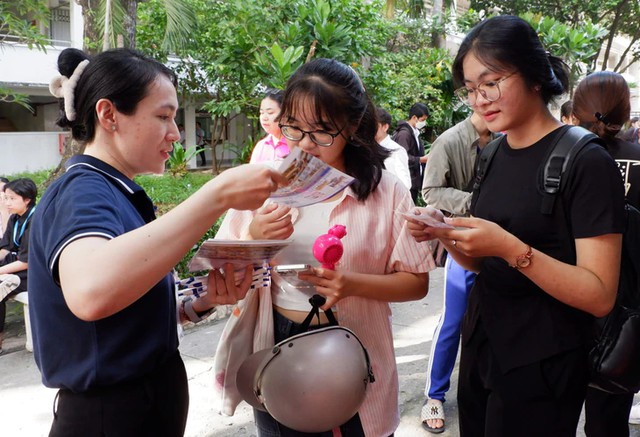
Job fairs give students opportunities to explore career options and apply for jobs as they prepare to enter the labor market. Photo: K.Anh / Tuoi Tre
Vietnam’s net employment outlook (NEO) reached 36 percent in October-December, up eight percentage points from the previous quarter, according to ManpowerGroup’s latest employment outlook survey.
The figure placed Vietnam third in the Asia-Pacific and Middle East (APME) region, above the regional average of 33 percent and the global average of 29 percent.
Of the 285 employers surveyed, 52 percent said they planned to increase their workforce in the fourth quarter, while 16 percent expected to cut staffing and 32 percent anticipated no change.
Business expansion was the main reason for stronger recruitment, cited by 52 percent of employers planning to hire more workers.
The information sector posted the strongest hiring outlook at 64 percent, up 10 percentage points quarter on quarter.
Northern Vietnam led the country with an NEO of 41 percent, while companies employing 50-249 workers recorded the strongest outlook by company size, at 49 percent.
Employers are also becoming more open to entry-level talent, with 57 percent saying they had increased recruitment of such workers compared with 2025. The rate reached 77 percent in the information sector.
Demand is particularly strong for workers in engineering, AI model and application development, information technology, and data-related roles, reflecting growing demand for STEM talent as businesses accelerate digital transformation.
However, finding qualified candidates remains a major challenge.
Around half of employers said a lack of applicants with suitable skills was the main reason hiring processes were taking longer, while 43 percent pointed to a mismatch between candidates’ expectations and actual job requirements.
Automation is also reshaping labor demand. Among employers planning to reduce hiring, 52 percent cited declining demand for certain roles due to automation, more than double the APME average of 24 percent and the global average of 22 percent.
Economic pressures are another drag on recruitment, with four in ten employers saying economic challenges are negatively affecting staffing plans.
AI has created another challenge for recruiters.
While helping companies improve productivity, the growing use of AI to generate job applications is making it more difficult for employers to screen candidates effectively.
As Vietnam’s labor market heats up toward the end of 2026, employers’ competitive edge may increasingly depend not on how many people they can hire, but on whether they can secure workers with the skills needed for jobs being rapidly transformed by AI and automation.









Max: 1500 characters
There are no comments yet. Be the first to comment.