


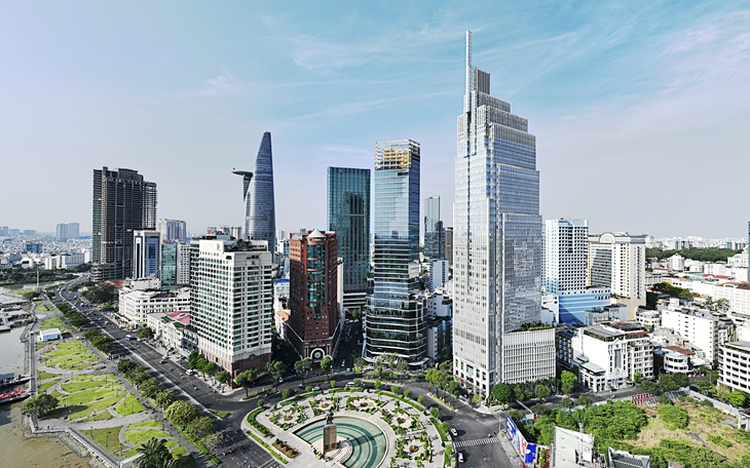
Vietnam's attainment of upper-middle-income status represents more than an economic milestone. Photo: Van Trung
According to the World Bank Group's latest National Income Classification update, Vietnam has officially graduated from lower-middle-income to upper-middle-income status after recording an average annual Gross National Income (GNI) growth rate of 10 percent between 2021 and 2025 [1].
Under the World Bank's methodology, upper-middle-income economies are those with a per capita GNI between US$4,636 and $14,375 [2].
Published annually on July 1 by the World Bank's Development Data Group, the income classifications assess 218 economies based on the previous calendar year's GNI per capita, grouping them into four categories: low, lower-middle, upper-middle, and high income.
World Bank data cited by Trading Economics estimated Vietnam's GNI at current prices to be approximately $460.7 billion in 2024 [3].
Gross National Income measures the total income generated by a country's residents and businesses, including income earned from abroad, and serves as one of the World Bank's principal indicators for comparing national income levels [4].
Divergent paths: The Philippine experience
Vietnam was not alone in reaching this milestone. The World Bank reported that Jordan, Micronesia, the Philippines, and Sri Lanka also advanced to upper-middle-income status, while Togo graduated from low-income to lower-middle-income.
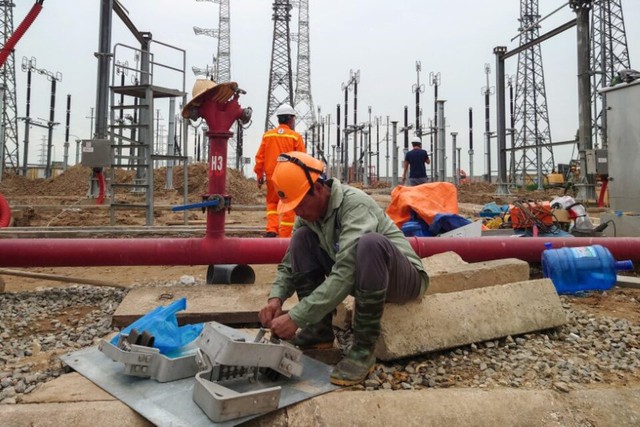
Workers work at the Pho Noi Power Station, a state utility owned by Electricity of Vietnam, in Hung Yen province, Vietnam, June 4, 2024. REUTERS/Khan Vu
Significantly, in its mid-July 2026 update, the World Bank noted that "this year, none of the countries assessed moved down," meaning that no evaluated economy experienced a downgrade.
Yet attaining the same income classification does not necessarily reflect the same development model or the same long-term economic resilience.
The Philippines provides an instructive comparison. According to the World Bank, the country reached upper-middle-income status following broad-based economic expansion across its major industries, recording an average annual GDP growth rate of 5.8 percent over the previous five years [5].
Data from the Asian Development Bank (ADB) show that services accounted for 63.2 percent of the Philippine economy, industry for 27.7 percent, and agriculture for 9.1 percent [6].
Despite this economic progress, the Philippines continues to face substantial social and food security challenges.
The ADB estimates that approximately 17.5 million Filipinos remain below the national poverty line, while around 55.6 million people—nearly half the country's population—cannot consistently afford a healthy and nutritious diet [7].
Reflecting these concerns, ADB country director Andrew Jeffries reaffirmed the bank's long-term partnership with the Department of Social Welfare and Development (DSWD) to address hunger and strengthen social resilience [8].
These challenges are also reflected in international food security indicators. The 2025 Global Hunger Index (GHI) ranked the Philippines 60th out of 123 countries with a score of 13.4 [9]. Vietnam, by comparison, recorded a lower—and therefore more favorable—score of 11.1 [10].
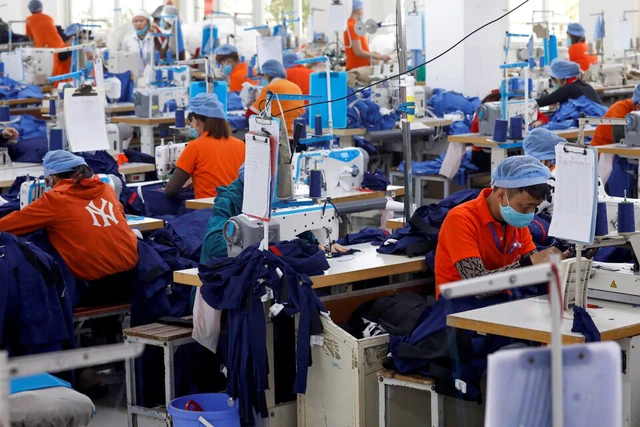
Labourers work at Hung Viet garment export factory in Hung Yen province, Vietnam December 30, 2020. REUTERS/Kham
Vietnam's trajectory and the 'middle power moment'
Vietnam's development trajectory differs in several important respects. Rather than relying primarily on domestic consumption or services, the country has pursued an export-led growth model anchored by manufacturing and international trade.
The World Bank highlighted that Vietnamese exports expanded by more than 15 percent in both 2024 and 2025, contributing to GDP growth of sevent percent and eight percent, respectively. Its average annual GNI growth of 10 percent between 2021 and 2025 ranks among the strongest in the region.
Sustained export growth, together with relatively strong food security, has provided Vietnam with more than economic momentum. It has also expanded Hanoi's strategic flexibility at a time when geopolitical competition is intensifying across the Indo-Pacific.
Writing in East Asia Forum, Dr. Nicholas Chapman of Tohoku University argues that amid the weakening of the rules-based international order and intensifying U.S.-China rivalry, Vietnam is emerging as a distinct middle power, one increasingly shaping regional affairs rather than merely responding to them [11].
According to Dr. Chapman, Hanoi has steadily expanded relations with regional and global partners, made greater use of multilateral institutions to amplify the voices of developing countries, and linked domestic governance with broader regional cooperation.
In doing so, Vietnam seeks to preserve strategic autonomy while contributing to regional stability and reinforcing international legal norms.
A landmark illustration of this evolving posture came with General Secretary and State President To Lam's address at the 2026 Shangri-La Dialogue, the first speech by a top Vietnamese leader at the annual security summit in more than thirteen years.
Addressing representatives of smaller and developing nations, he argued that economic development and national security cannot be treated as separate objectives.
Drawing parallels with former Bank of Canada Governor Mark Carney's observations at the World Economic Forum in Davos regarding the fragmentation of the international order and the growing importance of non-aligned middle powers, Dr. Chapman concluded that "Mr. To Lam's speech shows that Vietnam is ready to meet the middle power moment."
Vietnam's growing influence is likewise reflected in the Lowy Institute's 2025 Asia Power Index, where it recorded the second-largest increase in overall power since 2024, ranking 12th among the region's 27 assessed countries.
Vietnam's graduation to upper-middle-income status therefore represents more than an economic milestone. It reflects the cumulative effects of decades of export-led industrialization, improving food security, and pragmatic diplomacy.
As the international environment becomes increasingly fragmented, these foundations provide Vietnam with greater resilience at home while strengthening its capacity to play a more influential role abroad.
Economic prosperity, in Vietnam's case, is becoming not only an end in itself but also a source of strategic advantage.
Source Notes & References
[1] World Bank Group Open Data: Income Classifications Update
[2] World Bank Country and Lending Groups: Threshold Definitions
[3] Trading Economics: Vietnam GNI Data
[4] Trading Economics: GNI Definition
[5] World Bank Official Communications: Global Income Trends
[6] Asian Development Bank: Key Indicators Database – Philippines
[7] Asian Development Bank: Ending Hunger in the Philippines
[8] ADB Press Release: DSWD Partnership
[9] Global Hunger Index: Philippines Profile
[10] Global Hunger Index: Vietnam Profile
[11] East Asia Forum: 'Vietnam's Middle Power Moment'








Max: 1500 characters
There are no comments yet. Be the first to comment.