


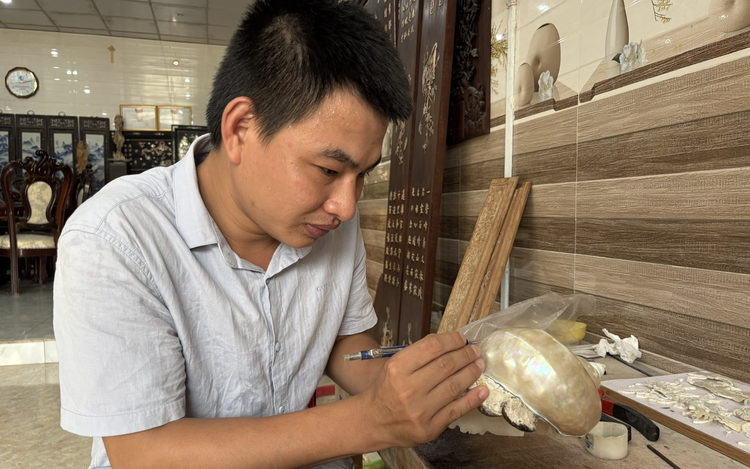
Phan Tan Dat carefully saws pieces of shell, the first step in the mother-of-pearl inlay process. Photo: Linh Chi / Tuoi Tre
Mother-of-pearl inlay, known in Vietnam as kham xa cu (also called shell or nacre inlay), is a refined traditional craft found across East Asia.
The technique involves cutting, polishing, and fitting thin pieces of shell, typically from oysters or snails, onto wood or lacquer surfaces to form decorative patterns and images.
What distinguishes mother-of-pearl inlay is its shifting iridescence: the surface changes color with light and viewing angle, giving objects both visual depth and a sense of quiet luxury.
In Vietnam, Hue City has long been linked to mother-of-pearl inlay through its history as a former royal capital.
During the Nguyen Dynasty (1802-1945), the craft was widely used in palaces and temples, helping establish Hue as a center of refined decorative arts.
While the trade never grew into large craft villages, it has endured through small family workshops, preserving its reputation as a delicate, royal tradition rather than a mass craft.
The air hums with the sound of drills, chisels, and saws in Dat’s mother-of-pearl inlay workshop on a rare sunny winter day in Hue.
Bent over a large wooden panel, he works in near silence, carefully fitting one tiny shell fragment after another.
The slow, methodical process feels less like routine labor than an act of reconstruction, piecing together fragments that echo the memories and craftsmanship of the old imperial city.
A new generation works to preserve an old soul
At 33, Dat has spent more than two decades practicing mother-of-pearl inlay.
What began as a way to earn a living has become, for him, a quiet act of preservation, holding on to the spirit of earlier generations as modern life accelerates and traditional values steadily fade.
Raised in a modest household, Dat developed an early fascination with wood and handcrafts.
As a child, he would linger wherever artisans worked, watching for hours.
His path was set the first time he encountered a mother-of-pearl inlay craftsman.
The iridescent glow of the shell, shaped into flowing, intricate patterns, held him transfixed.
Drawn by instinct more than calculation, he found a way to apprentice himself and learn the trade.
Working steadily, Dat explains that the craft flourished under the Nguyen Dynasty and was closely tied to the royal spaces of Hue.
Screens, ceremonial furniture, altars, and calligraphic panels were adorned with hand-cut shell inlays forming dragons, phoenixes, and symbolic plants, motifs long associated with prosperity, integrity, and endurance.
The shells he uses today are sourced from coastal regions such as Khanh Hoa and Phu Quoc, or imported from countries including Japan and Singapore. Some prized shells can cost several thousand dollars.
Holding one up to the light, Dat points to its surface, where layers of nacre shimmer in shifting hues of blue and violet.
Each shell is polished by hand, sliced into thin strands, then cut again into fragments for shaping.
The process begins with sketching a design on paper, transferring it onto the shell, sawing each piece, carving recesses into wood, and finally fixing the shell in place with specialized adhesive.
Precision is essential at every step. Even small items can take weeks to complete, while large works may require months or years.
Dat recalls spending two years on a single folding screen nearly two meters tall, later sold for more than US$20,000.
His greatest fortune, he says, was finding a devoted teacher.
Four years of apprenticeship instilled patience and discipline, qualities that continue to anchor him to a craft he now sees not merely as work, but as a way of keeping the past alive through careful, deliberate hands.
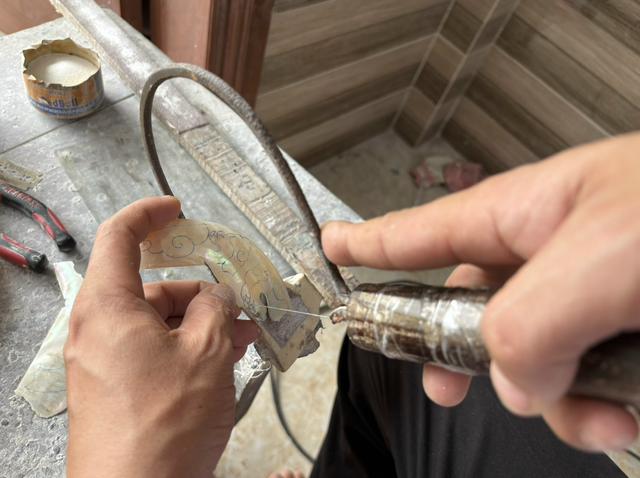
Each stage of the inlay process requires a high level of precision and meticulous attention to detail. Photo: Linh Chi / Tuoi Tre
Keeping a small craft alive
As the market shifts, many mother-of-pearl inlay workshops have moved toward modern, minimalist designs to cut costs.
Dat has chosen a different path. For him, the craft must follow traditional methods, entirely handmade, to preserve its essence, even if that means higher prices.
“Materials can be new, designs can be new,” Dat says, “but the lines must be old, and the work must carry the spirit of those who came before.”
To achieve that, he spends long hours studying historic architecture, heritage sites, and museum artifacts in and beyond Hue, examining composition, motifs, and aesthetic principles.
By working the old way, he believes he can better understand how past artisans thought and worked, and how they gave life to their creations.
Though passionate and articulate when speaking about his craft, Dat’s voice softens when he acknowledges the reality facing mother-of-pearl inlay today.
Few young people in Hue are willing to enter the trade, deterred by unstable incomes and uncertain prospects.
At the same time, many customers now favor mass-produced items at lower prices, while traditional, highly intricate works remain costly and appeal to a shrinking audience.
Still, Dat’s clients come from across Vietnam and overseas, collectors and enthusiasts who value finely crafted inlay on rare hardwoods such as rosewood, ebony, and ironwood.
For Dat, whatever the profession, endurance comes down to one thing: a heart that continues to nurture passion, day after day.
That passion has sustained him as he chooses to go against the current.
His commitment was formally recognized in late December, when Phan Tan Dat was awarded the title of 'Hue Artisan' in the field of traditional handicrafts for 2025 by city authorities, an acknowledgment of both his skill and his resolve to keep an old craft alive through young hands.
Restoring heritage inside Hue’s Imperial Citadel
In 2015, Dat became one of the youngest artisans selected to work inside the Imperial Citadel of Hue, directly restoring mother-of-pearl inlay details at just 23 years old.
His hand can be found on restored calligraphic panels at Trieu To Temple, decorative couplets at Thai Binh Pavilion, and even ornamental details on ceremonial carriages in Huu Vu.
At the time, most artisans involved in the restoration were seasoned veterans in their forties and fifties.
Being chosen alongside them was both recognition and encouragement.
"Standing inside the citadel and seeing the parts I helped restore, I felt a deep sense of pride,” Dat recalls.
“I knew I had been given the chance to contribute, in a small way, to preserving something ancient and meaningful.”
Passing on the craft to a new generation
Over the years, Dat has trained more than 100 apprentices, though not all have stayed in the trade.
Some have gone on to open their own workshops, often focusing on more modern product lines.
Dat continues to share orders with former students when work is scarce, while complex, highly detailed commissions still find their way back to him.
Today, his workshop includes a woodworking unit, a carving studio and a mother-of-pearl inlay section.
At peak times, it provides work for around 20 people, dropping to about half that during slower periods.
Beyond selling directly at the workshop, Dat also reaches customers through social media.
"Sometimes we can’t keep up,” he says with a smile.
“Whatever we finish, it sells right away.”








Max: 1500 characters
There are no comments yet. Be the first to comment.