


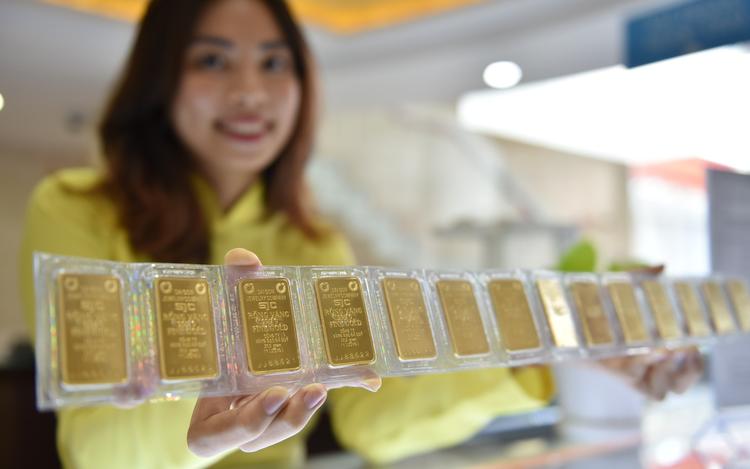
A bank employee holds gold bars. Photo: Quang Dinh / Tuoi Tre
Under its proposal, the association called for the early issuance of policies that would foster the development of Vietnam’s gold jewelry industry, with the ambition of positioning the country as a regional hub for high-quality jewelry manufacturing and exports.
The association hinted at issuing breakthrough mechanisms that would allow firms engaged in the production and export of gold jewelry to import raw gold in line with the volume specified in contracts signed with foreign suppliers.
Enterprises would be required to register these contracts with the commercial banks where they maintain accounts.
When importing gold materials, firms would only need to present the relevant documentation to the bank.
According to the association’s estimates, Vietnam’s demand for gold used as production input averages around 50 metric tons per year, equivalent to some US$5 billion annually, or about $416 million per month.
Of this volume, roughly half would be used to meet domestic demand, while the remaining 25 metric tons would be processed for export, potentially generating up to $4 billion in revenue.
The association emphasized that allowing enterprises to import raw gold for production would not only meet domestic consumption needs, but also help generate foreign currency through exports.
The amount of about $5 billion per year needed for raw gold imports is modest compared to the scale of Vietnam’s interbank foreign exchange market, where daily trading averages between $1 billion and $1.2 billion, or $25 billion to $30 billion per month.
The association said the demand for foreign currency to import raw gold falls well within the capacity of commercial banks and would not significantly disrupt the balance of the foreign exchange market.
The proposal also highlighted a lack of formal regulations governing the purchase and mobilization of gold from domestic sources.
According to the association, the absence of clear guidelines has led to the underutilization of gold held by the public, representing a missed economic opportunity.
To address this, the association urged the government to issue specific mechanisms and guidance for mobilizing gold within the population as input for jewelry production.
It also proposed allowing jewelry enterprises to borrow gold from individuals at mutually agreed interest rates, in compliance with civil law, to support manufacturing activities.








Max: 1500 characters
There are no comments yet. Be the first to comment.