


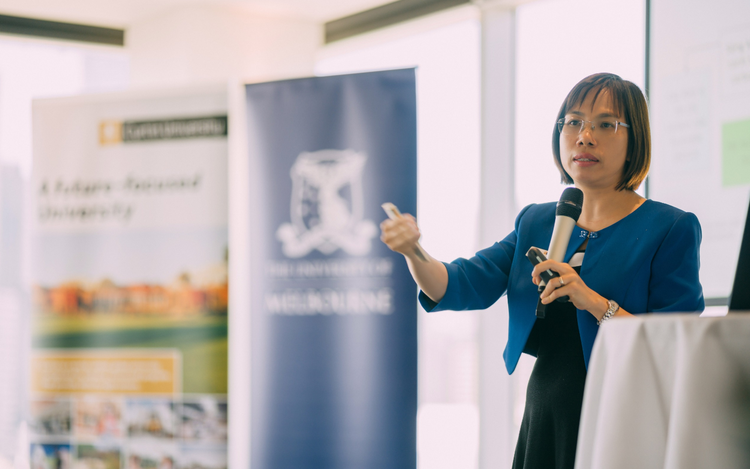
Assoc. Prof. Dr. Duong Thi Hong Lien, vice-chairwoman of the Vietnam-Australia Scholars & Experts Association (VASEA), speaks at an event on the carbon market held in Melbourne, 2025. Photo: Supplied
“Australia and Vietnam have a strong foundation under the comprehensive strategic partnership, so the next stage should move from connecting to co-researching, co-developing and co-creating products,” said Assoc. Prof. Dr. Duong Thi Hong Lien, vice-chairwoman of the Vietnam-Australia Scholars & Experts Association (VASEA).
Australia is home to a large Vietnamese community of more than 350,000 people, including scientists, experts, academics and managers working at universities, research institutes and technology companies, Assoc. Prof. Dr. Lien, in charge of ESG and sustainable development, told Tuoi Tre (Youth) online newspaper ahead of Party General Secretary and State President To Lam’s state visit to Australia.
The top Vietnamese leader and a high-ranking delegation arrived at Sydney Kingsford Smith Airport on Sunday evening (local time), beginning a four-day state visit to Australia at the invitation of Governor-General Sam Mostyn.
She said that one of the Vietnamese intellectual community’s greatest strengths in Australia is its ability to ‘connect two knowledge ecosystems.’
Her biggest aspiration, shared by many Vietnamese intellectuals overseas, is to receive more concrete commissions from Vietnam and contribute to solving specific problems.
“We have been trained and work in Australia’s research, technology and innovation environment, giving us access to international academic, business and technology networks,” she said.
“In addition, we understand Vietnam’s language, culture and development context.”
That combination represents a valuable resource for bilateral relations.
To produce tangible results, she advocates a different approach: rather than simply assembling experts by discipline, cooperation should begin with Vietnam’s specific needs.
“We need to move from a ‘network of experts’ to a ‘network for solving problems,’” she stressed.
Instead of merely connecting specialists in particular fields, cooperation should start with concrete challenges facing Vietnam, whether in artificial intelligence, semiconductors, smart agriculture, energy transition or green technology.
The right experts, universities and Australian companies can then be brought together to develop solutions, she underlined.
VASEA can help match the right people with the right problems, establish interdisciplinary cooperation teams and, crucially, maintain connections long enough for an initial exchange to evolve into joint research, technology transfer, human-resource training or a specific investment project.
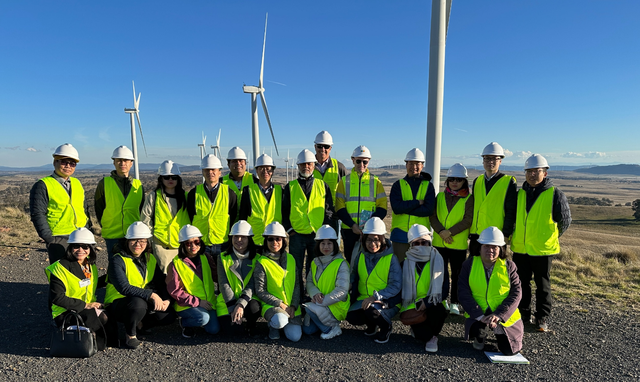
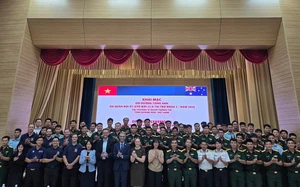
Assoc. Prof. Dr. Duong Thi Hong Lien, vice-chairwoman of the Vietnam-Australia Scholars & Experts Association (VASEA), and a delegation of Vietnam’s Ministry of Finance engaged in a carbon market project in 2023. Photo: Supplied
Success should be measured beyond number of agreements
During Party chief and State President Lam’s visit to Australia, the Tech Connect Forum is expected to serve as a key platform for direct interaction among governments, businesses, universities, scientists and expert communities from both countries.
“What we want to emphasize is not simply showcasing technology, but matchmaking,” she said.
“The focus is on identifying a specific need in Vietnam, finding an Australian partner with the right capabilities, and bringing the two sides to the next stage, from joint research and pilot projects to human-resource training, investment and commercialization.”
She hopes the forum will generate new cooperation groups in AI and digital transformation, smart agriculture and food technology, clean energy, carbon markets and energy transition, as well as advanced materials and strategic technologies.
Looking five to 10 years ahead, she envisions bilateral science and technology cooperation evolving from individual projects into a shared innovation ecosystem.
Scientists would conduct research together, while businesses would jointly develop and commercialize technologies.
Besides, the ecosystem will serve as a place allowing students and postgraduate researchers to move in both directions, and governments to create an environment in which successful initiatives could be scaled up.
“The ultimate goal is not merely to connect the two countries, but to jointly create new knowledge, technologies and value,” she said.
According to Deputy Foreign Minister Nguyen Manh Cuong, during the top Vietnamese leader’s visit to Australia, many important cooperation documents are also expected to be signed at the government level and between research institutions and businesses.
Lien said the real value of such agreements should not be measured by the number of documents signed, but by how many substantive projects emerge afterward.
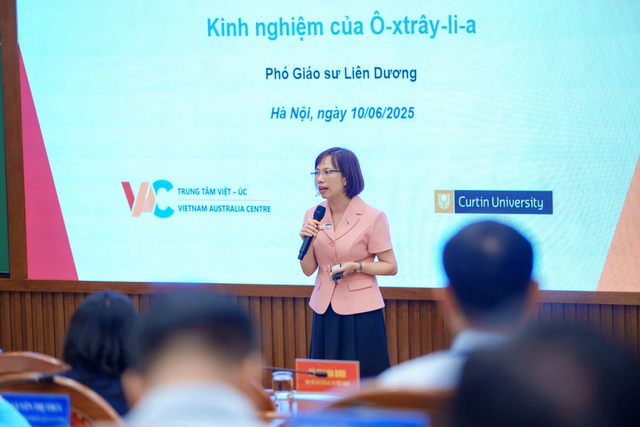
Assoc. Prof. Dr. Duong Thi Hong Lien, vice-chairwoman of the Vietnam-Australia Scholars & Experts Association (VASEA). Photo: Supplied
Over the next two to three years, she expects bilateral cooperation to undergo three clear shifts, including more joint research and technology-transfer programs between universities and businesses, greater exchanges of experts, postgraduate researchers and students, and the development of pilot projects with commercialization potential in priority areas such as AI, strategic technologies, clean energy and smart agriculture.
Drawing on her experience connecting research and technology-transfer projects between the two countries, Lien said the biggest obstacle is not a lack of goodwill or ideas, but the gap between an attractive cooperation concept and the ability to implement it.
She cited carbon-market projects as an example.
Vietnam’s policies in this area are evolving rapidly, while international projects must comply with multiple governance and financial requirements.
In connecting research projects between the two countries in this field, VASEA has sought to overcome the challenge by co-designing projects with Vietnamese partners from the outset, regularly adjusting their content to reflect policy needs and maintaining relationships after projects end.
This continuity has enabled an initial project to develop into a series of follow-up programs, she said.
A memorandum of understanding only has real value when it is backed by people responsible for implementation, an action plan, resources and specific deadlines.
Immediately after signing, the two sides should select several priority projects that can be launched within six to 12 months rather than creating an overly broad list of ambitions.
To implement agreements effectively, she proposed a four-part model that features senior leaders providing the enabling conditions, specialist teams taking responsibility for implementation, businesses participating from the beginning to ensure practical applicability, and financial resources to help move ideas through the pilot stage.
VASEA can support this ‘middle ground’ by connecting government, academia, experts and businesses while maintaining momentum after high-level delegations have returned home.
Duong Thi Hong Lien has been directly involved in Australia-Vietnam cooperation on green transition and carbon markets since 2022 through Curtin University and programs funded by the Australia’s Department of Foreign Affairs and Trade.
The 10 programs she has led have attracted more than AU$4 million (US$2.8 million) in funding, trained more than 350 Vietnamese officials and brought together more than 500 participants in policy dialogues.








Max: 1500 characters
There are no comments yet. Be the first to comment.