


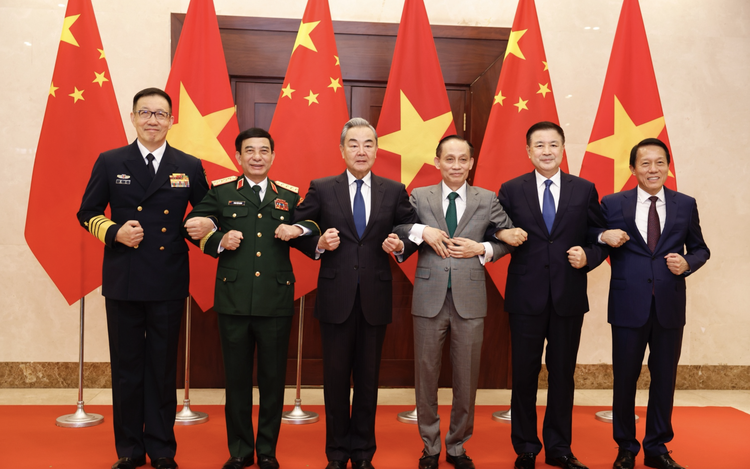
Ministers of Defense, Foreign Affairs, and Public Security of Vietnam and China pose at their strategic dialogue in Hanoi, March 16, 2026. Photo: The Ministry of Foreign Affairs
The dialogue took place in a ‘friendly, trusting, and open atmosphere,’ according to Vietnam’s Ministry of Foreign Affairs.
During the meeting, the ministers from both sides highlighted the significance of the '3+3' strategic dialogue mechanism and exchanged views on the rapidly evolving and increasingly complex global and regional landscape.
They insisted on strengthening political trust, coordinating development and security strategies, and maintaining their socialist paths while working with the international community to address common security and development challenges in accordance with international law and the United Nations Charter.
The three Chinese ministers congratulated Vietnam on its development achievements under the leadership of the Communist Party of Vietnam, headed by General Secretary To Lam.
They also expressed optimism about the future prospects of both nations as Vietnam enters a new era of development and China implements its 15th five-year plan.
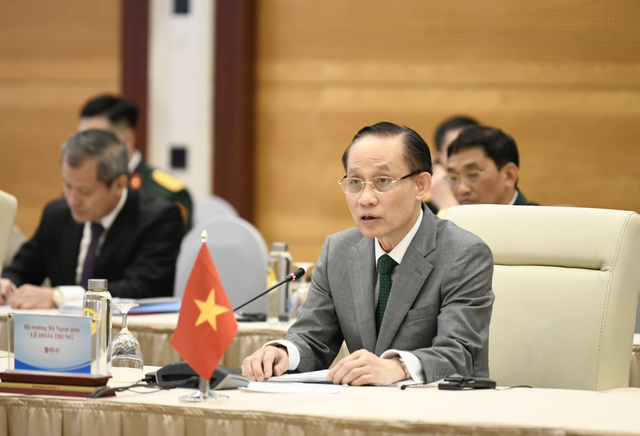
Vietnam’s Minister of Foreign Affairs Le Hoai Trung. Photo: The Ministry of Foreign Affairs
The Chinese officials affirmed that China values its relations with Vietnam and is ready to work closely to implement high-level common understandings, exchange governance experience, and strengthen cooperation in areas such as Party-building, state management, and the protection of national security and development interests.
The Vietnamese ministers stated that the Vietnamese Party and state consistently regard the development of relations with China as an objective requirement, a strategic choice, and a top priority in Vietnam’s independent, self-reliant, and diversified foreign policy.
Vietnam consistently adheres to its ‘Four No’s’ defense policy – no participation in military alliances, no affiliation with one country to oppose another, no permission for foreign countries to establish military bases in or use Vietnamese territory to oppose others, and no use or threat of force in international relations.
Vietnam further confirmed its commitment to the ‘One China’ policy and expressed support for and willingness to participate appropriately in China’s initiatives related to development, security, civilization, and global governance.
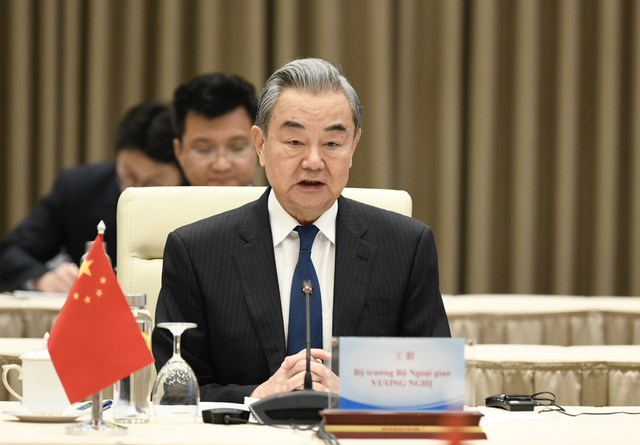
China’s Minister of Foreign Affairs speaks at the dialogue. Photo: The Ministry of Foreign Affairs
Strengthening Vietnam-China trust
The three Vietnamese ministers proposed that the foreign affairs, defense, and public security sectors of both countries take a leading role in enhancing political trust and implementing high-level agreements, while maintaining regular high-level exchanges between the two Parties and states.
They also called for making full use of existing cooperation mechanisms and expanding sectoral cooperation, particularly in areas such as trade, investment, strategic infrastructure, and science and technology.
The ministers proposed closer cooperation in border defense, border management, immigration control, and efforts to combat transnational crime.
In addition, the Vietnamese side suggested boosting information and experience sharing on safeguarding regime security and broader national security issues, including energy security, environmental security, information security, and data security.
Regarding multilateral cooperation, Vietnam urged China to coordinate and support each other in United Nations peacekeeping operations, search and rescue missions, humanitarian assistance, and regional cooperation frameworks in which the ASEAN block plays a central role.
The Chinese ministers welcomed the proposals and agreed to work closely with Vietnam to effectively implement high-level agreements.
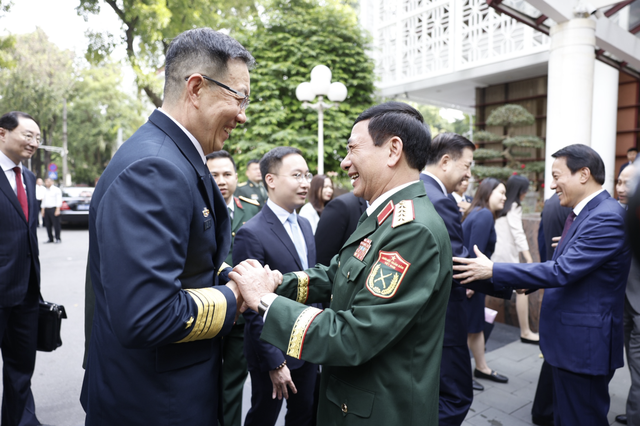
Vietnamese Minister of National Defense Phan Van Giang (R) welcomes Chinese Minister of National Defense Dong Jun in Hanoi. Photo: The Ministry of Foreign Affairs.
They pledged to maintain regular exchanges between relevant agencies to share updates on domestic developments and international and regional issues, while safeguarding political security.
China also agreed to deepen cooperation in defense, security, law enforcement, and cross-border crime prevention, including high-tech crime, while expanding practical cooperation across multiple sectors.
Both sides further agreed on the importance of coordinating development and security policies, promoting socialist development under the leadership of their Parties and fostering multilateral coordination to address both traditional and non-traditional security challenges.
The ministers also underscored the significance of properly managing and resolving maritime issues in a manner consistent with bilateral friendship and international law, contributing to a peaceful and stable environment for the development of both countries and the wider region.








Max: 1500 characters
There are no comments yet. Be the first to comment.