


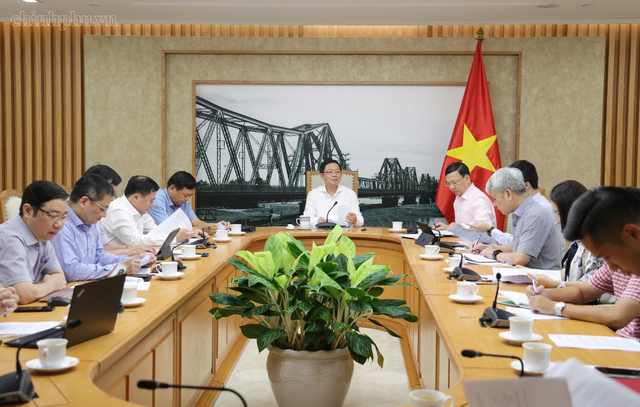
Deputy Prime Minister Ho Quoc Dung chairs the meeting. Photo: chinhphu.vn/Gia Huy
On Monday afternoon, Deputy Prime Minister Ho Quoc Dung chaired a meeting on the implementation of the government's Resolution 36/2026, which simplifies administrative procedures for growing-area and packing-facility codes to support durian sales and exports.
Durian testing system largely meets demand
At the meeting, Deputy Minister of Agriculture and Environment Nguyen Hoang Hiep said Vietnam harvested 768,000 metric tons of durian in the first seven months of the year.
Another 1.3 million metric tons are expected to be harvested by year-end, mainly in the Central Highlands.
With much of the crop concentrated in a short period from August to October, authorities need to ensure efficient harvesting, testing, processing and logistics to prevent bottlenecks and ease pressure during the peak season.
Vietnam's durian exports are expected to exceed US$4 billion this year, Hiep said.
India officially approved imports of fresh Vietnamese durian in July, opening another major market, he said.
Vietnamese durian is now exported to more than 20 countries, while the ministry is negotiating with Australia, New Zealand and other markets to further expand export opportunities.
For durian exports to China, Vietnam had more than 1,200 approved growing-area codes and 120 packing-facility codes in operation as of July 2026.
More than 1,100 additional codes are still awaiting approval from Chinese authorities.
Vietnam currently has 50 testing laboratories approved by China's General Administration of Customs, including 47 authorized to test for cadmium and 39 for gold O.
The ministry said testing capacity is sufficient, with the main challenge being how the system is operated.
Vietnam is therefore shifting toward testing at orchards and packing facilities to improve quality control and give producers greater control over the process.
Regarding Resolution 36, Hiep said most legal and procedural obstacles for major durian-growing areas have been addressed.
The ministry is working with local authorities in Dak Lak, Gia Lai, Lam Dong and Quang Ngai to develop and implement the resolution.
The ministry is also negotiating with China's General Administration of Customs to align testing standards and establish mutual recognition of test results, which would help shorten customs clearance times.
Deputy Minister of Industry and Trade Nguyen Sinh Nhat Tan said the ministry has instructed its trade offices to work with the Ministry of Agriculture and Environment to promote Vietnamese durian, develop new markets and negotiate access to additional markets.
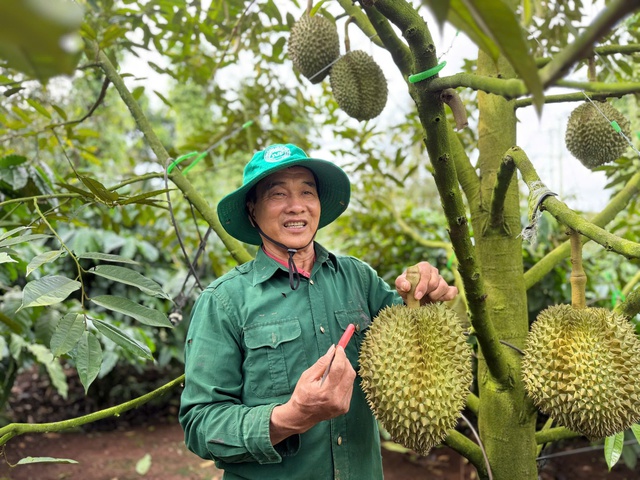
Vietnam is expected to harvest about 1.3 million metric tons of durian from now through the end of the year. Photo: Minh Phuong
Putting Vietnamese durian on global map
At the meeting, Deputy Prime Minister Ho Quoc Dung said Resolution 36 had been implemented decisively, helping resolve bottlenecks related to growing-area and packing-facility codes and creating more favorable conditions for durian production, sales and exports.
As a result, the target of more than $4 billion in durian exports this year is achievable, he said.
But the rapidly growing industry also needs long-term solutions to reorganize production, control quality, expand markets and increase the value of Vietnamese durian.
Dung called for a review and restructuring of production, particularly the planning of durian-growing areas and other fruit-growing regions.
Drawing lessons from the durian industry, he urged the agriculture sector to closely manage cultivated areas and provide farmers with better information before they decide what to grow.
"Vietnam must avoid a situation in which farmers rush to expand durian-growing areas, eventually creating an oversupply that hurts production efficiency and farmers' incomes," Dung said.
He also called on ministries, agencies and local authorities to focus on building a Vietnamese durian brand, with the goal of making Vietnam known internationally as a leading source of durian.
The country should also strengthen the quality and reputation of Vietnamese durian, particularly produce from regions with strong advantages such as the Central Highlands, he said.
"This is a long-term task. Without a strong brand, higher quality and greater competitiveness, Vietnamese durian will struggle to compete in international markets over the long term," Dung said.
Local authorities held responsible for bottlenecks
For provincial and municipal authorities, Dung called for decisive implementation of Resolution 36 and detailed action plans at the local level.
Local authorities must ensure timely issuance of growing-area and packing-facility codes and prevent bottlenecks in those processes or at testing laboratories that could disrupt exports.
They must also closely monitor export conditions and promptly address any difficulties or obstacles.
Provincial and municipal chairpersons will be held accountable for bottlenecks in the issuance of growing-area and packing-facility codes, testing or export operations.








Max: 1500 characters
There are no comments yet. Be the first to comment.