


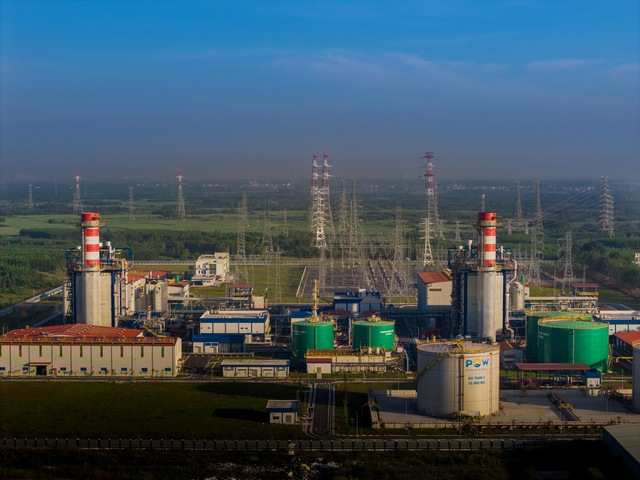
Nhon Trach 3 and 4 power plants constitute Vietnam’s first power complex to use LNG as fuel and to deploy H-Class gas turbine technology. Photo: GE Vernova
According to U.S.-based GE Vernova, the power plants, funded by PetroVietnam Power Corporation, have a total investment of around US$1.4 billion, with the Lilama-Samsung C&T consortium serving as the EPC contractor.
The project is located in Ong Keo Industrial Park in Dong Nai Province, about 70 kilometers from Ho Chi Minh City.
Under the project, GE Vernova supplied two generating units, each with a capacity exceeding 800 MW, along with key equipment including 9HA.02 gas turbines, steam turbines, generators, and an integrated control system.
This is Vietnam’s first power complex to use LNG as fuel and also the first to deploy H-Class gas turbine technology, one of the world’s most advanced high-efficiency gas turbine platforms currently used in major power systems globally.
With a combined capacity of 1.6 GW, the power plants are expected to significantly strengthen electricity supply for Ho Chi Minh City and key industrial provinces in the south, where power demand continues to rise rapidly.
The project adds a flexible and reliable baseload source at a time when the power system increasingly requires fast-response generation to balance supply and demand.
A PetroVietnam Power Corporation representative said the complex is designed as a combined-cycle power facility, enabling efficiency levels of over 63 percent, placing it among the most efficient gas-fired power plants worldwide.
Beyond adding capacity, the project is expected to improve grid stability and reliability, which is especially critical as renewable energy such as wind and solar accounts for a growing share of Vietnam’s power mix.
Energy experts said the commercial operation of a large-scale LNG power complex is significant not only in terms of capacity, but also as a clear step forward in diversifying Vietnam’s energy sources and upgrading power infrastructure, particularly in the country’s southern economic hub.
Compared with coal-fired power plants of similar capacity, H-Class gas turbine technology is estimated to cut carbon emissions by about 60 percent.
It also offers high operational flexibility, making it well suited to complement intermittent renewable energy sources.
The project has also been designed with future fuel conversion, allowing a transition from LNG to hydrogen blending or hydrogen combustion, supporting Vietnam’s long-term goal of net-zero emissions.
According to Vietnam’s revised Power Development Plan VIII, LNG is identified as a key flexible baseload source during the country’s energy transition.
LNG power helps reduce dependence on coal, offers rapid load adjustment to stabilize the grid amid renewable fluctuations, and is planned to reach about 22 GW of total capacity by 2030, accounting for 9.5 percent to 12.3 percent of the national power structure, mainly in high-demand regions such as the south.
The commissioning of the Nhon Trach 3 and 4 power plants is widely seen as a concrete step in Vietnam’s shift from coal to lower-emission power generation sources.








Max: 1500 characters
There are no comments yet. Be the first to comment.