


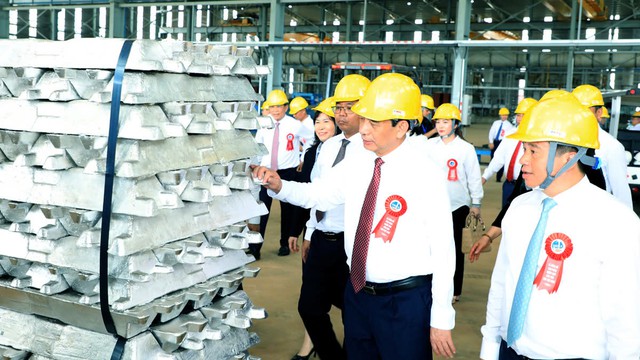
Vietnamese Deputy Prime Minister and Minister of National Defense General Phan Van Giang said mastering aluminum electrolysis technology marks a historic milestone for domestic primary aluminum production. Photo: T.H.Q. / Tuoi Tre
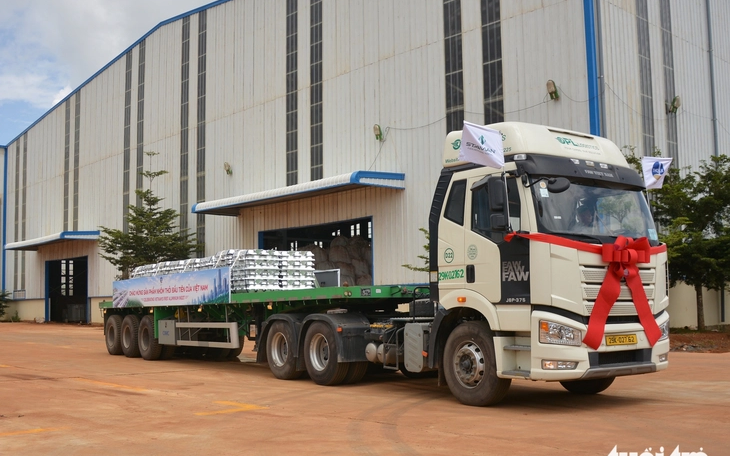
The opportunity became clear on July 26, when the Dak Nong Aluminum Electrolysis Plant unveiled Vietnam's first domestically electrolyzed primary aluminum ingots, with a purity of 99.71 percent.
Lam Dong Province said the milestone completes the final link in Vietnam's bauxite-alumina-aluminum chain after 11 years.
Completing the bauxite-aluminum chain
The project is Vietnam's first pilot primary aluminum production facility, located in the country's bauxite hub of Lam Dong, with total investment of more than VND18.423 trillion (US$708 million) on nearly 130 hectares.
In its first phase, the plant will operate at 150,000 tonnes per year.
Its capacity is expected to rise to 300,000 tonnes by the end of this year and reach its designed capacity of 450,000 tonnes in 2027.
Vietnam currently spends an average of $1.5 billion a year importing primary aluminum for manufacturing, construction, and consumer use.
At the ceremony unveiling the high-purity aluminum ingots, Vietnamese Deputy Prime Minister and Minister of National Defense General Phan Van Giang said mastering aluminum electrolysis technology marked a historic milestone for domestic primary aluminum production.
According to Giang, the achievement provides fresh momentum for Vietnam's metallurgy industry to develop processing and manufacturing, while gradually strengthening the country's self-reliance and competitiveness.
He reiterated the Party and state's policy of developing a complete value chain, from bauxite mining and alumina production to aluminum electrolysis and deeper processing into high-value aluminum products, alongside resource and environmental protection.
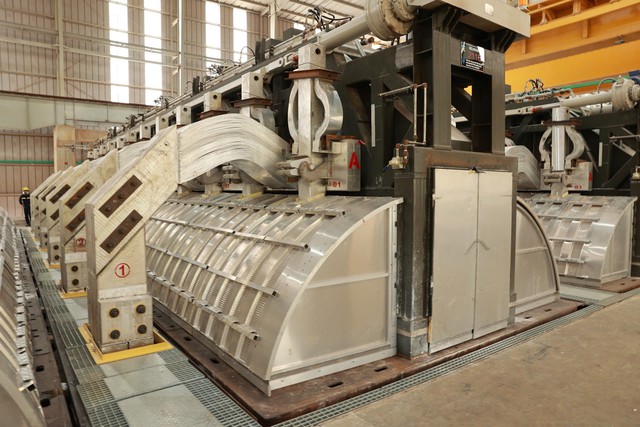
Aluminum production at the Dak Nong Aluminum Electrolysis Plant. Photo: T.H.Q. / Tuoi Tre
Vietnam currently has an estimated 5.8 billion tonnes of bauxite, concentrated mainly in Lam Dong Province in the Central Highlands.
The development of a domestic primary aluminum industry will create a stable supply of raw materials for rolling, drawing, casting, extrusion, alloy production, and aluminum manufacturing, Giang said.
This would help form an industrial ecosystem with greater scale and economic value.
With the shift in growth from resource extraction toward science and technology, innovation and deeper processing, Giang instructed ministries and agencies to continue reviewing and improving institutions, mechanisms and policies to develop Vietnam's aluminum industry in a synchronized and modern direction.
Lam Dong seeks to address hurdles for 'green aluminum'
Tran Hong Quan, director of Tran Hong Quan Metallurgy Co., Ltd., the plant's investor, recalled the project's journey through policy obstacles, electricity prices and infrastructure subsidence at the Nhan Co Industrial Park in Lam Dong.
Each tonne of electrolyzed aluminum consumes 13,000-15,000 kWh of electricity.
At the plant's full designed capacity of 450,000 tonnes a year, electricity consumption would reach around 6 billion kWh.
This is a substantial amount of electricity, and Lam Dong authorities are coordinating efforts to ensure stable production.
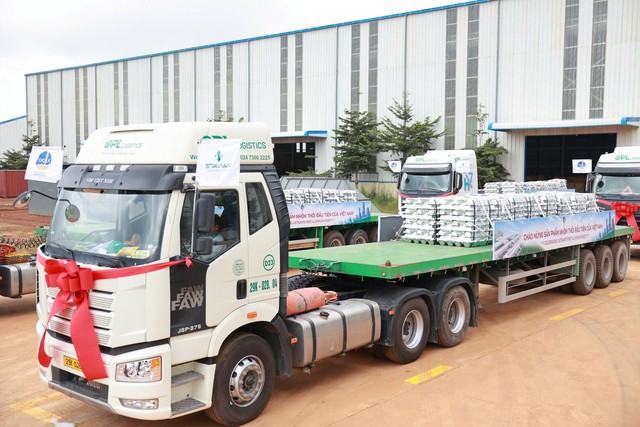
'Made in Lam Dong' aluminum ingots. Photo: T.H.Q. / Tuoi Tre
Environmental risks also have a precedent.
Between 2018 and 2020, five consecutive subsidence incidents occurred at the site preparation package for Nhan Co Industrial Park, causing more than VND55 billion ($2.11 million) in damage and delaying the progress of the bauxite-aluminum complex there.
The cause was attributed to accumulated groundwater that had not been fully drained under the design, combined with inadequate compaction during site filling.
Red mud presents a longer-term challenge.
Each ton of alumina produces around 1,049 kilograms of dry red mud with a pH of 11-13.
Red mud from the Central Highlands contains more than 50 percent iron.
Research projects under the Central Highlands 3 Program have processed it into steel and pressed it into non-fired bricks, but these applications have yet to be adopted on a large scale.
Y Thanh Ha Nie Kdam, secretary of the Lam Dong Party Committee, said the first aluminum ingots made in Lam Dong should be viewed from multiple perspectives.
The products open an opportunity to establish a new industrial value chain, he said.
Lam Dong and the Central Highlands could attract supporting industries including mechanical engineering, new materials, electronic components and renewable energy.
However, exporting alumina still amounts partly to exporting a raw material, with profits from the metallurgical processing stage remaining in the countries that purchase the material.
Lam Dong will assess the remaining obstacles and seek solutions to develop the bauxite-aluminum value chain to its full potential.








Max: 1500 characters
There are no comments yet. Be the first to comment.