


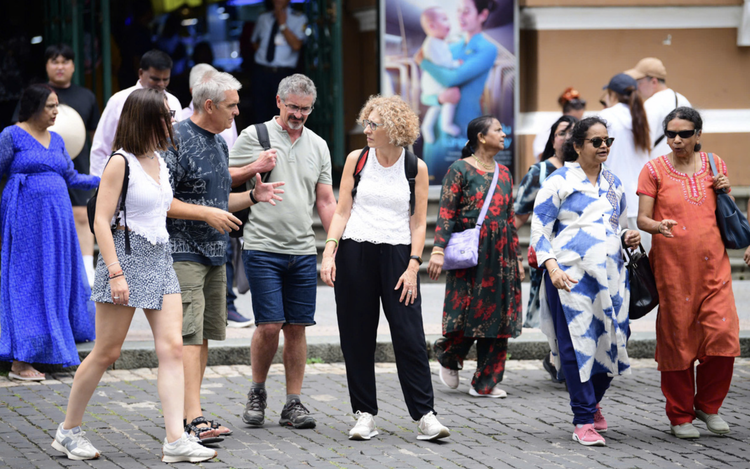
International tourists in Ho Chi Minh City. Photo: Tuoi Tre
The National Assembly passed Resolution 59/2026/QH16 on special mechanisms and policies for Vietnam's tourism development on Saturday, with 468 of 480 deputies voting in favor.
The resolution, comprising 14 articles, will take effect from January 1, 2027 through December 31, 2036, providing a long-term policy framework for localities and businesses to develop tourism projects and attract investment.
Under the resolution, Vietnam will study controlled pilot visa and residency arrangements for foreigners working remotely.
Vietnam has several destinations that could appeal to remote workers, including Da Nang, Da Lat and Ho Chi Minh City. However, the resolution does not yet specify the proposed visa's duration, eligibility requirements, income thresholds or application procedures.
Visitors coming for medical examinations and treatment, rehabilitation, resort stays, and long-term healthcare are another group targeted by the proposed policy.
Vietnam has been seeking to develop medical tourism by leveraging competitive treatment costs, skilled healthcare professionals, and increasingly advanced medical services.
Under the resolution, foreign nationals visiting Vietnam for medical examinations and treatment, rehabilitation, resort stays, and long-term healthcare, together with accompanying people, may be considered for more favorable pilot visa and temporary residence arrangements.
The resolution also calls for expanding bilateral visa exemptions for visitors from key and source markets with strong growth potential and high spending power.
It also seeks to introduce more flexible visa policies tailored to individual markets, prioritizing long-stay visitors, repeat travelers, and those combining tourism with business trips or international conferences and meetings.
Vietnam’s existing visa policies
Beyond the proposed pilot schemes, Vietnam currently offers several visa options for foreign visitors.
The country currently grants 45-day unilateral visa exemptions to citizens of 24 countries.
Ordinary passport holders from nine other ASEAN member states also enjoy visa-free stays of 14 to 30 days in Vietnam, depending on their nationality.
Foreign passport holders can visit Phu Quoc Island in southern Vietnam without a visa for up to 30 days, including those transiting through an international airport or seaport in Vietnam before continuing to the island.
Vietnam also issues electronic visas to citizens of all countries and territories, allowing stays of up to 90 days with single or multiple entries.

International visitors enjoy Ha Long Bay in northern Vietnam. Photo: M. Phuc / Tuoi Tre
Vietnam has also implemented a time-limited visa exemption scheme for foreign nationals in specially designated categories whose presence is deemed beneficial to the country’s socio-economic development.
With this visa policy, international visitors from six categories have found it easier than ever to enter Vietnam.
They include guests invited by top national and local leaders; scholars, experts, scientists, university professors, chief engineers, and high-quality human resources in the digital technology sector; investors and executives from the world’s 100 largest corporations; influential figures in culture, arts, sports and tourism; Vietnam’s honorary consuls abroad; and guests of designated research institutes, universities, and large enterprises.
The special visa-exemption card allows multiple entries and is valid for up to five years.


The visa initiatives are part of broader efforts to make Vietnam more competitive as an international tourism destination.
Vietnam sets a target of welcoming 45-50 million international visitors annually by 2030, with tourism expected to contribute 10-12 percent of the country's gross domestic product.
By 2045, the country aims to attract 70 million international visitors and rank among the world's 30 leading countries in tourism competitiveness.
This year, the country is targeting around 25 million international visitors, meaning the number of international visitors will have to nearly double over the next four years.
Resolution 59 is expected to provide a new policy framework to support Vietnam's efforts to achieve these tourism targets.


Max: 1500 characters
There are no comments yet. Be the first to comment.