


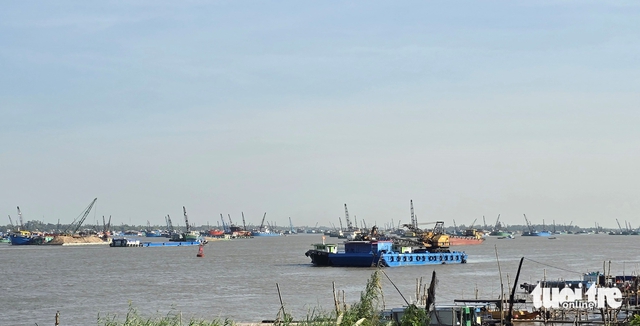
Barges and dredging vessels are anchored on the Tien River between Vietnam’s An Giang and Dong Thap Provinces as they wait to receive sand transferred from Cambodia, January 12, 2026. Photo: Buu Dau / Tuoi Tre
The vessels are clustered on the Tien River in Vinh Xuong Commune, An Giang Province, where Vietnam borders Cambodia.
The river section, which also forms part of the boundary between An Giang and neighboring Dong Thap Province, has been crowded with barges and dredging vessels waiting to receive sand shipped from Cambodia and transferred midstream to Vietnamese boats, according to local authorities and Tuoi Tre (Youth) newspaper observations.
Border guards, customs officials, and inland waterway authorities have been deployed regularly to manage traffic and ensure cross-border river transport between the two countries remains open.
A customs official in Vinh Xuong said around 30 companies from An Giang and other provinces have set up representative offices in the area to purchase Cambodian sand for infrastructure and construction projects.
Multiple layers of agents are involved in the trade, contributing to price differences, the official added.
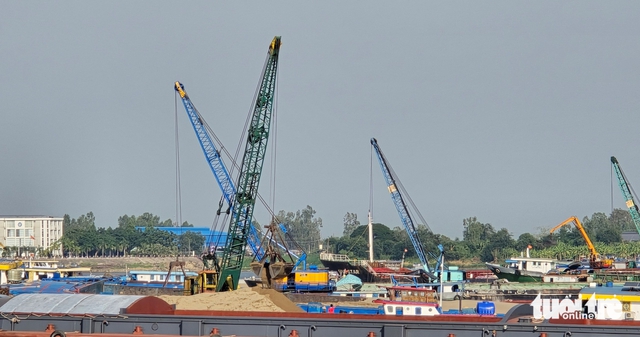
Barges and dredging vessels are anchored on the Tien River between Vietnam’s An Giang and Dong Thap Provinces as they wait to receive sand transferred from Cambodia, January 12, 2026. Photo: Buu Dau / Tuoi Tre
Sand mining in the Mekong Delta has significantly eroded riverbanks and altered sediment flows, contributing to shortages of locally available construction sand, according to reporting by VnExpress.
Cambodian sand exports to Vietnam have risen sharply, with Cambodia shipping tens of thousands of cubic meters per day to meet demand, according to the Vietnam News Agency.
The shift has driven up costs for contractors.
Cambodian sand purchased at the Vinh Xuong border currently costs about VND185,000 (US$7) per cubic meter, industry sources said.
After transport to construction sites and pumping onto projects, the cost rises to VND280,000–285,000 ($10.6–10.8) per cubic meter.
By comparison, locally-mined sand, when available, typically sells for VND80,000–100,000 ($3–3.8) per cubic meter.
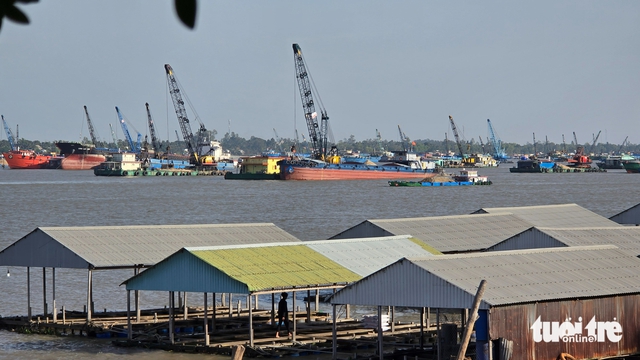
Barges and dredging vessels line a nearly-two-kilometer stretch of the Tien River between An Giang and Dong Thap Provinces in southern Vietnam as they wait to receive sand from Cambodia, January 12, 2026. Photo: Buu Dau / Tuoi Tre
A representative of a contractor working on a bypass road for Provincial Road 941 in An Giang said the company had been forced to use Cambodian sand to keep the project on schedule, despite erratic supply and sharply higher prices.
"At these prices, we are losing more than VND100,000 per cubic meter compared with our winning bid," the representative said, adding that the project requires more than 60,000 cubic meters of sand.
The company has petitioned provincial authorities to allow sand extraction from local mines, warning that prolonged shortages could delay construction.
Sand traders expect prices to rise further after the Lunar New Year holiday in mid-February.
A sand trader operating in Vinh Xuong said Cambodian sand prices had already climbed to about VND205,000 ($7.8) per cubic meter and could increase further as nearby Cambodian mines approach depletion.
Mining sites may be relocated closer to Phnom Penh, nearly doubling transport distances to Vietnam from around 50 kilometers to almost 100 kilometers, the trader said, pushing up shipping and related costs.
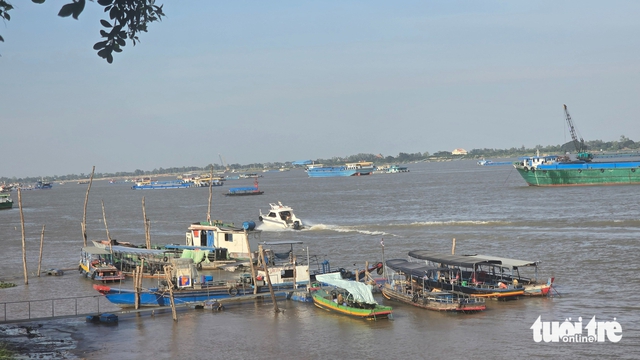
Vietnamese border guards, customs officers, and inland waterway authorities patrol the Tien River between An Giang and Dong Thap Provinces in southern Vietnam to keep the waterway open to traffic amid heavy congestion from anchored barges waiting for sand from Cambodia, January 12, 2026. Photo: Buu Dau / Tuoi Tre
Local officials said more than 100 barges and over 50 dredging vessels are currently anchored on the Tien River waiting to receive sand, stretching nearly two kilometers.
Authorities have coordinated with inland waterway port operators to organize anchorage points and maintain navigation safety for residents and commercial traffic.
The Vinh Xuong international border guard station said dozens of barges transport Cambodian sand into Vietnam each day through the area.
About 70 percent of companies complete import procedures and pay taxes on the Dong Thap side of the river, with the remainder handled in An Giang, officials said.








Max: 1500 characters
There are no comments yet. Be the first to comment.