


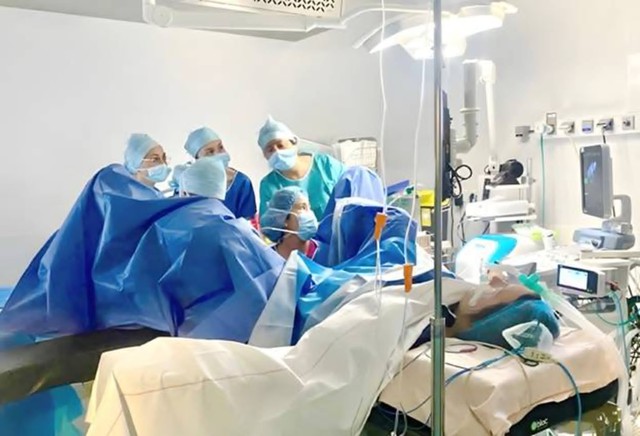
Associate Professor Vuong Thi Ngoc Lan performs and guides the immature oocyte retrieval technique on the first patient at Saint Joseph Hospital in Marseille, France, April 2026. Photo courtesy of hospital
Early this month, Associate Professor Vuong Thi Ngoc Lan of the University of Medicine and Pharmacy at Ho Chi Minh City and Le Hoang Anh of My Duc Hospital traveled to France to provide on-site training in two-phase in vitro maturation (IVM) at Saint Joseph Hospital in Marseille.
Lan, scientific director of the research collaboration, said French colleagues were seeking a safer, more effective, and less invasive treatment option, while patients also had high expectations for the technique.
She said direct, on-site training help doctors gain confidence and practical skills beyond theoretical instruction.
French doctors had visited Vietnam four years earlier to study the IVM model and later prepared legal procedures, equipment, and patient selection to deploy the technique with Vietnamese support.
Isabelle Koscinski, a biologist at Saint Joseph Hospital, said she decided to study the model in Vietnam following advice from Belgian Professor Johan Smitz after questioning existing assisted reproduction methods.
She joined the hospital’s reproductive team in 2021 and later sought alternatives after finding standard IVM results unconvincing in both effectiveness and biological approach.
Her interest deepened after attending the ESHRE conference in Milan in July 2022, where Vietnamese doctor Ho Manh Tuong presented results showing reduced hormone use while maintaining oocyte quality.
Koscinski then conducted extensive research and secured hospital funding to train in Vietnam in October 2022.
The transfer process took four years as French teams built a legal framework, secured approvals from regulatory and ethics bodies, and developed the OPKAPAMIV research project to enroll 30 patients over three years.
The project involves collaboration between Belgian scientists providing culture systems, Vietnamese doctors providing technical support, and French teams handling patient preparation and cryopreservation.
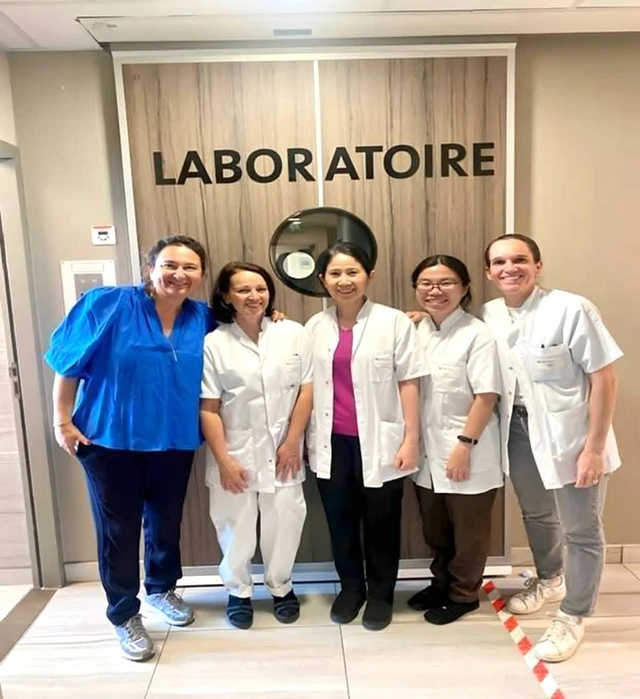
Key members of the OPKAPAMIV project at Saint Joseph Hospital in Marseille, France, from left: the department head, biologist Isabelle Koscinski, Associate Professor Vuong Thi Ngoc Lan, embryologist Le Hoang Anh, and the laboratory head. Photo courtesy of hospital
Logistical challenges, including the distance between operating and laboratory rooms, led the hospital to install a temperature-controlled station with microscopy equipment in the operating theater.
The first four oocyte retrieval procedures were carried out on April 8–9, 2026, with direct participation from the Vietnamese doctors.
Koscinski said the team viewed the initial successful retrieval of immature oocytes without ovarian stimulation as a significant milestone, though they were awaiting embryo development results before transfer.
She said support from Vietnamese specialists was key to launching the project.
The IVM technique allows egg retrieval, fertilization, and pregnancy without ovarian stimulation, with immature oocytes collected at any time and matured in specialized culture before fertilization and embryo transfer.
It is typically used for patients with polycystic ovaries, poor response or contraindications to stimulation, and for fertility preservation before cancer treatment.
The method is now used in more than 10 countries, with Vietnam among leading adopters.
French Consul General in Ho Chi Minh City Etienne Ranaivoson said the transfer reflected more than 30 years of bilateral medical cooperation and marked a shift toward two-way exchange.
He said nearly 3,000 Vietnamese doctors have trained in France and expressed hope for a new intergovernmental health agreement to update the 1993 framework.
Vietnam began applying in vitro fertilization in 1997, with its first test-tube babies born in 1998 after adopting techniques from overseas, including France.
Lan said the technique must be adapted to each hospital and patient, while Le Hoang Anh noted that handling immature oocytes requires precision to maintain quality during laboratory processing.








Max: 1500 characters
There are no comments yet. Be the first to comment.