



A draft amendment to Vietnam’s Law on Real Estate Business proposes electronic identification codes for real estate assets. Photo: Cong Trieu / Tuoi Tre
The proposal is intended to digitalize the real estate market, while strengthening legal and financial oversight and reducing fraud.
National Assembly deputies discussed the proposed amendments at a plenary session on Saturday.
Real estate IDs to help identify, track assets throughout transactions
Under the draft law, a competent state agency would create and issue a unique electronic identification code to each individual, organization, real estate asset or other entity covered by the Law on Real Estate Business and the Law on Housing.
The code would be linked to relevant information systems and databases to identify and track the asset throughout its transaction history.
The draft covers existing housing and housing under construction, except public housing assets.
It also covers existing and future construction works for education, healthcare, sports, culture, offices, commerce, services, and industry.
Mixed-use construction works and floor space in these buildings would also be covered.
Land use rights with completed technical infrastructure in real estate projects and real estate projects themselves would also require identification.
Real estate without an electronic identification code could still be traded under existing regulations. Once a code is issued, however, it would have to be used in subsequent transactions.
Pham Viet Thuan, director of the Institute of Natural Resources and Environmental Economics in Ho Chi Minh City, said the requirement would improve transparency in the real estate market.
A unique code would allow data on an asset's development, ownership, and transaction history to be updated and tracked.
The system would give buyers more information to verify an asset's legal status and actual condition, while reducing false or incomplete information in the market.
It could also help prevent fraud involving the sale of the same property to multiple buyers or the use of multiple sets of forged documents.
A single identification code would make it easier to verify the asset involved in a transaction and lower the risk of disputes.
The system could also help authorities and market participants assess property values based on clearer information about an asset's location, size, and legal status.
Property identification could also improve tax administration and financial oversight.
Tracking transaction histories and cash flows could help prevent sellers from declaring transfer prices below actual values to reduce tax liabilities.
The system could also help authorities verify asset origins, trace money flows, and combat money laundering, Thuan added.
Draft law seeks to digitalize real estate transactions
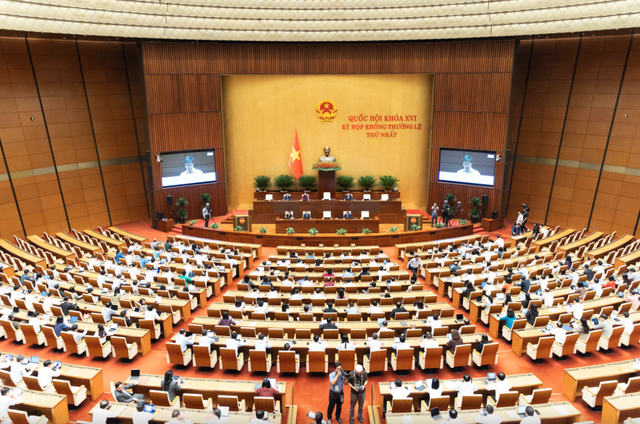
National Assembly deputies discuss the draft amendments at a plenary session. Photo: Gia Han / Tuoi Tre
The proposed amendments would promote administrative reform, decentralization, digital transformation, and the development of interconnected real estate databases.
The draft would also establish a framework for real estate transactions.
It would add provisions on fulfilling financial obligations for build-transfer projects through guarantees, escrow payments or mechanisms under public-private partnership regulations.
The draft would also introduce a mechanism to secure the remaining five percent of the value of real estate business contracts.
The amendments would expand the types of real estate business contracts eligible for transfer.
They would include contracts for the sale of existing housing without a certificate.
They would also include contracts for the sale or lease-purchase of construction works and floor space in future buildings.
Existing construction works and floor space without certificates could also be covered under land regulations.
The draft would give provincial-level People's Committees the authority to approve the transfer of all or part of real estate projects subject to the prime minister's investment policy approval.
The draft would also adjust state management responsibilities to the two-tiered local government model.
Some duties previously handled by district-level authorities would be transferred to commune-level People's Committees.








Max: 1500 characters
There are no comments yet. Be the first to comment.