



Nestlé Vietnam Deputy General Director Khuat Quang Hung speaks during a panel discussion on supply chains at the 2026 Swiss-Vietnam Economic Forum (SVEF). Photo: T.L. / Tuoi Tre
On Monday, the 2026 Swiss-Vietnam Economic Forum (SVEF) was held in Hanoi as Vietnam and the European Free Trade Association (EFTA) signed a trade agreement, while Vietnam and Switzerland marked the 55th anniversary of their diplomatic relations.
EFTA comprises Switzerland, Norway, Iceland and Liechtenstein. Two-way trade between the bloc and Vietnam reached EUR4.8 billion (US$5.4 billion) in 2025.
Beyond commitments on industrial goods, the agreement also covers sustainable development, small and medium-sized enterprises, cooperation and capacity building.
Speaking at a panel discussion on industrial transformation and supply chains, Khuat Quang Hung, deputy general director of Nestlé Vietnam, said supply chain competitiveness and resilience must be built from the production base, including the role of farmers.
Hung cited sustainable coffee value chains to illustrate the need to strengthen production capacity and meet market standards.
Climate change, declining soil quality, pressure on water resources, and requirements for traceability and emissions reduction are posing growing challenges to the coffee industry, he said.
Farmers therefore need access to knowledge, technology and suitable farming practices to maintain productivity, protect natural resources and secure their livelihoods.
Sustainability can only be maintained when it delivers economic benefits and improves farmers’ livelihoods, the Nestlé executive said.
Businesses must therefore go beyond simply purchasing crops and build long-term partnerships with farmers, helping them improve productivity, reduce costs and adopt appropriate farming standards.
Strengthening the capacity of small and medium-sized enterprises in supply chains is also part of this effort. Since 2011, NESCAFÉ Plan has worked with more than 23,000 farming households and delivered over 492,000 training sessions on sustainable coffee production under 4C standards.
According to the company, the program provides high-yielding coffee varieties resistant to drought and pests, promotes water-saving irrigation and reduced use of chemical fertilizers, and supports the transition to regenerative agriculture.
These measures help farmers lower costs, improve incomes and better meet export requirements.
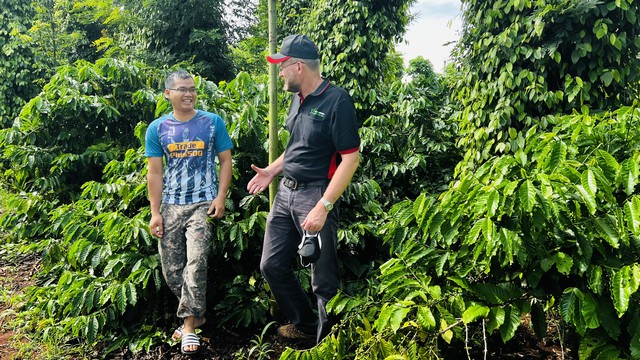
The Agripreneurship-NESCAFÉ program helps farmers, including young people, access knowledge and sustainable coffee farming practices. Photo: T.L.
These activities aim to improve production efficiency and help farmers meet market requirements. However, their impact on income, costs and emissions needs to be assessed using specific program data.
According to Nestlé Vietnam, sustainable value chains require trust among stakeholders, the capacity to meet standards and a commitment to long-term cooperation.
These factors enable stakeholders to coordinate investments, address emerging challenges and strengthen the capabilities of local suppliers.
“Swiss businesses bring strengths in technology, expertise, quality standards and international experience, while Vietnamese businesses offer local market knowledge and production capacity. Cooperation between the two sides could help develop more competitive and sustainable value chains in the future,” Hung said.




Max: 1500 characters
There are no comments yet. Be the first to comment.