


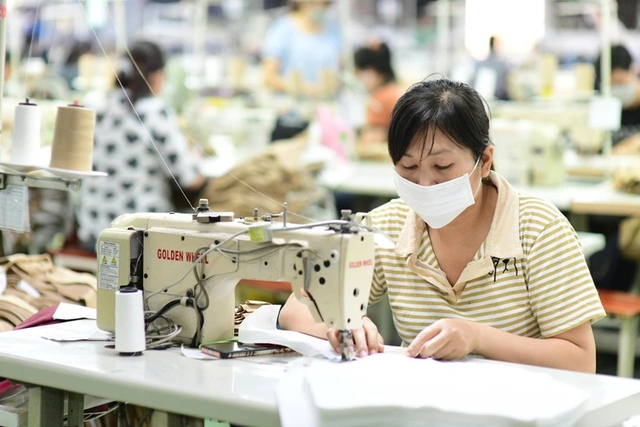
Workers at a garment factory in Ho Chi Minh City. Industry representatives have called for urgent measures to address delays in certificate of origin issuance that are affecting export shipments. Photo: Quang Dinh / Tuoi Tre
The Vietnam Leather, Footwear and Handbag Association (LEFASO) said it had received numerous complaints from member companies and export manufacturers regarding prolonged processing times for C/Os required for exports to key markets, including the United States, ASEAN countries and Chile.
The delays stem largely from the transfer of C/O issuance authority from the Import-Export Department under the Ministry of Industry and Trade’s to local trade authorities, creating two major bottlenecks.
Exporters are required to re-register their trader profiles, a process that can take up to 10 days and prevents them from submitting C/O applications during that period.
At the same time, local trade departments are struggling to handle a surge in applications from multiple industries, resulting in longer review and approval times.
LEFASO said the delays in C/O issuance are having a direct impact on exporters and supply chains serving key markets, including the United States, South Africa, Chile, China, Taiwan, the Philippines, Malaysia, Indonesia, Singapore and Thailand.
Without timely C/Os, importers may be unable to claim preferential tariff rates under free trade agreements, forcing them to pay higher most-favored-nation (MFN) duties upfront and seek refunds later.
This not only increases costs and administrative burdens but also puts pressure on exporters' cash flow.
The delays also raise the risk of customs clearance bottlenecks in markets where C/Os must be presented at the time of import.
Consequently, shipments may be held at ports, leading to higher warehousing and demurrage charges as well as potential penalties for late delivery.
LEFASO added that prolonged delays could disrupt the distribution plans of international brands, damage the reputation of Vietnam's manufacturing sector and prompt buyers to shift orders to competing countries.
Therefore, LEFASO has urged the Ministry of Industry and Trade to adopt a series of emergency measures to ease the bottlenecks.
The association proposed allowing trader profile data already registered on the Electronic Certificate of Origin System (eCoSys) to be automatically transferred to local Departments of Industry and Trade, eliminating the need for businesses to repeat the registration process.
During the transition period, LEFASO also recommended allowing parallel processing of trader profile verification and C/O applications, or introducing a temporary registration mechanism that would enable companies to apply for C/Os while their profiles are still under review.
The association further called for increased staffing, training and technical support for local trade departments in major manufacturing hubs.
It also suggested considering overtime processing or fast-track procedures for urgent shipments and exports to distant markets.
The issue emerged after new regulations on the issuance of C/Os took effect on August 1 under Circular No. 26/2026/TT-BCT.
The circular does not change origin rules or criteria for determining the origin of goods.
Instead, it transfers C/O issuance authority to local governments as part of a broader decentralization effort, giving local trade authorities a greater role in handling applications and related procedures.
Speaking with Tuoi Tre (Youth) online newspaper, a representative of the Ministry of Industry and Trade said the transfer of C/O issuance authority to local governments is part of a broader decentralization effort aimed at delegating powers and cutting administrative procedures by 30 percent.
As a result, resolving operational bottlenecks now falls under the jurisdiction of local authorities.
Acknowledging concerns that similar issues could affect other export-oriented industries, the ministry representative suggested several possible solutions.
These include allowing reputable exporters with strong compliance records and large export volumes to self-certify the origin of their goods, as well as expanding the use of electronic certificates of origin.
During the initial transition period, the representative also proposed allowing import-export management offices under the ministry's Import-Export Department to continue issuing C/Os in parallel with local authorities to help ease disruptions for businesses.








Max: 1500 characters
There are no comments yet. Be the first to comment.