


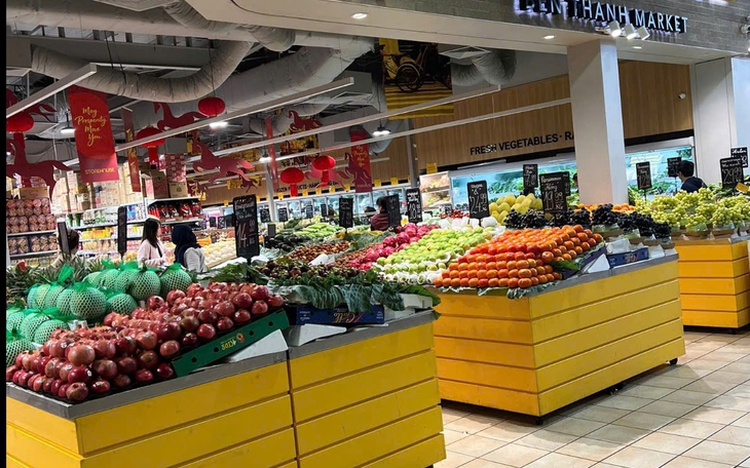
Various Vietnamese fruits are displayed for sale at a retail outlet in Vietnam. Photo: Sy Linh
Australia is the world's 13th-largest economy and the fourth-largest RCEP economy, after China, Japan, and South Korea, with a GDP of US$1.634 trillion in 2023, according to the World Bank.
Vietnam's exports to Australia have grown steadily, from $3.6 billion in 2020 to $6.8 billion in 2025, My told Tuoi Tre (Youth) online newspaper.
Her comments came as Vietnamese Party General Secretary and State President To Lam is on a state visit to Australia from August 9 to 12 at the invitation of Australian Governor-General Sam Mostyn, with the trip expected to help lift bilateral trade from its current level of around $14 billion toward a target of $20 billion.
My identified three major groups of products with strong potential in the Australian market: deeply processed agricultural products and high-quality foods; construction materials and supporting industrial products; and energy and essential minerals.
For deeply processed agricultural products and high-quality foods, Australia is an attractive market thanks to its high per-capita income and strong consumer spending.
Besides fresh farm produce, dried, canned and ready-to-eat foods, as well as halal and organic products, have room to penetrate deeper into Australia's multicultural and diverse market.
Construction materials and supporting industrial products also have strong prospects, as Australia is stepping up infrastructure development, housing construction, and the green transition.
This is driving growing demand for steel, wood, furniture, and green or environmentally friendly construction materials from Vietnam.
Energy and essential minerals are another promising area for cooperation.
Vietnam has significant demand for mineral resources for industrial production and energy, while Australia is rich in natural resources.
Sustainable cooperation in essential raw material supply chains could help maintain bilateral trade worth tens of billions of dollars over the long term.
However, My noted that Australia is one of the world's most demanding markets when it comes to food safety, biosecurity, technical standards, and sustainable development.
Vietnamese businesses often face difficulties in fully meeting these requirements, particularly those related to biosecurity.
As a result, moving from shipping individual consignments to establishing a long-term foothold in the Australian market is not easy.
My therefore recommended that Vietnamese businesses place greater emphasis on standardization and compliance, proactively studying and strictly meeting Australia's technical and import requirements.
For example, agricultural exporters must understand regulations on quarantine, pesticide residues, traceability, packaging, and labeling from the production stage in Vietnam.
A single non-compliant shipment can not only cause losses for the business involved but also damage the reputation of Vietnamese exports as a whole.
Businesses should also focus on building their brands.
Australian consumers are increasingly interested in added values such as sustainability, green production processes, environmental protection commitments, and social responsibility.
Vietnamese companies therefore need to invest systematically in packaging design, brand identity, and professional English-language communication to effectively tell their product stories.
Consumers and importers in Australia are also paying increasing attention to sustainable production, green processes, emissions reduction commitments, and social responsibility, posing a significant challenge for many Vietnamese businesses, My said.
She also advised businesses to make effective use of free trade agreements, including tariff advantages and rules-of-origin requirements under agreements to which Vietnam and Australia are both party, to better tap into the Australian market.








Max: 1500 characters
There are no comments yet. Be the first to comment.