


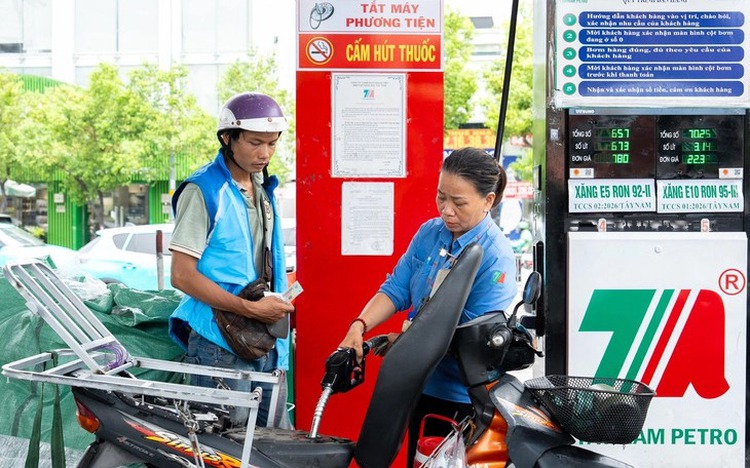
A gas station attendant fuels a motorcycle in Vietnam. Photo: Huu Hanh / Tuoi Tre
The extension was approved under Resolution 34/2026 issued by the government on June 30 and effective July 1, following a proposal by the Ministry of Finance.
The ministry’s proposal maintains the zero-percent preferential import tariff on gasoline, oil products and related inputs, keeps the environmental protection tax at zero dong, and retains the value-added tax exemption on gasoline, oil products, related inputs and aviation fuel through September 30.
These tariff measures were first introduced under Government Decree 72/2026, originally set to expire on April 30 before being extended through June 30 under Resolution 25 issued on April 30.
Under Decree 72, issued on March 9, import tariffs on unleaded gasoline and blending components such as naphtha and reformate were reduced from 10 percent to zero percent.
Tariffs on diesel, fuel oil, jet fuel, and kerosene were cut from seven percent to zero percent, while tariffs on several petrochemical feedstocks, including xylene, condensate and paraxylene, were also reduced to zero percent.
Other cyclic hydrocarbons were lowered from two percent to zero percent.
The government said the latest extension reflects continued uncertainties linked to the Middle East conflict.
Separately, the special consumption tax on gasoline remains to be governed by the Law on Special Consumption Tax and its implementing regulations, with rates set at 10 percent for mineral gasoline, eight percent for E5 biofuel gasoline, and seven percent for E10 biofuel gasoline.
The government also said it may shorten or further extend the validity of the resolution depending on socio-economic conditions, energy security needs, and developments in the domestic fuel market.
In such cases, the Ministry of Industry and Trade would submit a proposal to the Ministry of Finance, which would then report to the government for consideration.
In its earlier proposal, the finance ministry said maintaining the tax relief was necessary as tensions in the Middle East had disrupted shipping through the Strait of Hormuz, driving global oil prices higher.
Although global prices have eased since shipping resumed, they remain above pre-conflict levels.
In Vietnam, retail fuel prices have fallen to their lowest level in about three months, but E10 and E5 gasoline prices remain about 9.2 percent and 5.9 percent higher, respectively, than before the conflict, while diesel prices are still 23.86 percent to 33.84 percent higher.
The finance ministry noted that global oil markets remain at risk as tensions in the Middle East could flare up again.
It also said most fuels currently circulating in Vietnam were imported or stockpiled at higher prices, while lower-cost supplies will take time to reach the domestic market.
The ministry estimated that extending the tax relief through September 30 would reduce state budget revenue by around VND15.4 trillion (US$585.2 million) over the three-month period.
However, it said the policy would help diversify fuel imports from markets outside ASEAN, reduce reliance on a limited number of suppliers, and strengthen energy security.
The extension is also expected to stabilize the domestic fuel market, support macroeconomic stability, and contribute to economic growth.









Max: 1500 characters
There are no comments yet. Be the first to comment.