


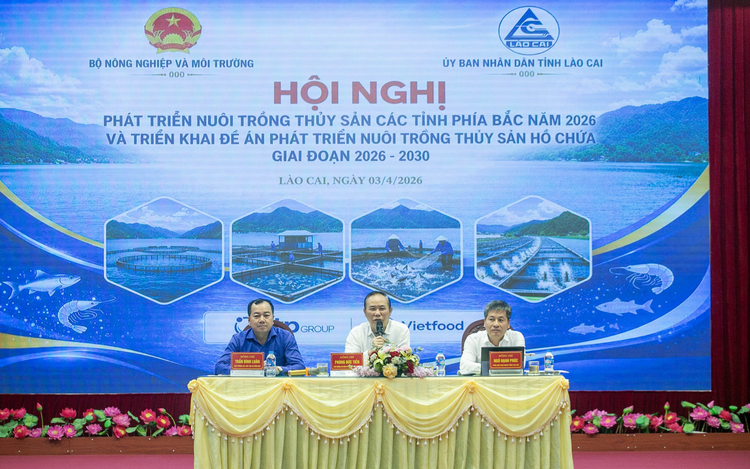
Officials at a conference on aquaculture development in northern provinces held in Lao Cai Province, April 3, 2026. Photo: C. Tue / Tuoi Tre
The Ministry of Agriculture and Environment, in collaboration with the provincial administration, organized the conference, outlining an ambitious plan to accelerate aquaculture development in the northern region and roll out a reservoir aquaculture strategy for the 2026-30 period.
Speaking at the event, Tran Dinh Luan, head of the Directorate of Fisheries under the ministry, underscored that Vietnam is home to nearly 6,750 irrigation reservoirs and more than 700 hydropower reservoirs.
They account for over 50 billion cubic meters in capacity and cover an estimated 400,000-450,000 hectares of water surface, with several reservoirs suitable for aquaculture.
The ministry targets annual reservoir aquaculture output of more than 260,000 metric tons by 2030, valued at around VND16 trillion.
“This is an enormous opportunity that has yet to be fully realized,” Luan said, emphasizing that the initiative could create sustainable livelihoods for residents.
However, some experts said that the reservoir aquaculture growth remains limited due to long-standing bottlenecks.
Dr. Le Thanh Luu from the Vietnam Fisheries Society noted that reservoir aquaculture has been under discussion since 2000, but it has seen limited advancement.
He attributed the slow development to the lack of clear policies governing the allocation of water surface areas for aquaculture.
He also pinpointed other obstacles, including the absence of well-defined value chains for key species, which discourages private investment, financial constraints, infrastructure gaps such as the lack of fishing ports, transportation systems, and processing facilities, and the shortage of scientists, managers, and technical workers across the sector.
To address these challenges, Luu hinted at developing a pilot value chain centered on tilapia.
By resolving policy issues and improving access to credit, authorities could create a scalable model for broader implementation, he said.

Residents and employees of a company cast nets to catch fish on Thac Ba Reservoir in northern Vietnam. Photo: C. Tue / Tuoi Tre
Quach Manh Long, chairman of Vietfood Aquaculture and Seafood Processing JSC, proposed state agencies review, amend, and supplement regulations in the Law on Irrigation, the Law on Fisheries, and the revised Law on Land to facilitate the use of reservoir surfaces for aquaculture development.
He pointed to several reservoirs, including Dau Tieng, Ngan Truoi and Cua Dat, where pilot aquaculture projects remain stalled because of unresolved legal issues surrounding water surface allocation.
Long also stressed the need for stricter enforcement against illegal fishing practices, such as the use of electric shocks and fine-mesh nets, which threaten aquatic resources.
Deputy Minister of Agriculture and Environment Phung Duc Tien underlined the scale of the opportunity but warned that achieving the sector’s targets would require a fundamental transformation in both policy frameworks and implementation strategies.
He called for urgent revisions to laws governing irrigation and water resources to expedite the allocation of water surfaces to aquaculture operators.
On the technological front, Tien highlighted Vietnam’s heavy reliance on imported fish breeds and urged research institutes to develop domestic capabilities in selective breeding and genetic technologies.
Also, Tien encouraged relevant units and localities to focus on building brands for reservoir aquaculture products, ensuring quality standards and improving traceability systems to boost exports.








Max: 1500 characters
There are no comments yet. Be the first to comment.