


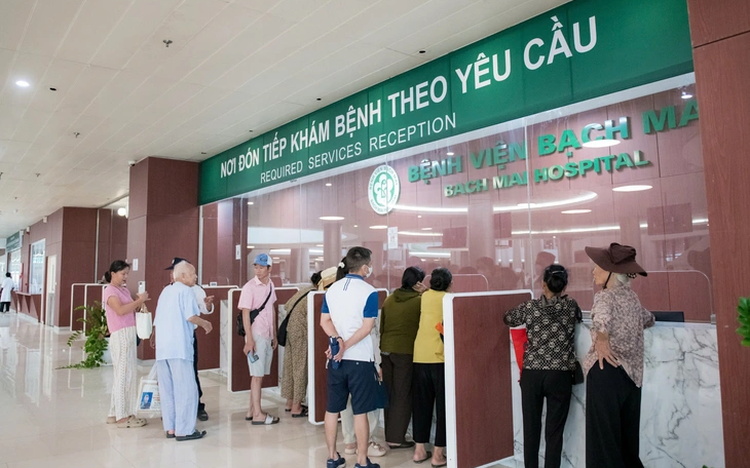
Bach Mai Hospital's second facility has recently opened in Ninh Binh Province, northern Vietnam. Photo: Nam Tran / Tuoi Tre
Vietnam’s Ministry of Health is drafting a plan for developing medical tourism for 2026-30, with the goal of establishing Vietnam as a competitive destination for medical tourism in Southeast Asia and gradually positioning the country among Asia's leading destinations.
Vietnam’s healthcare services attract international tourists
According to the Ministry of Health, medical tourism in Vietnam has made some initial progress.
Based on data from the health and tourism sectors, around 300,000 international visitors use healthcare services in Vietnam each year.
Their total spending is estimated at US$1-2 billion annually, including healthcare services as well as accommodation, transportation, food, and other related expenses.
There are currently no separate statistics on revenue from healthcare services alone.
Medical tourism is concentrated in several key destinations, with Ho Chi Minh City leading the country and accounting for around 40 percent of international medical tourists, thanks to its advanced healthcare system and active tourism promotion.
Hanoi ranks second, while destinations such as Da Nang, Hue, and Khanh Hoa are gradually developing medical tourism products based on their strengths in resort tourism and traditional medicine.
Medical tourists visiting Vietnam are mainly overseas Vietnamese, along with visitors from Cambodia, Laos, South Korea, Japan, Australia, and several European countries.
The most commonly used healthcare services include cosmetic dentistry, assisted reproduction, aesthetic medicine, general health checkups, and some high-tech medical specialties.
Challenges facing medical tourism
The Ministry of Health said medical tourism still faces several obstacles.
Vietnam does not yet have a dedicated and comprehensive legal framework governing the sector.
Standardized service packages are still at an early stage, making prices and service quality difficult to compare.
Current financial mechanisms also do not allow public healthcare facilities to fully account for the cost of services provided to foreign patients.
Direct payment arrangements with international health insurers are currently available at only some private healthcare facilities.
Vietnam also lacks a national brand for medical tourism.
Meanwhile, Vietnamese citizens are estimated to spend $2-3 billion each year on medical treatment abroad, exceeding the total revenue generated by international medical tourists visiting Vietnam.
Building national medical tourism brand
The draft plan seeks to establish a unified national policy framework, improve regulations, develop medical tourism products and services, and build a national brand, gradually turning medical tourism into a high-value, cross-sector service industry and positioning Vietnam as a reputable medical tourism destination in the region.
The plan also seeks to establish and promote a national medical tourism brand for Vietnam internationally, expand access to high-quality healthcare services for Vietnamese people, and reduce the number of Vietnamese traveling abroad for medical treatment.
The plan will be implemented in two phases. From 2026 to 2028, the focus will be on completing the regulatory framework and piloting integrated medical tourism models in five to seven key locations.
From 2029 to 2030, the model will be expanded nationwide.
The Ministry of Health aims to have at least 20 hospitals meeting international quality standards by 2030, including at least five public hospitals.
The plan also targets the development of at least 30 standardized medical tourism packages, as well as the launch of a multilingual national medical tourism portal and a national medical tourism database from 2028.
A national brand identity for "Vietnam Medical Tourism" will also be developed and rolled out nationwide.
By 2030, Vietnam aims to welcome around 750,000 international medical tourists.
Direct revenue from medical treatment and healthcare services is targeted at around $1 billion, while total spending by visitors and their companions is expected to reach approximately $2.5 billion.








Max: 1500 characters
There are no comments yet. Be the first to comment.