


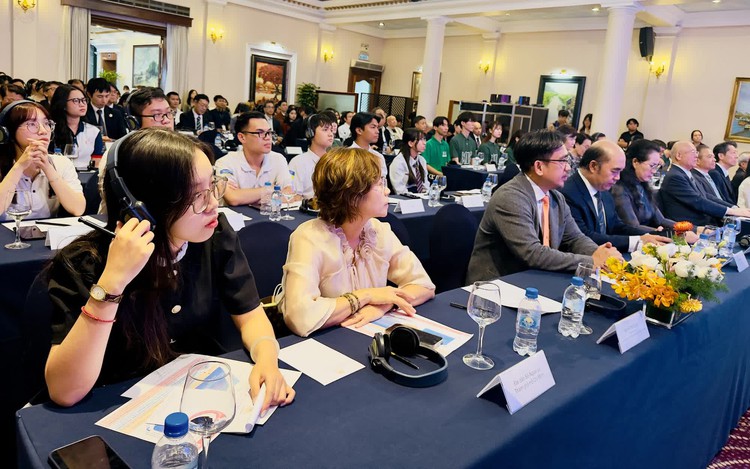
Vietnamese and Japanese experts attend a seminar on human resource development in Ho Chi Minh City, Vietnam, March 6, 2026. Photo: Bong Mai/Tuoi Tre
On Friday in Ho Chi Minh City, the 'Seminar on Human Resource Development for a Sustainable Future and Toward the Vision of an Olympic City' brought together Vietnamese and Japanese experts.
Speakers said hosting the Olympics would test not only infrastructure and financial capacity but also a country's broader institutional capability and social development.
Hosting the Olympics requires broad national capacity
Hashimoto Seiko, chair of the executive committee of the 11th Vietnam-Japan Festival and a former Japanese Olympic official, addressed the seminar online. "I am impressed by Vietnam's strong interest in developing sports and its long-term vision," she said.
She said the proposed 'Olympic Sports City' in Hanoi, which includes a planned stadium with a capacity of about 135,000 spectators, illustrates Vietnam's ambitions to expand its sports infrastructure.
Drawing on her experience with the Tokyo Olympic and Paralympic Games, Hashimoto said the Olympics are not only a global sporting event but also an opportunity for countries to demonstrate their organizational capacity.
She said economic strength, infrastructure, and organizational capacity are key prerequisites for hosting the Games.
She added that international observers also look at social factors, including the inclusiveness of society and how citizens respond to challenges.
Hashimoto described these qualities as reflecting a country's 'national dignity.'
Ly Dai Nghia, director of the Ho Chi Minh City Sports Training and Competition Center, said the concept of an 'Olympic city' extends beyond hosting a major sporting event.
He said the goal is to build an ecosystem linking sports, technology and the digital economy.
Human resources seen as key to sports development
Takebe Tsutomu, honorary chair of the Vietnam-Japan Festival executive committee, said investment in 'hard infrastructure' such as stadiums, high-speed rail, and modern buildings is necessary but not sufficient for development.
Infrastructure can be built with financial resources, and technology can be transferred. But developing the skilled workforce needed to operate and maintain such systems takes time, he said.
He added Vietnam would need significant improvements in human capital to avoid the so-called middle-income trap.
Le Thuy My Chau, deputy director of the Ho Chi Minh City Department of Education and Training, said a future 'Olympic city' would also require strong education and healthcare systems.
She said the city should meet international standards in education, healthcare, and smart technology.
Under the Japan-Vietnam Joint Initiative for 2025-26, Ho Chi Minh City's education sector plans to focus on three areas: developing talent in semiconductors and artificial intelligence, expanding Japan's KOSEN engineering education model, and promoting programs linked to green and sustainable development.
Education cooperation roadmap to 2030
During the 2026-30 period, Ho Chi Minh City aims to expand international scientific research partnerships, develop dual-degree programs, and build an education ecosystem closely linked to innovation.








Max: 1500 characters
There are no comments yet. Be the first to comment.