


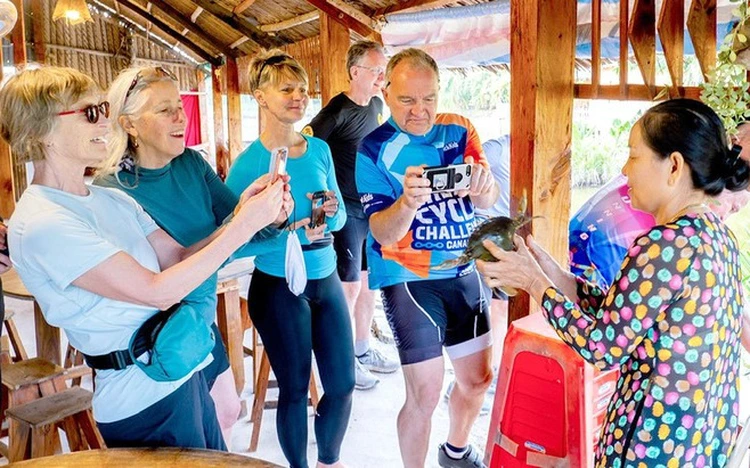
International tourists enjoy a tour of Chim (Bird) Islet in Vinh Long Province, southern Vietnam. Photo: Thanh Tri / Tuoi Tre
Despite welcoming a record of over 19 million international visitors in the first 11 months of the year, experts say Vietnam has yet to convert its tourism boom into strong retail revenue because of a lack of world-class shopping infrastructure and high-value products that genuinely appeal to foreign travelers.
Retail gaps keep tourist spending low
While international visitors indulge in Vietnamese cuisine and explore cultural and natural attractions, their retail spending remains modest.
Nguyen Thi Anh Hong, director of e-commerce at 24hStore, said many travelers from Europe, the U.S., and Australia compare prices extensively before buying, checking costs across Vietnam, duty-free outlets, and their home markets.
High-end electronics priced at VND20-40 million (US$760–1,520) rarely offer a clear advantage.
Concerns about returns, warranties, taxes, and documentation further discourage major purchases.
Tourists often limit spending to low-cost accessories, older devices, or items needed during their trip.
Pham Quy Huy, director of Kiwi Travel Company, said many products available to tourists are too basic or mass-market to appeal to middle- and upper-income travelers, who expect unique design, strong branding, and higher quality.
In the Mekong Delta, visitors largely dine, walk around, and buy simple souvenirs such as conical hats priced at VND20,000–30,000 ($0.75–1.13).
Huy noted that handcrafted items made from reed, lotus, or water hyacinth attract more interest but require stronger storytelling and branding.
“Without refined, culturally distinctive products, Vietnam struggles to convert tourist curiosity into meaningful retail spending,” he said.
Airports offer untapped opportunities for tourist spending
Vietnamese airports could become major retail and entertainment hubs, yet current offerings fall short.
Duty-free shops carry limited products, lack globally recognized luxury brands, and often cannot compete on price.
Dining, lounges, spas, cultural showcases, and entertainment spaces remain sparse, while slow and paper-based tax refund procedures discourage big-ticket purchases.
Regional competitors offer a stark contrast
Singapore’s Changi and South Korea’s Incheon have built airport cities where travelers can dine, shop luxury brands, attend cultural events, and relax in expansive leisure zones.
These hubs generate far higher per-passenger spending.
Experts believe Vietnam could unlock similar potential by expanding retail and dining options, creating immersive cultural zones, digitalizing tax refunds, and improving transit links between airports and city centers.
Targeting affluent visitors could boost tourism revenue
Vietnam also has major opportunities to attract and retain middle- and upper-class travelers, who typically stay longer and spend more.
Data from Yango Ads, a global advertising technology platform, shows strong demand among travelers from Russia, Kazakhstan, Belarus, Georgia, Eastern Europe, CIS countries, and Southeast Asia.
Among these groups, 80 percent prefer beach destinations, 46 percent seek nature-based tourism, and 43.2 percent prioritize cultural experiences.
Many stay up to two weeks and travel with families, indicating strong spending potential.
Experts say Vietnamese businesses must refine their approach through early seasonal promotions, multi-channel digital campaigns, personalized offers, and well-designed high-end itineraries.
Capturing affluent travelers requires aligning products and services with their expectations, from luxury retail and fine dining to distinctive cultural experiences and comfortable accommodations.
If Vietnam succeeds in transforming high visitor numbers into robust spending, experts say the country could not only boost economic gains but also elevate its standing as a world-class destination.








Max: 1500 characters
There are no comments yet. Be the first to comment.