


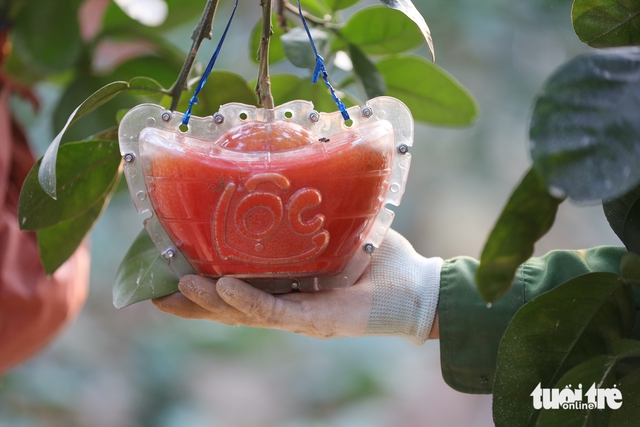
Dong Cao pomelos are molded into gold sycee ingot shapes bearing the Vietnamese character 'Loc,' meaning prosperity, at an orchard in Me Linh Ward, Hanoi, Vietnam. Photo: Danh Khang / Tuoi Tre
In Dong Cao Village, Me Linh Ward, growers are racing to pick, grade, and ship the red pomelos in time for the holiday, when households traditionally buy fruit for ancestral altars and as gifts.
The pomelos, whose flesh and rind turn deep red when ripe, are commonly shaped in molds to resemble gold sycee ingots and embossed with characters meaning 'fortune' or 'prosperity.'
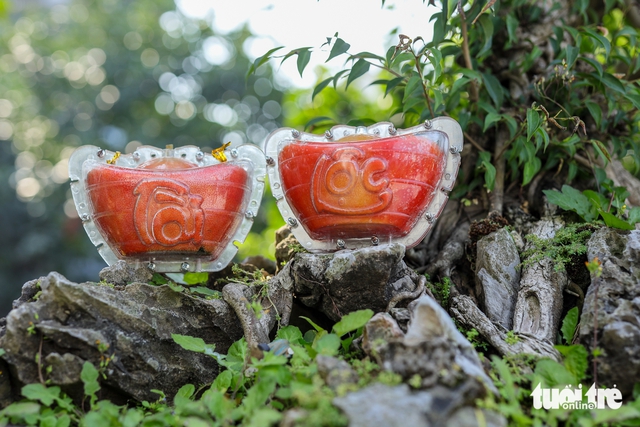
Pomelos molded into gold ingot shapes with the characters 'Tai' (Wealth) and 'Loc' (Prosperity) are displayed at a Dong Cao pomelo orchard in Me Linh Ward, Hanoi, Vietnam. Photo: Danh Khang / Tuoi Tre
The variety, known locally as Dong Cao red pomelo, is cultivated in only a handful of areas and regarded as a traditional 'tribute fruit' once presented to royal courts, growers said.
Shaped pomelos are sold at prices far higher than standard round fruit.
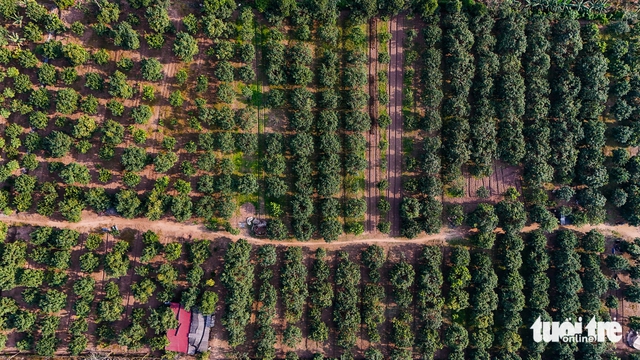
An aerial view shows a Dong Cao pomelo orchard in Me Linh Ward, Hanoi, Vietnam. Photo: Danh Khang / Tuoi Tre
At orchards, a pair typically sells for VND700,000 (US$27) to VND800,000 ($30), rising to about VND1.2 million ($46) per pair once distributed to urban markets.
By contrast, unshaped pomelos usually sell for VND75,000 ($2.8) to VND180,000 ($6.8) per fruit, depending on size and quality.
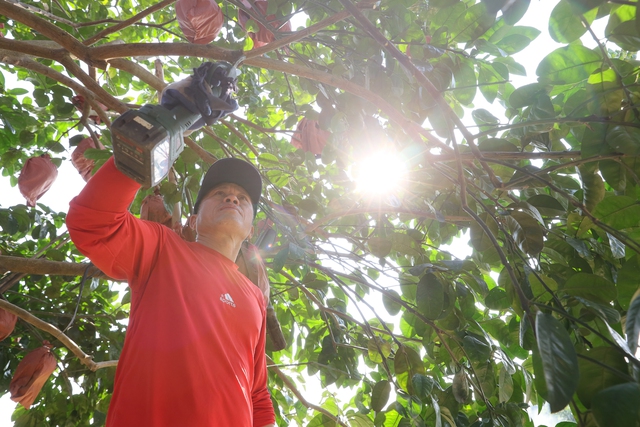
Luong Van Phuong tends Dong Cao pomelos at his orchard in Me Linh Ward, Hanoi, Vietnam. Photo: Danh Khang / Tuoi Tre
"Even at these prices, supply rarely meets demand because production is limited," said Luong Van Quyet, a 33-year-old orchard owner in Dong Cao, adding that most shaped pomelos are pre-ordered weeks in advance by repeat customers.
Farmers say the shaping process is labor-intensive and carries a high risk of loss.
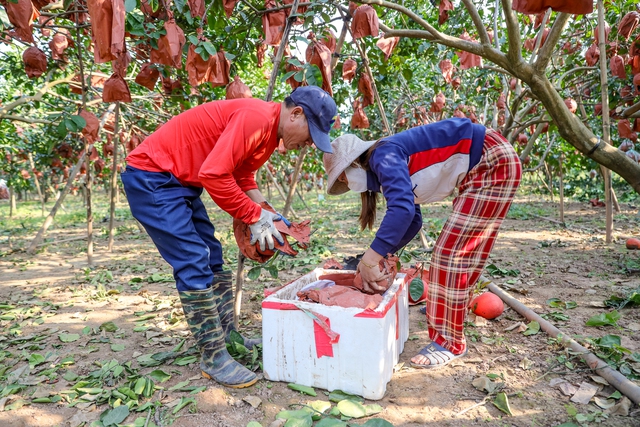
Luong Van Phuong (L) harvests Dong Cao pomelos at his orchard in Me Linh Ward, Hanoi, Vietnam. Photo: Danh Khang / Tuoi Tre
Pomelos must be selected early in their development, typically around March, and fitted into molds at a precise stage of growth.
A delay of even a few days can make the fruit unsuitable for shaping.
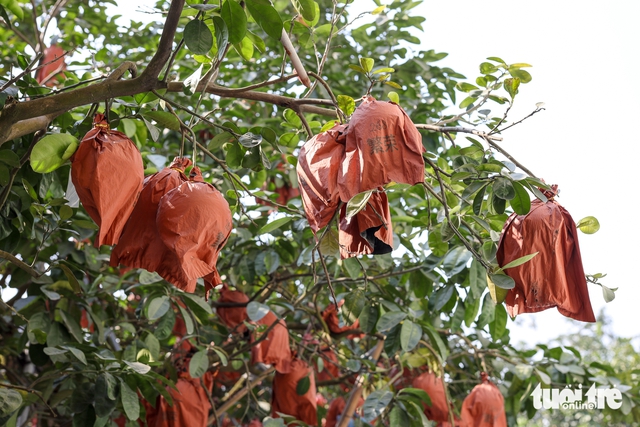
Dong Cao pomelos are wrapped in paper bags during the growing season to protect the fruit from weather damage at an orchard in Me Linh Ward, Hanoi, Vietnam. Photo: Danh Khang / Tuoi Tre
Beyond their commercial value, local officials and growers view the pomelos as an important agricultural heritage.
Luong Van Phuong, chairman of the Dong Cao Red Pomelo Cooperative, said his family still maintains a nearly 100-year-old pomelo tree that produces about 300 fruits per season.
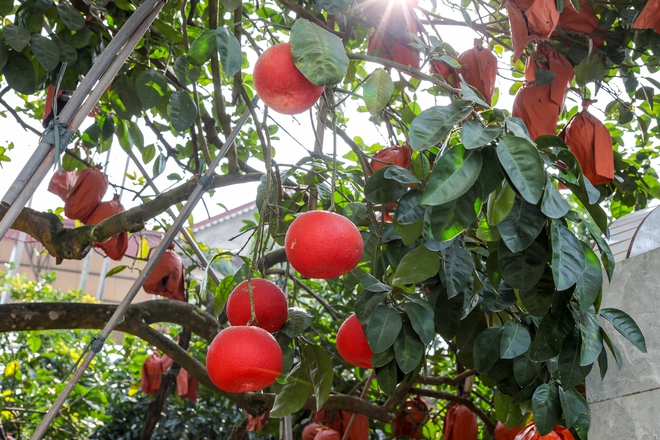
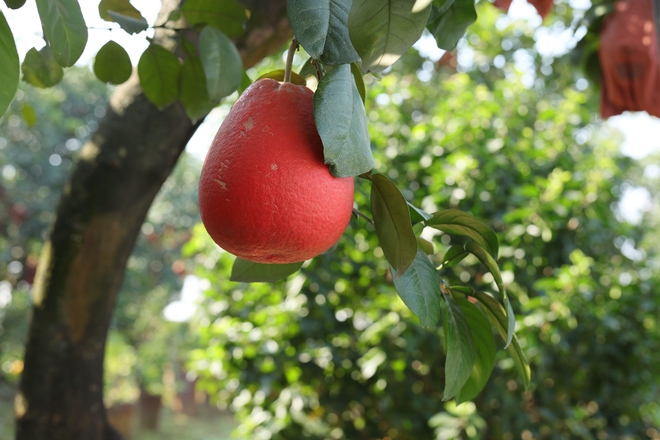
Dong Cao pomelos are seen at harvest time at an orchard in Me Linh Ward, Hanoi, Vietnam. Photo: Danh Khang / Tuoi Tre
After years of decline due to low returns, the cooperative has revived the variety to preserve its genetic stock, Phuong said.
It now manages nearly three hectares of orchards, producing close to 20,000 pomelos annually, though only a small fraction are shaped out of the complexity of the process.
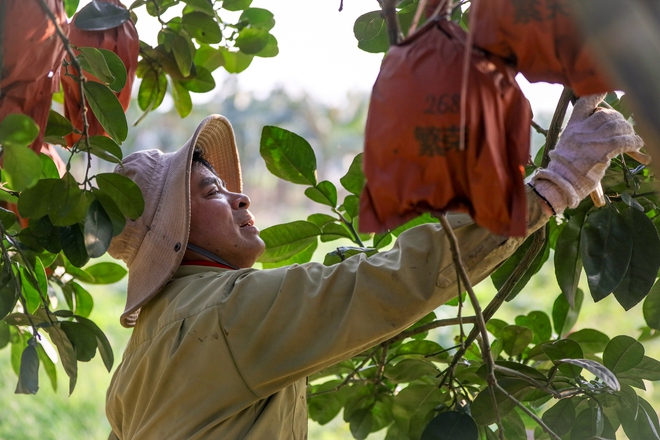
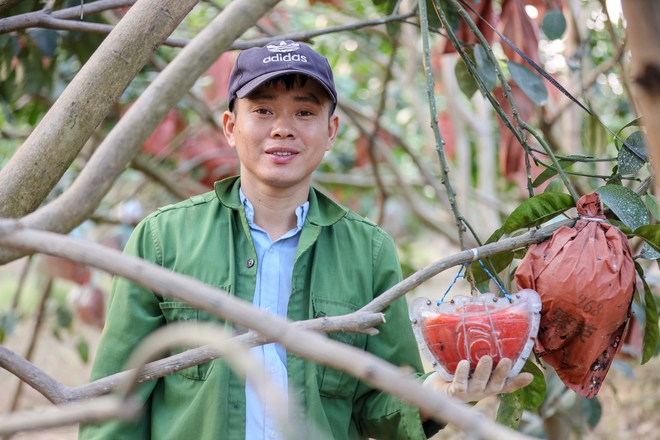
Farmers prune Dong Cao pomelo trees to improve sunlight exposure, encourage fruit setting and maintain low, spreading canopies for easier care at an orchard in Me Linh Ward, Hanoi, Vietnam. Photo: Danh Khang / Tuoi Tre
For now, sales are focused on the domestic market, particularly during the Lunar New Year season.
The cooperative hopes wider recognition will help raise incomes for local farmers and eventually open opportunities for exports, Phuong said.
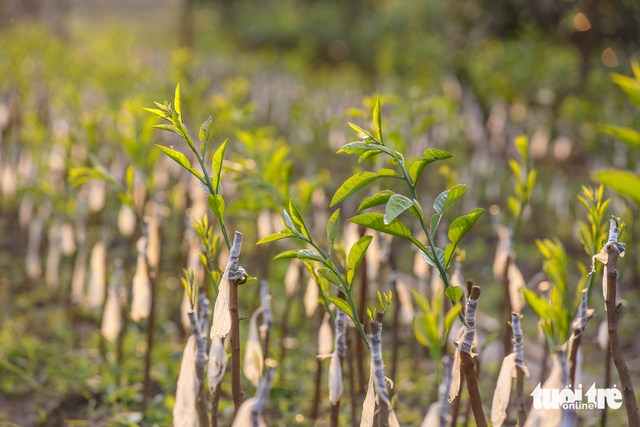
Young Dong Cao pomelo trees are seen at a nursery in Me Linh Ward, Hanoi, Vietnam. Photo: Danh Khang / Tuoi Tre
Vietnam's Lunar New Year, or Tet, is the country's largest annual holiday and typically drives a surge in demand for premium fruit and ornamental agricultural products.
The holiday begins in mid-February this year and lasts for about a week.








Max: 1500 characters
There are no comments yet. Be the first to comment.