


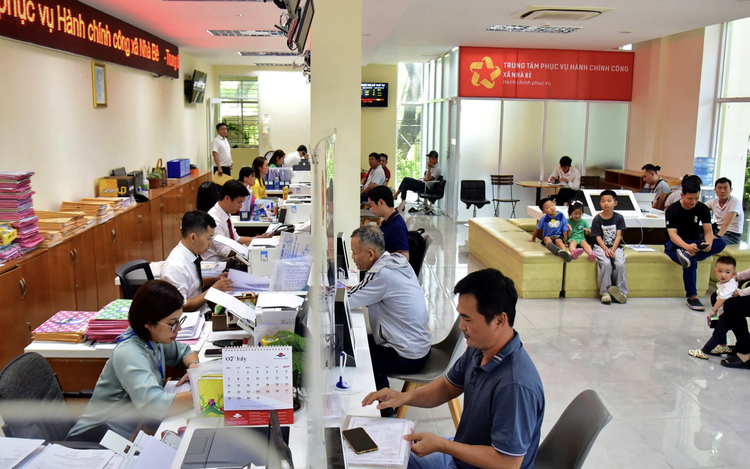
Residents conduct administrative procedures at the public administrative service center in Nha Be Commune, Ho Chi Minh City. Photo: Tri Duc / Tuoi Tre
The reforms span multiple ministries, including the Ministries of Industry-Trade, Agriculture-Environment, Science-Technology, Education-Training, Culture-Sports-Tourism, Health, and Public Security.
Also, a joint resolution led by the Ministry of Justice also covers seven additional sectors, including National Defense, Home Affairs, Finance, Construction, Foreign Affairs, Justice, and the State Bank.
The eight resolutions eliminate 184 administrative procedures, delegate 134 procedures to local authorities, and simplify a further 349.
On the business front, the government has abolished 890 business conditions and streamlined four others.
The total number of amended and supplemented legal documents is 164, including two government resolutions, 155 decrees, and six decisions issued by the prime minister.
With these changes, the government has effectively met all four key targets set for reducing and simplifying administrative procedures, easing business conditions, and strengthening decentralization.
Notably, central-level administrative procedures now account for only about 27 percent of the total, below the 30-percent ceiling mandated by national reform targets.
Meanwhile, the time and cost required to comply with administrative processes have been cut by more than half compared to 2024 levels.
In the public security sector, several procedures have been scrapped, including requirements for collecting and updating biometric data such as DNA and voice records in national identity databases at ministerial and provincial levels.
Procedures for issuing level-one and level-two electronic identification accounts to foreigners have also been removed.
The government has also mandated the decentralization of 16 administrative procedures, the simplification of 10 procedures, and the reduction of four business conditions under the management of the Ministry of Culture, Sports and Tourism.
The eliminated business conditions include those governing the organization of artistic performances, competitions and festivals, beauty pageants, and participation of Vietnamese citizens in international modeling and beauty contests.
In agriculture and environmental management, reforms benefit 15 areas.
Notably, business conditions related to consultancy services for land surveys, land evaluation, and land-use planning have been removed.
The education sector has also seen sweeping changes, with reduced and simplified procedures and business conditions linked to preschools, general education institutions, universities, foreign-invested educational institutions, representative offices of foreign education providers in Vietnam, and study abroad consultancy services.
In healthcare, authority over administrative procedures related to food safety and medical licensing has been decentralized.
Several business conditions have been abolished, including those tied to biosafety in laboratories, vaccination services, clinical training in health education, and treatment services for opioid addiction.
The Ministry of Science and Technology has implemented reforms across six areas, including standards and quality measurement, telecommunications and the Internet, radiation and nuclear safety, postal services, information technology, and scientific research activities.
Meanwhile, the Ministry of Industry and Trade has streamlined procedures and business conditions across 10 fields, ranging from chemicals, electricity, tobacco, and petroleum to e-commerce, international trade, import-export, trade promotion, commodity exchanges, and local industry.
Additional reforms extend to sectors such as defense, public administration, finance, construction, foreign affairs, justice, and banking.








Max: 1500 characters
There are no comments yet. Be the first to comment.