


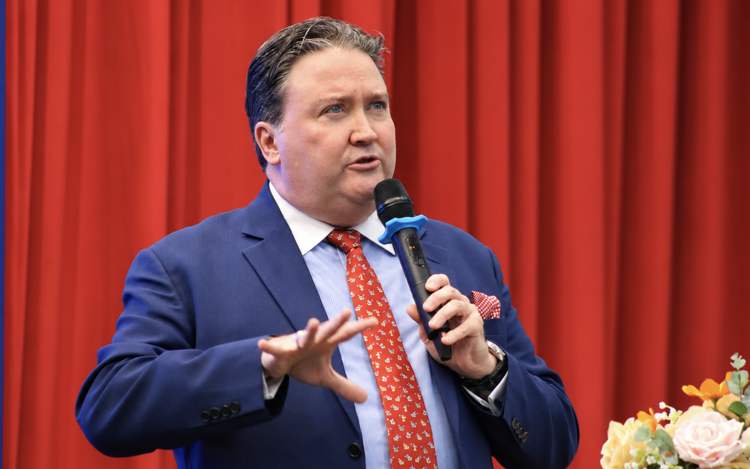
Former U.S. Ambassador to Vietnam Marc Knapper. Photo: Trong Nhan / Tuoi Tre
Knapper made the remarks in an interview with Tuoi Tre (Youth) online newspaper on Wednesday, a day after the U.S. midterm elections concluded with the Democrats winning control of both chambers of Congress.
Speaking as a ‘private citizen’ and long-time observer of Vietnam-U.S. relations, Knapper said he was no longer serving as ambassador and had no inside knowledge of the administration's deliberations, stressing that his comments reflected his personal views.
He said the incoming U.S. Congress could exercise greater oversight of President Donald Trump's trade policies, potentially creating opportunities for Vietnam to reinforce its strategic and economic ties with the U.S..
New Congress could influence US trade, tariff policy
The Democratic Party's victories in both chambers of Congress could give lawmakers greater leverage to scrutinize Trump's policies, particularly tariffs on imports, Knapper said.
However, the new Congress will not take office until January 2027, and Trump will retain substantial authority over trade policy in the meantime.
“I wouldn't expect an overnight change,” he said.
After the U.S. Supreme Court ruled in February that the International Emergency Economic Powers Act (IEEPA) did not authorize the president to impose tariffs, the administration turned to other authorities delegated by Congress, primarily Sections 301 and 232 of the Trade Act.
A Democratic-controlled Congress could use several tools to influence the administration's trade policy, including holding oversight hearings, attaching conditions to appropriations and other must-pass legislation, and pursuing laws to narrow the trade powers delegated to the president.
Lawmakers could also seek to require congressional approval for certain Section 232 actions or decline to extend any future temporary surcharge imposed under Section 122, which cannot remain in effect for more than 150 days without congressional approval.
Nevertheless, these measures would face limits, including the president's veto power, which the Democrats would not have the two-thirds majority needed to override.
“Congress's real influence lies in raising the political cost of new tariff increases and shaping incentives,” Knapper said, adding that relief for specific countries or products would still largely depend on negotiations with the Office of the U.S. Trade Representative (USTR).
He expected the administration to reassess its trade policies following the elections, but said the process would likely be gradual.
“I expect a reassessment, though a gradual one,” he said.
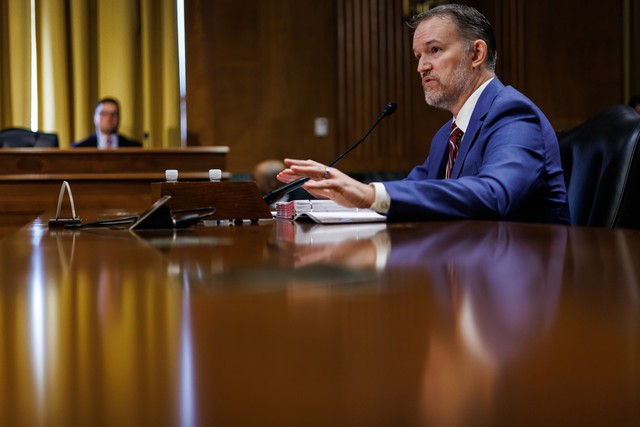
U.S. Trade Representative Jamieson Greer speaks during a hearing in July 2026. Photo: Reuters
The election results partly reflected voters' concerns about the cost of living, as tariffs and higher energy prices add to expenses for American households and manufacturers.
The conflict involving Iran has also become an important factor in this picture, with higher oil and fuel prices affecting U.S. households as well as Asian economies, including Vietnam, which experienced fuel shortages earlier this year.
Knapper said a Democratic-controlled Congress would likely use war powers resolutions, oversight hearings and its spending authority to press the administration to pursue a negotiated end to the conflict, although the president's veto power would limit how far Congress could go on its own.
He added that political pressure for de-escalation had grown stronger and markets had already responded to signs of diplomacy.
For Vietnam, a durable de-escalation would help reduce costs for manufacturers and shippers while highlighting shared interests in energy security, he said.
The Democrats also have their own trade priorities, including labor rights, action against forced labor, intellectual property protection and stronger enforcement against tariff evasion.
Vietnam remains strategic link in US supply chains
Washington is likely to adopt a more differentiated approach to its trade partners in the region, rather than treating them all alike, Knapper said.
Several of Vietnam's neighbors have already concluded trade agreements with the U.S., while new Section 301 measures related to forced labor set different rates depending on each partner's own policies.
The U.S. is likely to distinguish among partners based on their cooperation in customs enforcement, rules of origin and economic security.
“Given the seriousness Vietnam has brought to these issues, I see that as more opportunity than risk,” he said.
Regardless of changes in Congress, the underlying reasons for closer U.S.-Vietnam ties remain strong.
“The U.S. needs diversified, resilient supply chains in the Indo-Pacific, and Vietnam is central to that,” Knapper said, noting that the two countries' comprehensive strategic partnership enjoys broad bipartisan support in Washington.
Vietnam's market of more than 100 million people, its growing middle class and substantial American investment all underpin the bilateral economic relationship.
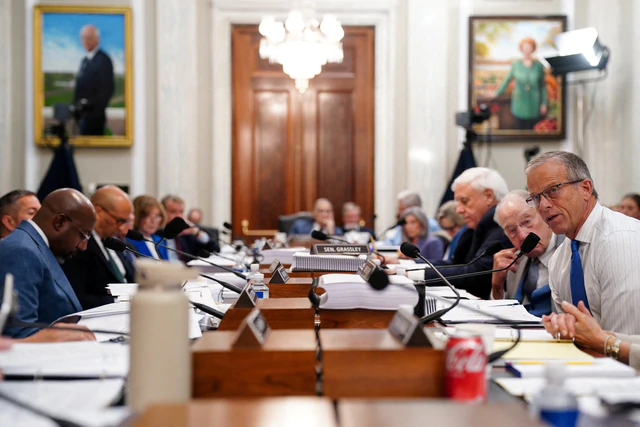
A meeting of the U.S. Senate Agriculture Committee takes place on Capitol Hill in August 2026. Photo: Reuters
He identified semiconductors, critical minerals, aviation, agriculture and energy as areas with considerable potential for further cooperation, including U.S. liquefied natural gas (LNG) and energy technologies that could support Vietnam's energy security and growth.
Trust between the two countries has also been built over decades of cooperation in addressing the legacy of war.
“More than three decades of normalization were built on war-legacy cooperation that both parties have championed,” he said.
Four priorities for Vietnam to strengthen trade position
Knapper said the term ‘transshipment’ deserves special care because it can mean different things to different people, and it is important to distinguish between legitimate manufacturing and illegal transshipment to evade U.S. tariffs.
“Vietnam importing components and adding real value through manufacturing is exactly what supply-chain diversification is supposed to look like. That is not transshipment,” he said.
The U.S. concern is instead about goods made elsewhere that are simply relabeled to evade U.S. duties.
He said Vietnam was working hard to address the issue, adding that both the government and business community understood the importance of preventing illegal transshipment.
Knapper outlined four priorities for Vietnam to strengthen its trade position and maintain the confidence of U.S. policymakers and businesses.
First, Vietnam should bring a reciprocal trade agreement with the U.S. to conclusion, as greater certainty and predictability would benefit both sides.
Second, it should continue combating illegal transshipment while increasing domestic value added in its exports.
Third, Vietnam should maintain progress in addressing forced labor and protecting intellectual property, issues that carry significant weight in current U.S. trade actions.
Fourth, it should broaden its engagement in Washington beyond the executive branch to include Congress, both political parties, state governors and the business community, all of which he said now matter as much as the executive branch.
“Vietnam has long since shown that it is not a transit point but a genuine partner. I'm confident that will remain true regardless of the political weather in Washington,” he said.


Max: 1500 characters
There are no comments yet. Be the first to comment.