


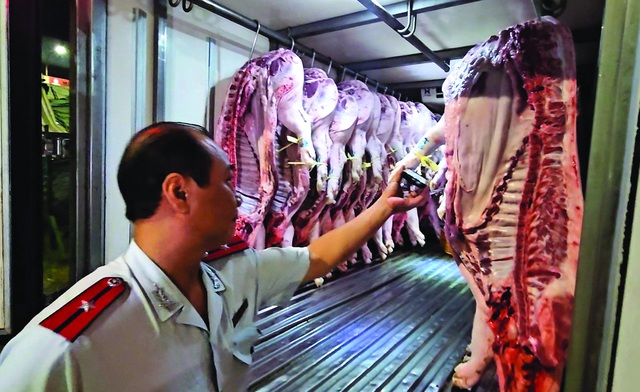
An inspector checks pork at a wholesale market in Vietnam. Photo: N.Tri
Two inspection teams have been formed, with team No. 1 in Ninh Binh led by Bui Thi Ngoan, deputy head of the legal-inspection division, and team No. 2 in Hanoi led by Luu Duc Du, deputy head of the food poisoning surveillance and communication division.
The inspections will last 15 days from the date of announcement.
Local food safety sub-departments will select the facilities to be checked.
The teams will review compliance with the Food Safety Law and related regulations.
They are authorized to handle or recommend penalties for violations and must report findings to the ministry.
The ministry’s decision to form the inspection teams follows recent cases of diseased pork being illegally slaughtered and distributed to markets and collective kitchens, including school canteens.
According to the ministry, collective kitchens serve large groups in schools, hospitals, and factories, and thus require strict food safety controls.
The ministry warned that unsafe food in these settings poses serious risks of disease outbreaks, threatening public health, especially children, students, and workers.
Recently, a food safety scandal involving hundreds of metric tons of diseased pork in Hanoi has raised public alarm.
The case came to light on March 17 when police inspected a slaughterhouse operated by Nguyen Thi Hien, 31, in Nam Phu Commune, Hanoi.
The site is known to supply large volumes of pork to wholesale markets, traditional markets, and major food distributors in the Vietnamese capital.
Officers found that Hien had processed pigs infected with African swine fever, a highly contagious disease.
She and her accomplices allegedly formed a closed supply chain, sourcing sick pigs from northern Vietnamese provinces such as Phu Tho and Tuyen Quang, transporting them to Hanoi for slaughter, and distributing the meat to consumers.
Police said the group colluded with quarantine officials to bypass mandatory controls, allowing infected and even dead pigs to enter the slaughter process.
Since early this year, the suspects are believed to have sold around 3,600 diseased pigs, equivalent to nearly 300 metric tons of pork.









Max: 1500 characters
There are no comments yet. Be the first to comment.