



Doctors at Tam Anh General Hospital in Ho Chi Minh City perform one of over 100 joint replacement surgeries using the AI-powered CUVIS-Joint robot. Photo: Supplied
A significant proportion of the cases were complex conditions that could not have been treated as effectively with conventional techniques or older generations of robotic systems.
Dr. Le Van Tuan, director of the Orthopedic Trauma Center at the hospital, said most of the more than 100 patients who have undergone AI-assisted joint replacement were challenging cases involving severe deformities or complex anatomical conditions.
Breakthrough in next-generation AI robotics
Conventional joint replacement techniques and older semi-active robotic systems require surgeons to estimate numerous factors during surgery, said Dr. Dang Khoa Hoc, head of the Department of General Orthopedic Trauma at Tam Anh General Hospital.
This can make it difficult to achieve the highest levels of accuracy and safety, particularly when a patient’s anatomy and soft-tissue characteristics differ from standard parameters.
The CUVIS-Joint AI robotic system provides surgeons with a visual representation of critical surgical parameters, including bone-cutting positions, limb alignment, cutting angles and thickness, flexion-extension gaps, soft-tissue tension and the positioning of the artificial joint.
These data allow surgeons to develop a highly precise three-dimensional surgical plan before the procedure.
When conditions change during surgery, the system can rapidly recalculate and update the plan, enabling surgeons to make personalized adjustments for each patient.
This capability is particularly valuable in severe cases involving significant joint deformity.
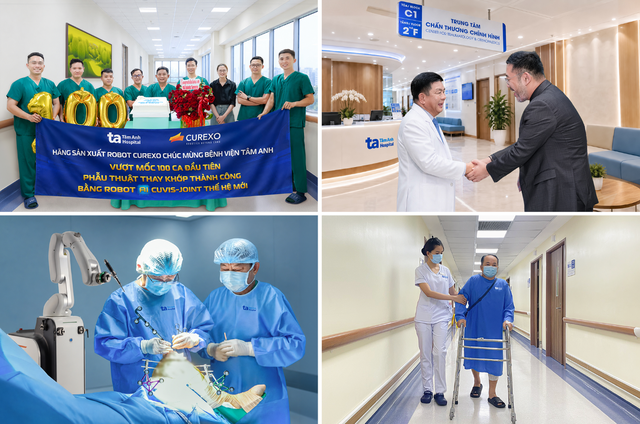
Cho Young Jean (right, top), head of overseas sales at CUREXO, congratulates Dr. Le Van Tuan and other doctors at Tam Anh General Hospital in Ho Chi Minh City on the 100-case milestone. Photo: Supplied
After performing the first 100-plus procedures with the AI robotic technology, Tam Anh’s orthopedic team has accumulated substantial practical experience and continued to shorten surgical times.
A robotic joint replacement currently takes some 60 to 90 minutes.
Patients typically experience less blood loss and reduced pain, while being able to begin rehabilitation exercises earlier and regain more natural mobility.
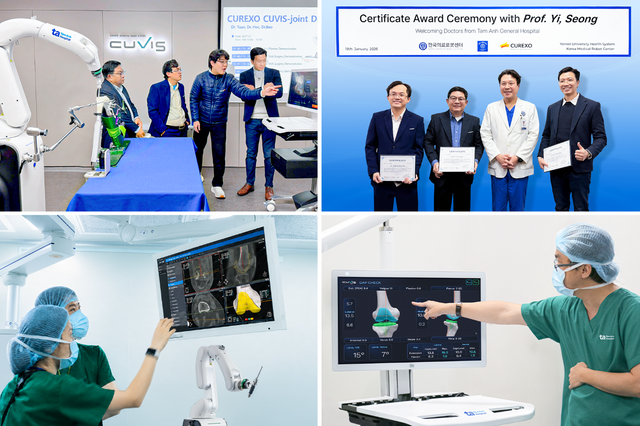
Doctors at Tam Anh General Hospital attend in-depth training courses in South Korea. Photo: Supplied
Recognition of international standards
Cho Young Jean, head of overseas sales at CUREXO, a medical robotics specialist, said Tam Anh General Hospital’s speed in surpassing 100 surgeries, together with its reported 100-percent success rate, places the hospital among the leading centers worldwide.
Many international medical facilities require six to 12 months to reach a similar number of procedures, he said.
The achievement reflects not only strong patient confidence but also the hospital’s readiness in terms of technological infrastructure and clinical expertise.
Over the past five years, Tam Anh’s orthopedic surgeons have participated in numerous international conferences on robot-assisted joint replacement across Europe and the United States.
In 2025, the hospital’s doctors underwent further training at five major hospitals in South Korea, the country with the largest number of CUVIS-Joint AI robotic systems in use.
Their training covered AI-assisted joint replacement surgery, complication management, simulation-based practice and hands-on clinical procedures.
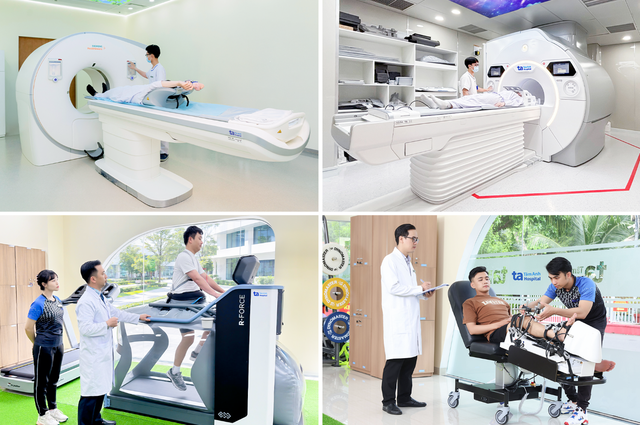
Apart from the AI robotic system, Tam Anh General Hospital has invested in a series of hi-tech medical machines for its treatment services. Photo: Supplied
Just one month earlier, Tam Anh General Hospital had also achieved a ‘hat-trick’ of three international certificates of excellence recognizing its performance in AI robotic joint replacement surgery using the CUVIS-Joint system.
The package cost for a CUVIS-Joint AI robotic joint replacement at Tam Anh ranges from VND135 million (US$5,160).
The package covers diagnostic procedures using advanced CT and MRI systems, specialized laboratory tests, robotic surgery, postoperative care, hospitalization and tailored nutrition, among other services.
The cost is approximately one-tenth of that in countries using the same robotic technology, while patients can also receive coverage for a number of eligible services under Vietnam’s health insurance regulations.
The hospital currently performs more than 1,200 orthopedic trauma surgeries each year.
The introduction of next-generation AI robotics is expanding access to treatment methods supported by advanced technology in Vietnam while also helping attract international patients seeking treatment in the country.










Max: 1500 characters
There are no comments yet. Be the first to comment.