


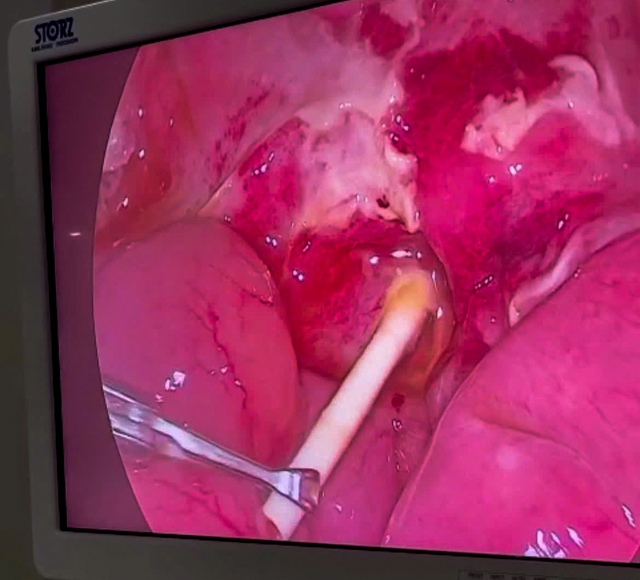
A plastic lollipop stickis removed from the duodenum of a five-year-old child from Ca Mau Province in southernmost Vietnam, after causing prolonged fever and abdominal pain. Photo: Supplied
The first patient was identified as N., a 5-year-old child from Ca Mau Province.
The child was admitted after suffering persistent abdominal pain for three days accompanied by fever.
Family members said N.'s parents worked far from home and that the child lived with the grandmother.
N. was known to frequently eat lollipops.
Clinical examinations and diagnostic tests showed severe peritonitis, prompting doctors to perform emergency surgery to prevent life-threatening complications.
During laparoscopic surgery, the medical team found cloudy pus throughout the abdominal cavity.
Surgeons then discovered a rigid white plastic tube, about six centimeters long, that had pierced the underside of the duodenum.
After 15 days of intensive treatment, the child's condition improved significantly.
N. was able to eat normally, and the surgical wound healed well.
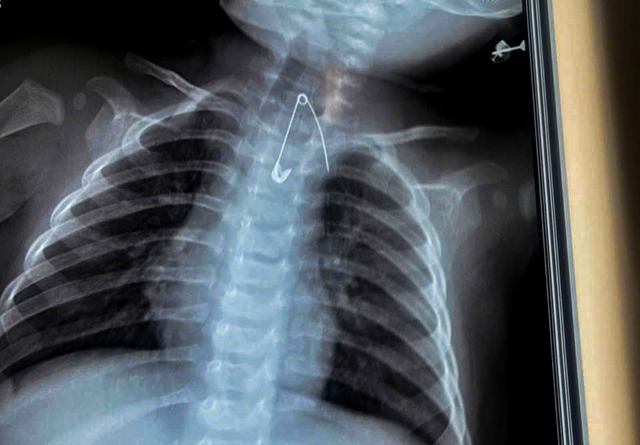
A safety pin was swallowed by a seven-month-old infant from Ca Mau Province in southernmost Vietnam and found lodged dangerously close to the aorta. Photo: Supplied
The second case involved a seven-month-old baby boy, identified as D., also from Ca Mau.
He was brought to the hospital with a two-day history of fever, coughing, and wheezing.
Medical history showed that over the previous three months, the infant had repeatedly suffered from respiratory infections.
Relatives told doctors that the family had a habit of attaching a good-luck charm to the baby's clothing using a safety pin.
Clinical and imaging examinations revealed that the safety pin had migrated into soft tissue and was lodged in an extremely dangerous position near the aorta.
Doctors warned that the sharp object could have caused massive bleeding and posed an immediate threat to the child's life.
Surgeons intervened promptly and successfully removed the safety pin without complications, preventing potentially fatal consequences.
Speaking to Tuoi Tre (Youth) newspaper, Ninh Thi Ly, head of the hospital's social work department, said the facility frequently treats children who swallow or inhale foreign objects.
Recently, doctors have seen an increase in particularly dangerous items, including safety pins measuring about three centimeters and lollipop sticks up to six centimeters long.
She noted that many children show no obvious symptoms immediately after swallowing foreign objects, making early detection difficult.
Parents should seek medical attention if children develop persistent coughing, abdominal pain, prolonged vomiting, or other unusual symptoms.
Medical experts also urged parents and caregivers to closely supervise children, keep sharp objects and small items out of reach, and bring children to medical facilities promptly to avoid serious consequences.








Max: 1500 characters
There are no comments yet. Be the first to comment.