


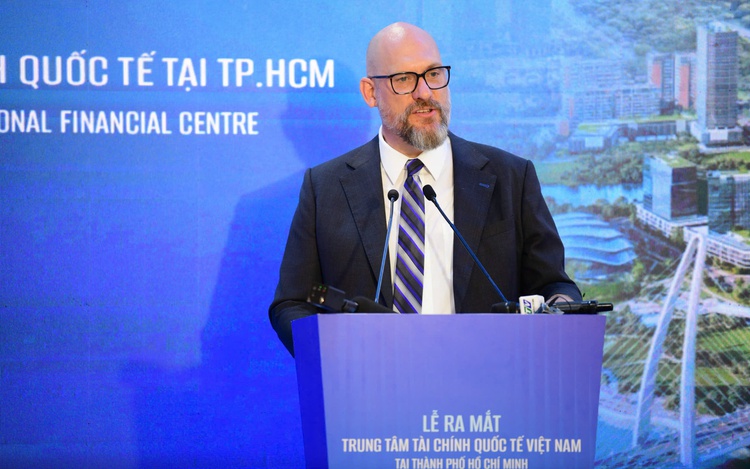
CEO of VIFC-HCMC Rich McClellan at the opening ceremony for the Vietnam International Financial Center in Ho Chi Minh City, February 11, 2026. Photo: Quang Dinh / Tuoi Tre
Editor's note: Rich McClellan is the Executive Director/CEO at the Vietnam International Financial Center in Ho Chi Minh City.
Ho Chi Minh City officially launched the Vietnam International Financial Center in Ho Chi Minh City (VIFC-HCMC) on February 11 at its headquarters at 8 Nguyen Hue Street, Saigon Ward.
Tuoi Tre News presents to readers McClellan's assessment of the direction of the VIFC-HCMC.
Bringing capital for next stage of economic development
Vietnam should not try to replicate established ASEAN financial hubs. Singapore and Hong Kong have decades of accumulated depth and global connectivity. Ho Chi Minh City's differentiation will come from serving a different role: acting as a capital bridge for Vietnam's next stage of economic development.
Vietnam is entering a phase where it must deepen domestic capital markets, mobilize long-term financing, and support enterprise restructuring and technology upgrading.
The VIFC-HCMC can differentiate itself by focusing on areas where Vietnam has structural momentum: infrastructure financing, energy transition, supply-chain modernization, and digital enterprise growth.
In green finance, the opportunity is practical rather than promotional. Vietnam has real demand for transition finance – renewable energy, grid upgrades, industrial decarbonization, and sustainable urban development. If the VIFC-HCMC can help structure transparent, bankable vehicles aligned with international standards, that alone would be meaningful progress.
In fintech, Vietnam's advantage is its digitally fluent population and rapid adoption of digital payments. The VIFC-HCMC can provide a controlled regulatory environment for innovation.
The goal is not to dominate on multiple fronts. It is to move responsibly and decisively where Vietnam's real economy creates demand.
Institutional reform first
Success for the VIFC-HCMC over the next 3-5 years should be measured first by institutional maturity, and then by market depth.
In the initial phase, the priority is institutional activation: standing up executive and supervisory bodies, issuing operating regulations, onboarding early participants, and demonstrating consistent rule application. That groundwork is essential.
By year three, I would expect to see a fully functioning regulatory framework and licensing process, a strong group of recognizable anchor participants, active pilot initiatives, and meaningful cross-border transactions structured through the VIFC-HCMC framework.
At that stage, the market should see tangible evidence that the platform works in practice.
By year five, success should mean operational depth. We should see established exchanges and platforms functioning smoothly, sustained participation from regional and global institutions, credible supervisory track records, and measurable capital flows facilitated through the VIFC-HCMC ecosystem.
IFCs are long-term projects. The early years focus on building structure and credibility; the later years are when scale and specialization emerge. If the foundation is strong, momentum compounds.








Max: 1500 characters
There are no comments yet. Be the first to comment.