



Vietnam's Permanent Deputy Minister of Health Vu Manh Ha speaks at a medical AI workshop in Hanoi, January 14, 2026 Photo: D.Lieu / Tuoi Tre
The initiative, known as the Vietnam Responsible Health AI Network, was announced on Wednesday at a medical AI workshop organized by the ministry's National Health Information Center.
Speaking at the event, Permanent Deputy Minister of Health Vu Manh Ha said the launch aligns with the National Assembly's adoption of the Artificial Intelligence Law and the Politburo's Resolution 57 on science, technology, and innovation development, which identifies AI as a national strategic breakthrough.
He said the technology is expected to play a central role in building a smart healthcare system by 2030, particularly by strengthening prevention, diagnosis, treatment, and health system management at the grassroots level, where shortages of personnel, infrastructure, and access to high-quality medical services remain major challenges.
"The Ministry of Health clearly recognizes that healthcare AI directly affects people's lives, health, and rights," Ha said.
"Therefore, its deployment must be cautious, phased, and managed based on risk levels."
He stressed that healthcare AI must be developed and applied using a human-centered approach, ensuring patient safety, health data security, transparency, fairness, and accountability, while complying with Vietnamese law and international guidelines.
Ha added that controlled sandbox-based testing combined with real-world impact assessments is essential to encouraging innovation while managing potential risks.
He pledged continued policy support and stronger international cooperation to ensure the safe and effective deployment of AI in healthcare.
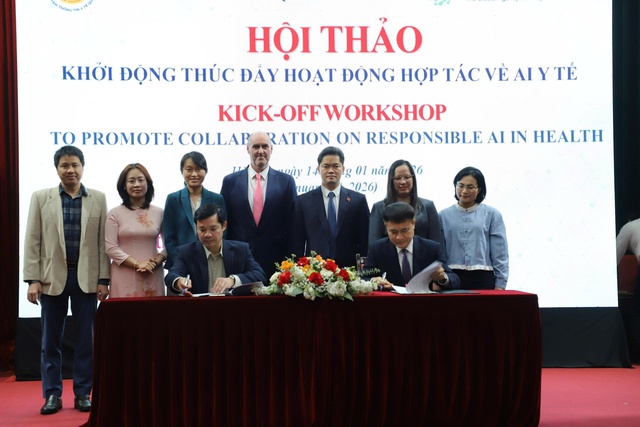
Representatives sign cooperation agreements to join the medical AI network at a medical AI workshop in Hanoi, January 14, 2026 Photo: D.Lieu / Tuoi Tre
Nguyen Truong Nam, deputy head of the National Health Information Center, said Vietnam has become one of the first 10 countries to join the global HealthAI network.
Membership allows Vietnam to access international governance tools, connect with the Global Regulatory Network, and participate in Communities of Practice to exchange knowledge and research data.
It also opens opportunities for 'Make in Vietnam' AI products to be recognized and listed in the Global Public Domain.
'Make in Vietnam' implies a shift away from 'Made in Vietnam,' which has largely relied on assembly work and foreign investment, toward a phase in which Vietnamese firms control design, technology, standards, and markets.
In 2026, the network plans to roll out AI applications at 3,321 commune- and ward-level health stations nationwide.
Planned solutions include tuberculosis and cardiovascular screening, community nutrition counseling, diagnostic support for serious conditions such as acute kidney failure and respiratory distress, and virtual assistants to help frontline medical staff manage daily operations more efficiently.
Experts attending the workshop discussed global and domestic trends in medical AI, its role in state management, data analysis, scientific research, and workforce training, as well as ongoing challenges related to data privacy, cybersecurity, ethics, and legal compliance.








Max: 1500 characters
There are no comments yet. Be the first to comment.