


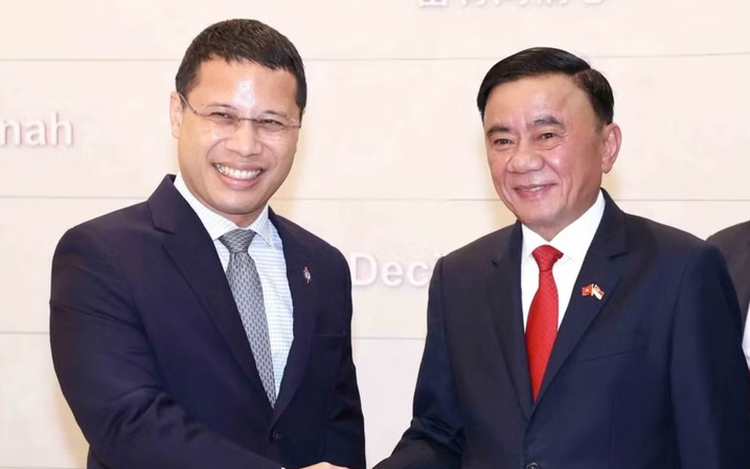
Politburo Member and Standing Member of the CPV Central Committee’s Secretariat Tran Cam Tu (R) meets Chairman of the People’s Action Party (PAP) of Singapore and Minister for Education Desmond Lee in Singapore, August 24, 2026. Photo: Vietnam News Agency
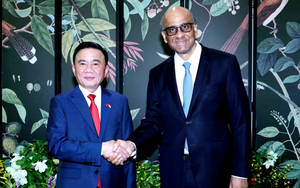
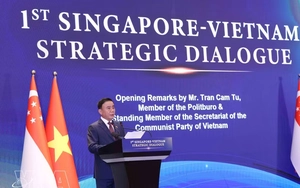
Politburo Member and Standing Member of the CPV Central Committee’s Secretariat Tran Cam Tu paid an official visit to Singapore and co-chaired the first Vietnam-Singapore Strategic Dialogue on Monday and Tuesday.
The dialogue marked the launch of a high-level mechanism agreed upon by the two sides during the visit to Singapore by Party General Secretary and State President To Lam at the end of May.
In a meeting with PAP Chairman and Minister for Education of Singapore Desmond Lee, Tu stressed that relations between the two parties constitute an important pillar guiding the overall bilateral strategic relationship.
Decoding PAP’s power
Vietnam-Singapore relations have reached their highest level following the establishment of a comprehensive strategic partnership in March 2025.
Yet a truly comprehensive and profound relationship cannot be complete without a political and ideological backbone linking the two governing parties.
The establishment of a Party-to-Party Strategic Dialogue is therefore an important, historic step in translating high-level agreements into concrete action, from cadre training and growth-model reform to digital-economy connectivity and green energy.
The CPV and the PAP share several important characteristics: their ability to maintain political leadership, a strong pragmatic orientation, and an ambition to modernize their respective countries.
Viewed through the lens of national governance and public policy, the dialogue provides Vietnam with a valuable practical reference at a time when the country is entering a period of accelerated development.
Singapore’s transformation is particularly instructive.
When it separated from Malaysia in 1965, the island nation was poor, resource-scarce and facing serious uncertainty.
It has since emerged as a leading global financial and technology hub.
At the center of that transformation has been the PAP-led governing system.
Unlike political parties whose legitimacy is primarily renewed through electoral mandates, the PAP has sustained its position through a strong record of governance and delivery.
It has demonstrated an ability to address practical social challenges, including economic growth, national security, social welfare, education, and healthcare.
Programs such as public housing, and high-quality education and healthcare systems, have delivered tangible benefits to a broad section of Singapore’s population.
These achievements have helped turn political support into public confidence in the party’s governing capacity, even as competition from opposition parties has grown.
Singapore’s long-term approach to infrastructure and urban planning also offers a practical reference for Vietnam as it tackles the immense urbanization challenges facing Hanoi and Ho Chi Minh City.
Vietnam, meanwhile, is entering a period of profound development transformation as it seeks to realize long-term strategic goals.
The strategic dialogue with the PAP comes at a time when Vietnam is seeking practical experience in streamlining its administrative apparatus, accelerating administrative reform, building an innovation ecosystem, and attracting higher-quality investment.
Vietnam can also examine Singapore’s approaches to organizing the public sector, identifying and developing young talent, managing the macroeconomy, attracting skilled professionals, and advancing smart cities and a green economy.
Lessons for Vietnam
Human resources are among the most pressing challenges facing Vietnam as it seeks to improve the quality of its officials and strengthen its capacity to design and implement long-term policies.
In this respect, Singapore’s experience under the PAP offers particularly practical lessons, especially regarding mechanisms for attracting and rewarding capable people.
The PAP is known for rigorous talent selection from the public sector, military and private sector, supported by competitive remuneration designed to attract highly capable individuals to public service.
Singapore has adopted competitive pay for ministers and senior officials, benchmarked against top private-sector incomes.
The approach is intended both to attract outstanding talent and to reduce corruption.
For Vietnam, this experience may offer useful reference points as it develops breakthrough mechanisms for talent recruitment and reforms public-sector remuneration.
Strict institutional discipline, combined with effective mechanisms for self-correction and anti-corruption enforcement, has also helped protect the PAP from internal erosion while maintaining strong organizational discipline and flexibility in responding to social change.
Adaptability is increasingly critical amid geopolitical volatility and rapid technological change.
Governing parties must strengthen their ability to respond to emerging challenges such as artificial intelligence, the green transition, and disruptions to global trade.
This requires governing elites to receive continuous, systematic training while ensuring generational renewal.
It is a process of constant institutional optimization.
A notable example is the PAP’s response to growing demands among younger generations for more diverse voices and concerns over widening inequality.
The party redesigned traditional social-welfare policies through the Forward Singapore initiative, seeking to preserve social consensus while addressing changing public expectations.
The strategy was developed through extensive public engagement, with more than 200,000 Singaporeans contributing their views through community dialogues.
This approach enabled the PAP to deepen its engagement with younger generations and sustain public trust.
* This article is authored by Dr. Nguyen Thanh Trung, a leading expert in international relations who currently teaches at Fulbright University Vietnam. He holds a master’s degree in international politics from Fudan University in China and a PhD in political science from Hong Kong Baptist University. He has also received training in educational management at Harvard University and Singapore Management University.








Max: 1500 characters
There are no comments yet. Be the first to comment.