


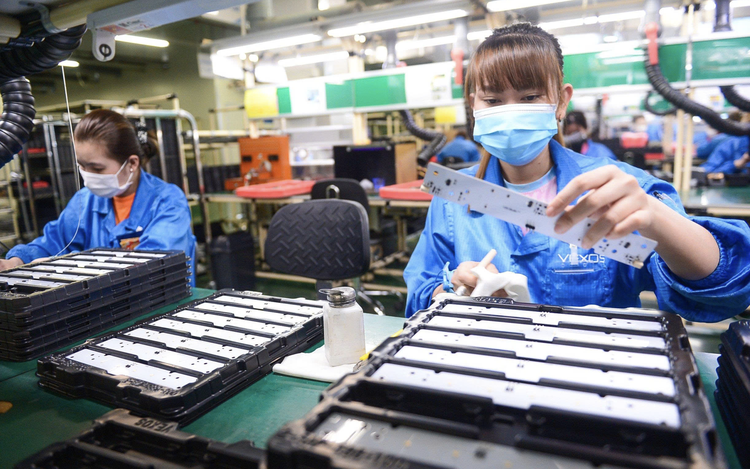
Employees at work at a foreign-invested firm in Ho Chi Minh City. Photo: Quang Dinh / Tuoi Tre
The Politburo held a nationwide conference in Hanoi on Tuesday morning to study, disseminate, and implement Resolution No. 10, issued on June 8.
For many years, investment success was often measured by headline figures such as registered capital, the number of licensed projects, or the occupancy rate of industrial parks.
While these indicators remain important, they can no longer serve as the sole benchmarks of success.
A project worth hundreds of millions of U.S. dollars does not necessarily create greater value than a smaller investment that brings cutting-edge technology, establishes research and development centers, trains Vietnamese engineers, and integrates local firms into global supply chains.
The global investment landscape is evolving faster than many economies can adapt.
International capital is no longer drawn to countries solely because of low labor costs or generous incentives.
Global corporations increasingly seek stable political and economic environments, transparent legal systems, reliable infrastructure, skilled workforces, and seamless access to international markets.
In other words, investors are no longer looking merely for locations to build factories or transform Vietnam into another manufacturing hub.
They are searching for trusted partners where they can plan for long-term growth.
As such, Resolution No. 10 is meant to focus on shifts from simply mobilizing capital to building a modern, efficient, and sustainable ecosystem for foreign-invested enterprises.
This transformation also places new responsibilities on local authorities.
Competing for investment at any cost by weakening environmental standards, offering indiscriminate incentives, or prioritizing large-scale projects with limited spillover benefits is no longer a viable strategy.
Instead, a locality's competitiveness should be defined by the quality of its governance, the efficiency of public services, streamlined administrative procedures, well-prepared industrial land, robust transport and energy infrastructure, efficient logistics networks, and a highly skilled workforce.
Foreign investment should be regarded as an integral component of the national economy rather than a separate sector operating in isolation.
When foreign-invested enterprises simply import raw materials, employ low-skilled labor, manufacture products, and export them, only a limited share of the value remains within Vietnam.
The real economic gains emerge when foreign companies partner with Vietnamese suppliers, commission research from local universities, train highly skilled workers, and transfer advanced management practices.
Only then can foreign capital generate deep and lasting impacts across the broader economy.
Strengthening domestic enterprises
Enhancing the competitiveness of Vietnamese businesses must therefore become a central priority.
Domestic companies could not remain passive observers as multinational corporations continue expanding their operations in Vietnam.
To participate meaningfully in global value chains, Vietnamese firms must improve corporate governance, standardize product quality, invest in technology, foster financial capacity, and meet increasingly demanding environmental, social, and governance standards.
Also, the government must play a proactive, enabling role by developing policies that back supporting industries, deepen capital markets, improve workforce training, and facilitate stronger connections between domestic enterprises and multinational corporations.
Preferential policies should be granted only when investors fulfill concrete commitments on technology transfer, workforce development, knowledge sharing, clean energy adoption, and partnerships with Vietnamese firms.
Incentives cannot simply be granted upfront without meaningful accountability.
Commitments to technology transfer should be evaluated through measurable outcomes, while promises to train local workers should be reflected in the number of employees acquiring advanced skills.
In addition, pledges to strengthen supply chains should be assessed by the actual participation of Vietnamese companies in production networks.
Such an approach would prevent generous incentives from producing only limited long-term benefits.
The resolution also reflects a broader understanding of international capital.
Beyond attracting foreign direct investment, Vietnam aims to develop its capital markets, encourage portfolio investment, establish international financial centers, create free trade zones, and build new engines of economic growth.
This strategy aligns with modern capital flows, which are increasingly intertwined with technology, data, financial services, and sophisticated risk management.
For Ho Chi Minh City, the opportunity presented by an international financial center extends far beyond attracting major financial institutions.
More importantly, it offers the foundation for connecting global investment funds, financial organizations, technology companies, and strategic national development projects.
To realize this vision, the city should continue strengthening its institutional framework, expanding its pool of finance and technology professionals, improving the quality of urban living, and reinforcing investor confidence.
The success of Resolution No. 10 should not be judged by impressive statistics on registered investment capital.
Its true measure will be reflected in the growing strength of Vietnamese enterprises, the country's expanding technological capabilities, the rise of a highly skilled workforce, and the increasing share of value retained within the domestic economy.
Vietnam's openness to international investment means building a stronger, more resilient, and more competitive nation.
That is the goal Resolution No. 10 seeks to achieve.








Max: 1500 characters
There are no comments yet. Be the first to comment.