


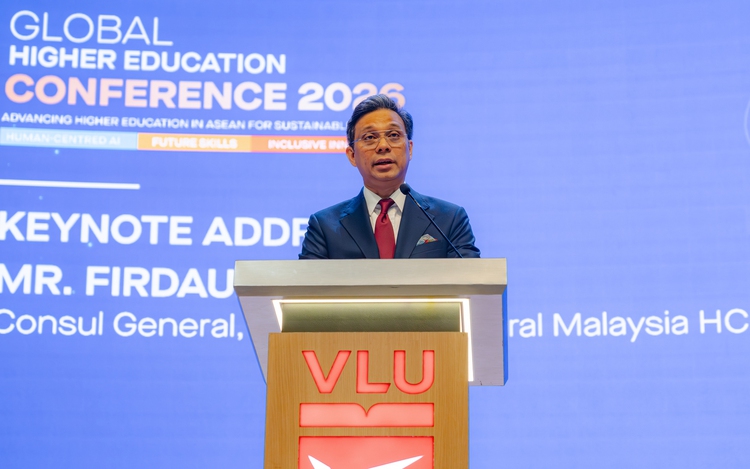
Malaysian Consul General in Ho Chi Minh City Firdauz Othman delivers the opening remarks at the international conference 'Advancing Higher Education in ASEAN for Sustainable Impact' in July 2026. Photo: Ngoc Duc / Tuoi Tre News
Firdauz Othman has served as consul general of Malaysia in Ho Chi Minh City for close to three years, a period in which the two countries elevated their relationship to a comprehensive strategic partnership.
On the sidelines of an international conference on higher education in late July, he spoke to Tuoi Tre (Youth) online newspaper about university cooperation, the movement of skilled people across ASEAN, and what AI is doing to both.
Shaping the future of higher education
You have often described education as a vital bridge connecting countries, Malaysia and Vietnam among them. In a broader sense, how is AI changing that bridge? What new forms of cooperation does it open up, particularly in the exchange of human resources?
AI is shifting education away from the movement of students between countries and toward something wider: the mobility of knowledge, the mobility of talent, and partnerships built around innovation.
The bridge itself is changing shape. It used to mean meeting in person, face to face. It now increasingly means meeting through a digital ecosystem, one in which universities in both countries can collaborate in real time, conduct joint research, and pursue human-centered technology and digital transformation alongside industry partners. Two concrete forms of this are the virtual classroom and cross-border training.
AI is also drawing universities and companies closer together by placing students on real projects while they are still studying. That equips them with precisely the skills the region's industries are asking for.
In that setting, students are not merely recipients of an education. They have to be active partners in shaping the future of higher education and of the ASEAN community.
How do you make sure that AI in education reaches every learner, and not only those who are already better placed?
Malaysia's position is that technology should narrow educational inequality rather than widen it. Education should not only prepare graduates to use artificial intelligence. It must also give them critical thinking, creativity, integrity, empathy, and the capacity to make sound and responsible decisions.
To get there, ASEAN countries need to invest in digital infrastructure and affordable Internet access, so that AI literacy reaches learners whatever their socio-economic background. AI has to be inclusive, ethical, and accessible to everyone. No one should be left behind.
This is not something any single actor can do alone. It requires collaboration across sectors -- universities, governments, industry, and society as a whole. At the regional level, ASEAN cooperation matters just as much, through the sharing of resources and expertise among member states.
Our responsibility does not end at adopting new technology. We have to make sure that technological progress remains human-centered, ethical, and inclusive.
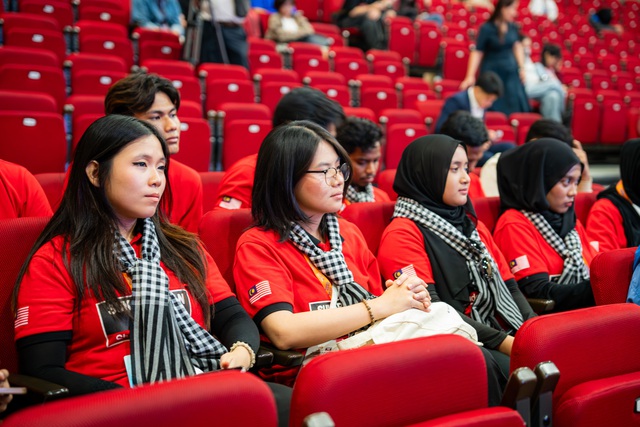
The Malaysian government has for years sent a contingent of student volunteers to take part annually in the Green Summer volunteer campaign in Ho Chi Minh City. Photo: Ngoc Duc / Tuoi Tre
A catalyst for ASEAN integration
Under the comprehensive strategic partnership, what is Malaysia's top priority in higher education cooperation with Vietnam?
Vietnam and Malaysia elevated their relationship to a comprehensive strategic partnership in November 2024. The meetings between our leaders set a clear mandate: to convert diplomatic trust into tangible and sustainable development.
From that mandate, Malaysia's priority in higher education cooperation with Vietnam is to develop talent that is ready for whatever comes next, through collaboration between institutions and through people-to-people ties.
More concretely -- and this is my own observation after nearly three years working in Ho Chi Minh City -- it means connecting higher education directly to high-tech industry. That includes expanding the mobility of both students and academics, in order to strengthen joint research in AI and digital technology.
Malaysia wants higher education to serve as a catalyst for ASEAN integration, producing graduates who are globally competitive, digitally skilled and -- no less important -- culturally connected.
That is why we encourage universities in both countries to work together, from joint academic programs and staff exchanges to industry-linked initiatives.
Malaysia recognizes the remarkable progress of Vietnam's higher education sector, particularly the ambitions its universities show in digital transformation, innovation, scientific research, and internationalization. Institutions in both countries have tremendous potential to learn from one another and to build partnerships that produce practical and sustainable outcomes.
Even so, I would stress that the value of such agreements should not be measured by the number of documents signed. Their real value lies in the opportunities they create for students, academics, institutions and society.








Max: 1500 characters
There are no comments yet. Be the first to comment.