


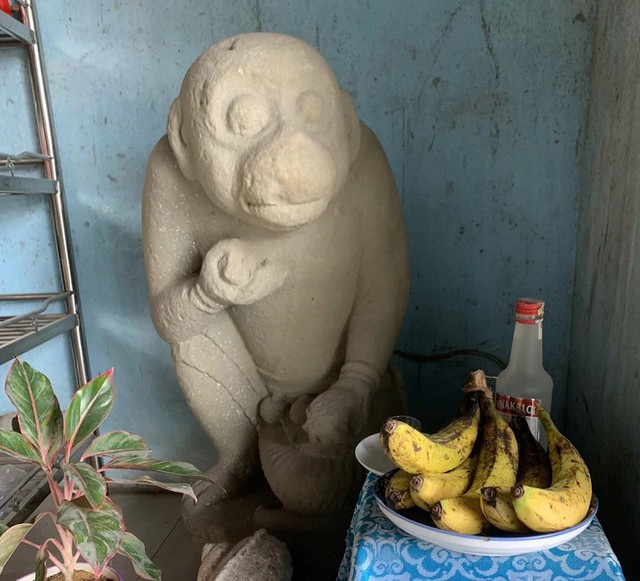
The Hanuman statue recovered by Luc while he was fishing Photo: Supplied
The Ministry of Culture, Sports and Tourism had approved the reward for Duong Dinh Luc, who transferred the artifact to the Quang Ngai General Museum, according to the local authorities.
The payment will come from the provincial culture department’s budget and is expected to be made within 2026.
Luc discovered the statue in 2021 while fishing at sea. It was buried beneath the sand about 50 meters from shore at a depth of around four meters.
As the statue weighed about 150 kilograms, Luc enlisted relatives and hired a crane to bring it ashore.
After news of the discovery spread, antique dealers approached him with offers to buy the statue, including one reportedly worth VND2 billion ($76,858). Luc refused to sell it.
Following encouragement from local authorities, he handed the artifact over to the Quang Ngai General Museum in 2023 for research and appraisal.

Luc poses with the ancient Hanuman statue. Photo: Supplied
Experts found that the statue was carved from fine-grained sandstone and measures 84 centimeters in height and 40 centimeters in width.
It consists of a 14-centimeter-high octagonal pedestal and a 70-centimeter-high seated figure.
Its rounded head, protruding eyes, high nose bridge, wide mouth, and decorative patterns around the abdomen are characteristic of late Champa sculpture, while also showing influences from Khmer art.
Researchers said the statue is notable for its large size, relatively intact condition, and value for studies of Champa sculpture.
Some believe it may have originated from the ruins of Chanh Lo Tower, where hundreds of Champa sculptures were discovered and excavated in 1927.
Dating to around the 11th-12th centuries, the artifact reflects the region’s historical and cultural heritage as well as the influence of Hinduism on Champa art.









Max: 1500 characters
There are no comments yet. Be the first to comment.