


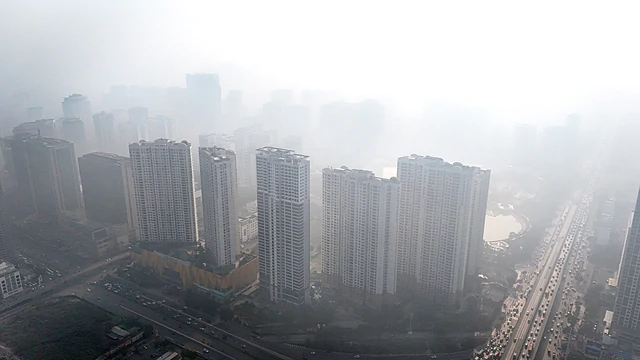
A view of Hanoi during a period of air pollution. Photo: Tuoi Tre
On Monday, the ministry submitted a proposal to the prime minister to issue regulations on interprovincial coordination and air quality management measures for eight northern provinces and cities in case of severe air pollution.
Air pollution worsens in urban areas, particularly PM2.5
According to the ministry, air pollution in Vietnam in general and several major urban areas in particular has tended to increase, with pollution mainly involving particulate matter, especially PM2.5, which consists of particles with a diameter of 2.5 micrometers or less.
Geographically, areas of concern are concentrated in eight northern localities, namely Hanoi, Hung Yen, Bac Ninh, Ninh Binh, Phu Tho, Thai Nguyen, Hai Phong, and Quang Ninh.
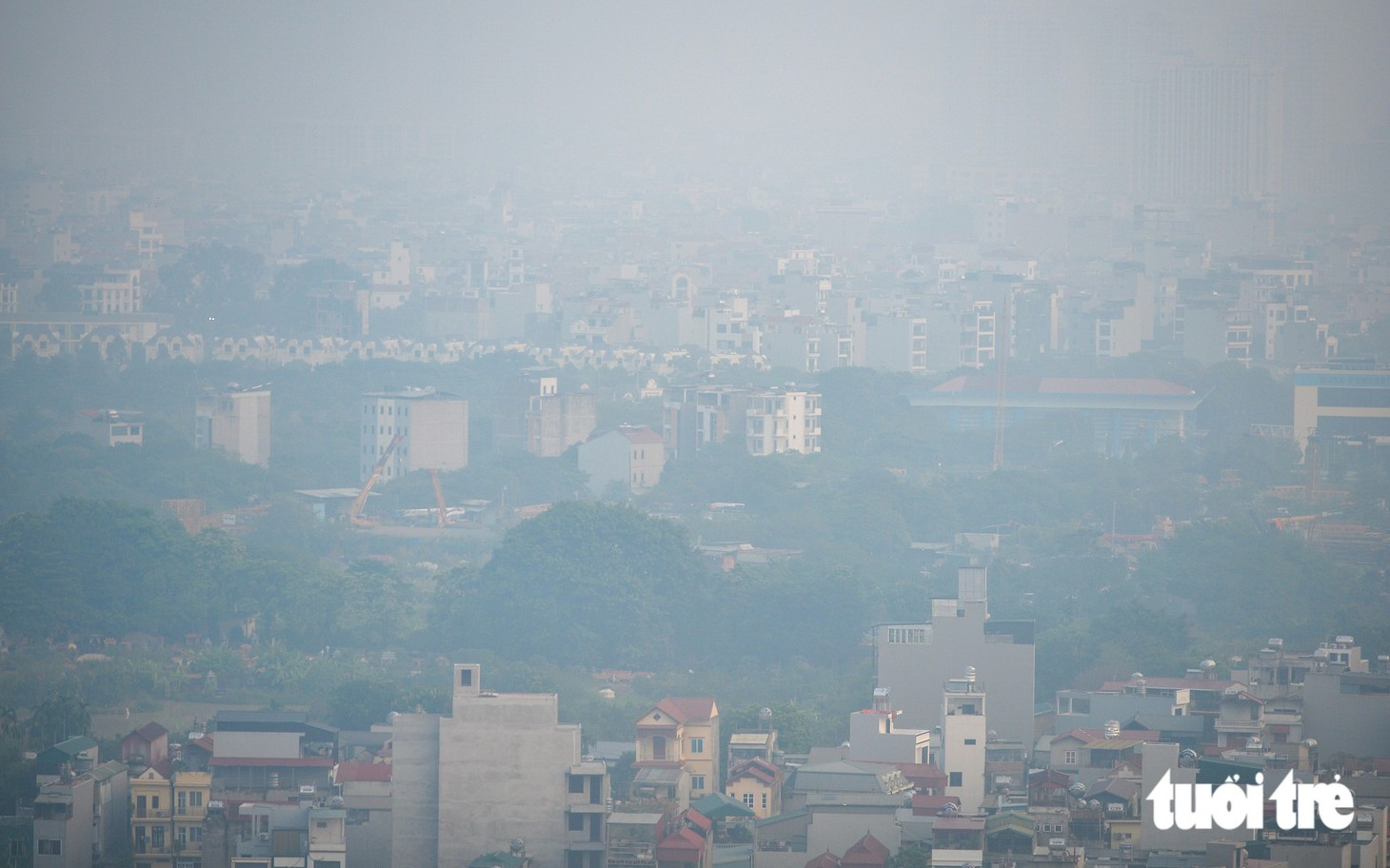
According to the 2021-25 national environmental report, daily average PM2.5 levels exceeded national limits on more than 15 percent to nearly 40 percent of days at monitoring stations across the eight localities.
Based on the experience of several neighboring countries and the situation in Vietnam, the ministry has proposed initially applying the regulations to these eight northern localities.
The draft regulations focus on responses to severe air pollution when Vietnam's Air Quality Index (VN_AQI) reaches the hazardous level of 301 or higher.
Two alert levels would be established based on the daily VN_AQI: Level 1, or yellow alert, and Level 2, or red alert.
Ministry proposes red alerts for severe air pollution
Under the proposal, the ministry would issue yellow alerts on behalf of the prime minister through the VN Air application.
In response to yellow alerts, affected provinces and cities would require major emission sources to maintain the continuous operation of automatic monitoring systems and run exhaust gas treatment systems at maximum efficiency.
These localities would also prepare production adjustment plans when the alert level rises to Level 2.
Other proposed measures include increasing street sweeping, dust collection, and road washing, with these activities prioritized at night.
Dust-generating construction stages would be temporarily suspended, while mist spraying and cleaning at construction sites and vehicles would be stepped up.
Authorities would prepare plans to restrict and reroute traffic if air pollution worsens to a more severe level.
Air pollution warnings and health recommendations would be issued at least twice a day.
Kindergartens, elementary and middle schools would suspend outdoor group activities, adjust student drop-off and pick-up times as needed, and encourage online learning.
Authorities would also step up patrols and inspections to prevent the open burning of rice straw, agricultural byproducts, waste, scrap materials, and other substances.
Under a red alert, the ministry would submit a proposal to the prime minister to issue the warning.
Affected provinces and cities would continue to control and monitor industrial emission sources and require reports on emissions.
Diesel-powered trucks weighing three metric tons or more would be restricted from entering inner-city areas and densely populated neighborhoods during peak hours, from 6:00 am to 9:00 am and from 4:00 pm to 7:30 pm.
Vehicles transporting essential goods and food would be exempt from the proposed restrictions.
Residents would be encouraged to limit private motorbike use, while public transport services would be promoted and fare exemptions considered.
Dust-generating construction activities in inner-city areas and densely populated neighborhoods would be suspended.
Air pollution warnings would be issued at least three times a day.
Protective supplies would be provided to outdoor workers and disadvantaged residents.
All educational institutions at every level would be required to switch to online teaching and learning until the alert level was lowered or the warning was lifted.
State agencies and public service units would require employees whose duties did not involve directly handling administrative procedures at their offices to work remotely.
Authorities would continue to prevent the open burning of rice straw, waste, and other materials.
The proposal would also suspend the burning of votive paper and ceremonies that generate widespread smoke and dust in public places, religious and worship establishments, and residential areas.


Max: 1500 characters
There are no comments yet. Be the first to comment.