


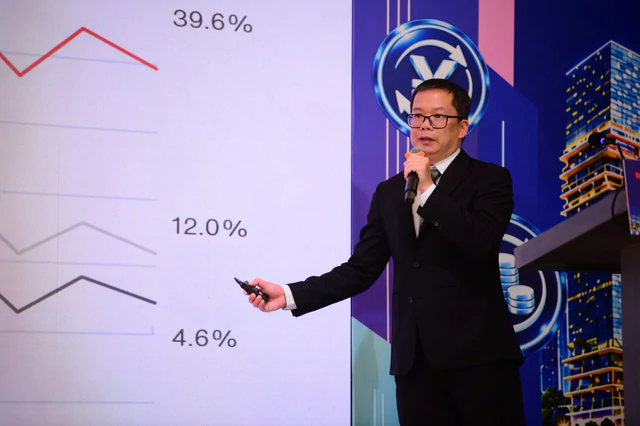
Dinh Duc Minh, senior investment director at VinaCapital Fund Management JSC, presents on Vietnam’s capital market outlook and opportunities to attract investment at the Vietnam Capital Market Forum held in Ho Chi Minh City, October 30, 2026. Photo: Quang Dinh / Tuoi Tre
Banks cannot meet growing capital demand alone
Speaking at the event, Dinh Duc Minh, senior investment director at VinaCapital Fund Management JSC, said Vietnam had an opportunity to achieve strong growth over the next five to 10 years, driven by global supply-chain shifts, favorable demographics, and plans to accelerate infrastructure investment.
The world is entering a period of growing polarization, prompting shifts in capital flows, technology and supply chains. This presents an opportunity for Vietnam to accelerate industrialization, develop technology and move further up global value chains, Minh said.
Vietnam is also still benefiting from its demographic dividend.
Meanwhile, infrastructure investment is expected to rise from around 4-5 percent of the country’s gross domestic product in previous years to approximately 7 percent in the coming period.
These factors will generate substantial demand for capital.
Citing Vietnam’s National Assembly resolutions and government decisions, Minh said total investment during 2026-30 was projected to reach approximately VND38.5 quadrillion (US$1.5 trillion), more than double the amount recorded in 2021-25.
Public investment is expected to surge significantly, particularly in railways, expressways and airports, while private businesses will also need substantial funding to support economic development.
However, Minh said the banking system would find it difficult to shoulder most of the economy's financing needs.
Vietnam's credit-to-GDP ratio is already high compared with many other ASEAN countries, while banks' capital adequacy ratios remain constrained.
Another challenge is the maturity mismatch between deposits and loans.
Long-term deposits remain limited, while the economy's demand for medium- and long-term credit continues to grow, putting pressure on banks' lending capacity.
Developing the capital market is therefore essential not only to mobilize additional resources but also to reduce dependence on bank credit and create more channels for medium- and long-term financing.
Mobilizing long-term funds, improving stock market quality

Investors believe Vietnam still has ample room to develop long-term investment institutions. Photo: Quang Dinh / Tuoi Tre
Vietnam still has ample room to develop long-term investment institutions, particularly voluntary pension funds and the corporate bond market, Minh said.
Voluntary pension funds in Vietnam remain relatively small compared with those in many regional economies, while the corporate bond market has yet to develop in line with the economy's financing needs.
These channels could provide businesses with additional long-term funding, reduce their reliance on bank loans and offer more investment options to individuals.
Vietnam also has opportunities to attract international capital, supported by its macroeconomic fundamentals, foreign currency inflows from exports and foreign direct investment.
Minh highlighted the potential benefits of an improvement in Vietnam's sovereign credit rating, saying it could expand access to international funding and help lower borrowing costs.
Regarding equities, he said the Vietnamese stock market's long-term growth performance had not been fully recognized.
Over the past decade, the market has outperformed many regional counterparts.
FTSE Russell's decision to upgrade Vietnam to secondary emerging market status on September 21 marked an important milestone, he said.
The next step is to continue improving market conditions to meet the requirements for an upgrade by MSCI, which could attract additional international investment.
However, attracting foreign capital remains challenging.
Although the number of foreign institutional investors has increased, foreign ownership as a proportion of the market has tended to decline, with overseas investors continuing to be net sellers in recent years.
The stock market is also highly concentrated, with gains in some large-cap stocks yet to spread evenly across other sectors and companies.
To attract more domestic and foreign investment, Vietnam needs to improve the quality of listed companies, strengthen market supervision and management, and expand investment opportunities across different business sectors, Minh said.
He added that listed companies were expected to deliver relatively positive earnings growth in the coming years, while Vietnamese stocks were trading at comparatively low valuations.
The combination of growth prospects and attractive valuations could make the market more appealing to investors. However, turning this potential into actual capital inflows will require better-quality listed companies, a wider range of investment products and stronger long-term funding channels.

Experts say Vietnam has multiple potential sources of funding that could supplement long-term capital for the economy. Photo: Quang Dinh / Tuoi Tre
Australian pension funds eye Vietnam
Allan Nguyen, chairman of EzyRemit Worldwide Co. Ltd., outlined ways Vietnam could tap into the AU$4.8 trillion (US$3.3 trillion) Australian superannuation sector to finance infrastructure and support long-term growth.
Australia has a steadily accumulating pool of pension savings with investment horizons spanning several decades and a need for real assets that can hedge against inflation.
Vietnam, meanwhile, has a pipeline of potentially profitable infrastructure projects but lacks sufficient long-term capital.
According to a 2026 report by the Thinking Ahead Institute, pension assets across 22 major markets totaled an estimated US$68.3 trillion by the end of 2025. Australia ranked fifth among individual countries, with nearly US$3 trillion in pension assets that year.
By mid-2026, assets under management in Australia's superannuation system had approached AU$4.8 trillion (US$3.3 trillion). The Association of Superannuation Funds of Australia forecasts that the figure will reach AU$13.6 trillion (US$9.5 trillion) by 2048.
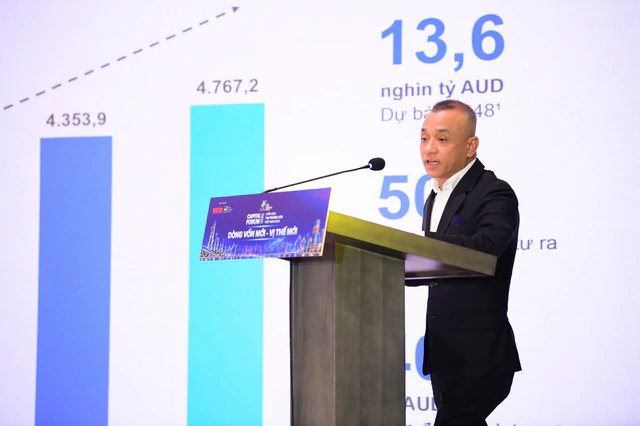
Allan Nguyen, chairman of EzyRemit Worldwide Co. Ltd. Photo: Quang Dinh / Tuoi Tre
Allan Nguyen said these funds had two particularly important characteristics: investment horizons of up to 20-30 years and a strong demand for real assets such as roads, seaports, renewable energy facilities and logistics infrastructure to hedge against inflation.
However, Australia's domestic market is too small to accommodate the funds' growing assets, prompting superannuation funds to increase their global allocations.


Their overseas investments have risen from about one-third to half of their total portfolios, with funds actively seeking fast-growing markets in the Indo-Pacific region.
The accumulated assets in Australia's pension system alone are large enough to finance Vietnam's major infrastructure investment programs many times over, Allan Nguyen said.
Because pension funds manage long-term capital and have payment obligations spanning decades, they are well suited to investing in long-lived infrastructure, including airports, seaports, energy facilities, expressways and data centers. These are also sectors in which Vietnam urgently needs investment capital.
To attract such funding, Vietnam needs to address several institutional and regulatory bottlenecks.
Allan Nguyen called for the Vietnam International Financial Center to play a stronger role in connecting international capital with domestic investment opportunities.
He also emphasized the need to improve the legal framework, ensure a stable and predictable investment environment, and develop long-term investment products suited to pension funds.
Other proposed measures include piloting infrastructure co-investment platforms involving the government and institutional investors, strengthening corporate governance and information transparency, improving environmental and social governance practices, and expanding direct engagement with Australian pension funds.
“Australia's superannuation capital is not only abundant and secure but also brings with it the highest international standards of governance,” Allan Nguyen said.
“If we proactively remove institutional bottlenecks, develop risk-mitigation instruments and infrastructure products that meet international standards, we can turn this AU$4.8-trillion pool of capital into bridges, railways, seaports and green energy projects.”



Max: 1500 characters
There are no comments yet. Be the first to comment.