


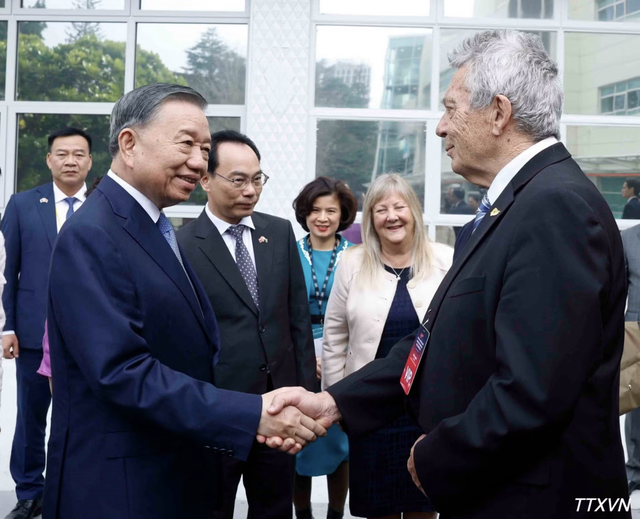
Vietnamese Party General Secretary and President To Lam attends the 2026 Viet Nam-New Zealand higher and vocational education forum at Auckland University of Technology on August 13. Photo: VNA
That exchange can be seen in the journeys of Vietnamese students and researchers who study in New Zealand, return to Vietnam, and later bring new questions and expertise back to New Zealand.
After completing his master's degree at Auckland University of Technology (AUT) in New Zealand, Tran Quoc Cong, born in 1990, returned to Vietnam.
Nearly two years of working with large language models, artificial intelligence (AI) agents and retrieval-augmented generation (RAG), an AI technique, in a corporate setting exposed Cong to questions that university classrooms had sometimes not yet addressed.
Those real-world challenges prompted him to consider returning to New Zealand to pursue a Ph.D.
In an interview with Tuoi Tre (Youth) online newspaper, Prof. Nguyen Hoang Minh, a computer science professor at AUT who previously supervised Cong and several other Vietnamese students, said such journeys should not be seen as a one-way movement from Vietnam to New Zealand.
"I really like journeys like these. Who knows, after completing their doctoral studies, they may return to Vietnam once again to continue contributing to their homeland," said Minh, who is now vice chairman of the Vietnamese Knowledge Network in New Zealand (VKNZ).
From a garden 'apple' to solving technology transfer challenge
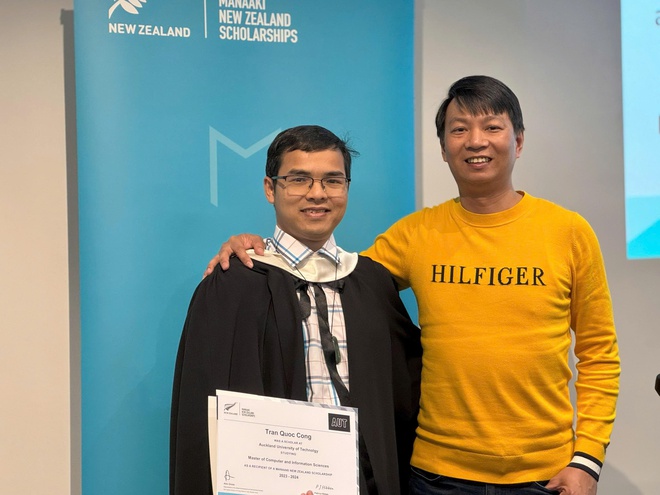
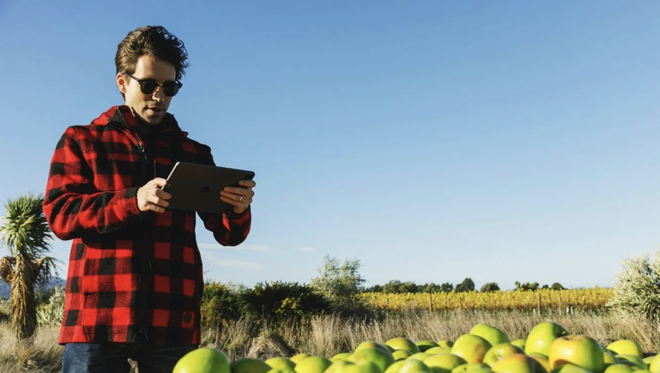
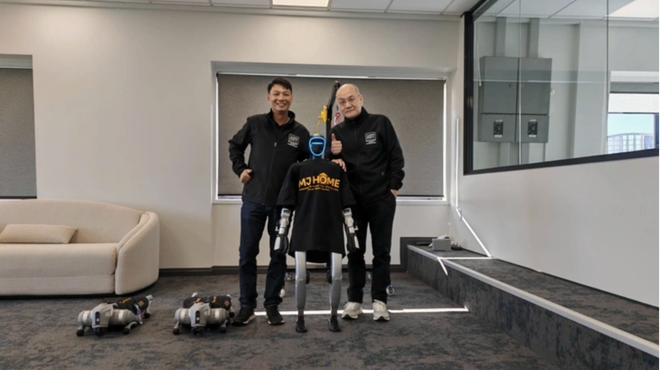
From left, top to bottom: Prof. Nguyen Hoang Minh with student Tran Quoc Cong; Hectre's technology being used on an apple; and a business trip by Prof. Nguyen Hoang Minh. Photos: Supplied
In New Zealand, Minh supervised students working with Hectre to develop a mobile system that uses computer vision and machine learning to assess fruit size and quality.
Instead of sending entire boxes of apples through expensive, fixed sorting lines, growers can use a mobile device to take photos from above.
The system automatically corrects the image angle, detects individual fruit and converts the information into actual measurements.
In trials involving multiple apple varieties and orchards across New Zealand, the system achieved about 95 percent accuracy compared with manual measurements using calipers.
The team then moved on to a more challenging task: estimating fruit size while the apples were still on the trees.
The biggest challenge, Minh said, was not developing an algorithm sophisticated enough.
"An apple in a laboratory is easy to work with: the lighting is fixed, the background is clean and the camera angle is standardized.
"But an apple in an orchard is completely different. One day it is sunny, the next it is cloudy; leaves can cover half the fruit; apples can overlap; the camera angle and distance can change; and each variety has different colors, shapes and sizes," he said.
That experience led Minh to a lesson he considers more important than any performance figure: a model that achieves 99 percent accuracy in a laboratory but cannot be used in the real world may be less valuable than a 95 percent model that farmers can simply take out their phones and use.
What is worth learning from Hectre is not just its technology.
The company has addressed the challenge of technology transfer by building networks with growers, packers and partners across multiple countries, then adapting its products to each market.
A technology developed in New Zealand but intended to work in the United States, Australia, Canada, Italy, Chile or Mexico cannot simply be translated into another language.
Developers need to understand production processes, how users work, market requirements and sometimes even small details of day-to-day operations.
For Vietnam to bring New Zealand technology home, Prof. Nguyen Hoang Minh said, it could learn from this model.
"I don't think Vietnam lacks the capacity to adopt AI or robotics. What we need more of are sustainable models that connect technology, businesses and users.
"If a Vietnamese-owned company in New Zealand could serve as a bridge between the two ecosystems, identifying the right technology here, the right partners in Vietnam, and jointly developing local data and talent, I think the chances of success would be much higher," he said.
The intermediary should be more than a product distributor.
It needs to understand both sides: how technology is developed, commercialized and protected through intellectual property rights in New Zealand, while also understanding Vietnam's business culture, investment capacity, needs and operating conditions.
That would allow issues such as local data, workforce training and technical support to be addressed in Vietnam rather than relying entirely on teams in New Zealand.
"A research project may end after a few years, but a well-trained young person can continue creating value for decades," said Prof. Nguyen Hoang Minh.
Investing in human capital
Prof. Do Xuan Hung of Massey University in New Zealand, another vice chairman of VKNZ, also sees people as a bridge for knowledge cooperation between Vietnam and New Zealand.
The Vietnamese Party General Secretary and State President's visit to New Zealand on August 12-13 resulted in several concrete agreements.
These included a memorandum of understanding on agriculture and environmental cooperation, an education cooperation agreement, and support for a climate-smart agriculture initiative (CGIAR) and its initiative for major Asian river deltas.
The two sides also agreed to promote a green, low-emission economy and develop a highly skilled workforce.
The agreements show that Vietnam and New Zealand are focusing on complementary strengths, particularly in education and training, human resource development, high-tech agriculture and sustainable development.
The challenge now is to ensure these agreements go beyond paper.
The two countries currently have no bilateral green finance agreement. New Zealand has also yet to establish an operational agricultural carbon market.
Given this, Hung said Vietnam should focus less on attracting financial capital and more on attracting human capital and expertise from New Zealand.
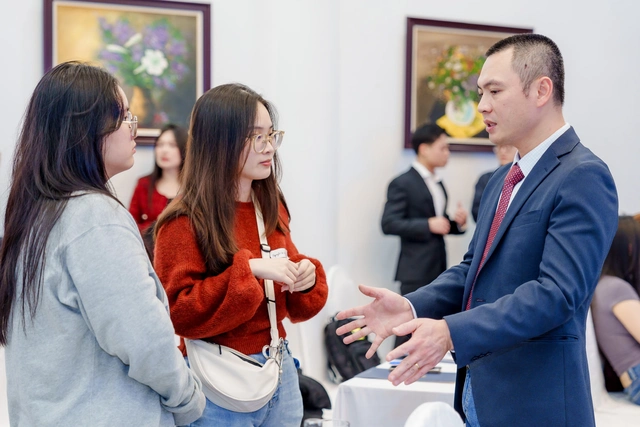
Prof. Do Xuan Hung (R) discusses the joint master's program in finance between Massey University in New Zealand and Vietnam's Academy of Finance, as well as life in New Zealand, with Vietnamese students. Photo: Supplied
Prof. Do Xuan Hung said the strength of the Vietnamese community in New Zealand lies not in its size, which is just over 15,000 people, but in the concentration of expertise in agriculture, soil science, veterinary medicine and climate science, fields in which New Zealand has global strengths.
To facilitate knowledge exchange, sharing and joint creation between the two countries, Hung proposed linking scholarships to a small alumni fund that would allow graduates to apply for funding to carry out joint projects with their former New Zealand partners.
He also proposed establishing mechanisms for recognizing experts and allowing reciprocal part-time appointments between Vietnamese research institutes and New Zealand universities.
In particular, the two sides should consider mutual recognition of qualifications and professional standards, especially in veterinary medicine, soil science and emissions verification.
Another priority, Hung said, is to further facilitate short-term travel for agricultural experts and technicians.
Vietnam and New Zealand are both founding members of the CPTPP, which already includes a chapter on the temporary movement of natural persons.
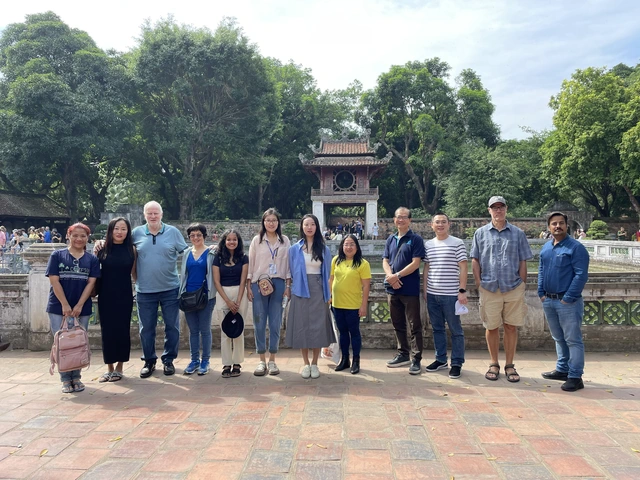
Prof. Do Xuan Hung takes international scholars on a visit to the Temple of Literature after an international conference on banking and finance co-hosted by the Banking Academy of Vietnam, the Association of Vietnamese Scientists and Experts (AVSE Global) and Massey University. Photo: Supplied
Sustainable cooperation goes both ways
Prof. Nguyen Hoang Minh also said Vietnam and New Zealand need a genuine 'pipeline' for knowledge cooperation.
What needs to be transferred is not simply an algorithm or funding, but human expertise and the ability to sustain collaboration over time.
For cooperation to be sustainable, particularly in knowledge sharing, the exchange cannot be one-way.
At the policy level, Minh proposed co-funded research programs between the two countries.
If a New Zealand lab has to secure all the funding for a project with Vietnam, or vice versa, he said, cooperation can easily depend too much on goodwill.
But if the two governments jointly provide funding, businesses participate and universities train the necessary workforce, projects are much more likely to lead to practical applications.
Having lived in New Zealand for many years, Minh said the country also has a real need for workers, particularly in some agricultural and seasonal jobs.
This creates an opportunity to develop better-structured work, internship and training programs that allow Vietnamese workers to work in suitable sectors in New Zealand.
They could also gain first-hand experience with the country's technology, management practices and production standards.
This is particularly important for AI, especially its use in agriculture.
New Zealand has a strong research environment but a relatively small population, while Vietnam has a much larger population and a far larger production base.
For example, if a New Zealand doctoral researcher working on AI in agriculture had the opportunity to work in Vietnam, they could access a much wider range of crops, climatic conditions, production processes and datasets.
Vietnamese students, in turn, could gain access to advanced technologies, laboratories and research methods in New Zealand. The two sides could therefore complement each other's strengths.
'Learn one, Share three' and the power of shared knowledge
VKNZ was established on July 23, 2026, as Vietnam introduced Resolution 19 on renewing its development model and Resolution 23 on work related to Vietnamese people living overseas.
The network's guiding principle is to serve all Vietnamese people, be built by all Vietnamese people and benefit all Vietnamese people, while promoting solidarity, integration and sustainable prosperity.
Prof. Do Xuan Hung said knowledge in this context is not limited to academia or research. It also includes professional expertise, life skills and practical experience.
A skilled worker, technician, nurse, small-business owner, student or teacher can all bring valuable knowledge.
Prof. Nguyen Hoang Minh recalled a simple idea he recently shared at a VKNZ gathering: "Learn one, share three."
Explaining the idea, Minh said that if someone gains new knowledge, an opportunity or support, they are encouraged to share it with three others.
In this way, one becomes three, three become nine, and nine become 27, multiplying the impact with each exchange.
"If VKNZ's success is not measured by how many members we have or how many conferences we organize, but by how many people have been lifted up and then go on to lift others up, I think the network will have achieved something truly meaningful," Minh said.









Max: 1500 characters
There are no comments yet. Be the first to comment.