


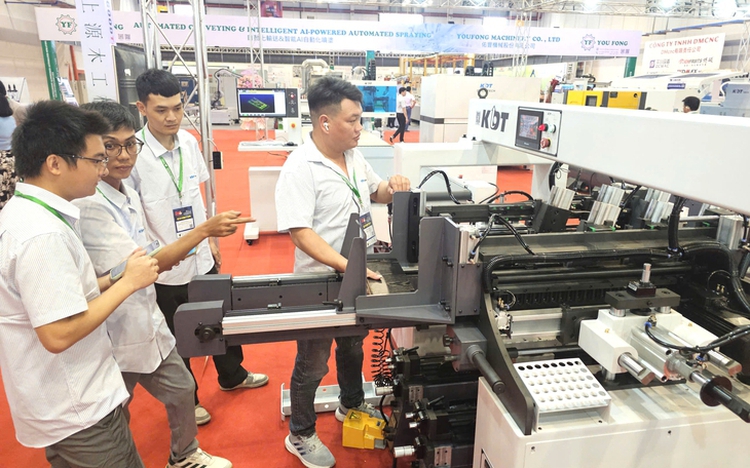
Technicians are seen during the operation of a machine system at a work session in a facility in Vietnam. Photo: N. Tri / Tuoi Tre
The figure was released by Le Trung Hieu, deputy director of the National Statistics Office (NSO) under the Ministry of Finance, at a press briefing in Hanoi on Tuesday.
Data showed that the domestic sector posted a trade deficit of $20.76 billion, while the foreign-invested sector recorded a surplus of $6.96 billion in the first five months of this year, resulting in a trade deficit of $13.8 billion.
In the same period of 2025, Vietnam registered a trade surplus of about $5.1 billion.
Hieu said Vietnam's economy remains heavily export-dependent and highly open, adding that the recent shift into deficit is linked to global economic volatility and rising import costs.
He noted that the deficit in the first five months can be broken down into two main drivers.
The first is an estimated $8 billion deficit in petroleum products, mainly due to higher crude oil prices.
Hieu said domestic crude oil output remains limited, while refineries rely heavily on imported crude, making the economy more vulnerable to global price fluctuations.
The second driver is surging imports of high-value inputs such as electronics components and semiconductors, which have also seen price hikes.
Hieu added that several foreign direct investment projects in provinces such as Phu Tho and Thai Nguyen have already begun importing semiconductor chips worth up to $2 billion ahead of production.
He explained that these firms are still in the pre-operation phase, requiring significant imports of machinery, equipment, and raw materials before their factories become fully operational.
Large-scale state-backed projects, including the construction of a national data center, are also likely to significantly drive up import value, although official figures have not been released yet.
However, Hieu stressed that imports of machinery and equipment should be seen as investments in future growth, as they contribute to capital accumulation and long-term GDP expansion.
He added that imports of raw materials and electronic components not only support domestic production and exports, but are also partly driven by rising export orders and expectations of higher global chip and component prices.
Commenting on the impact of the trade deficit on economic growth, Nguyen Thi Huong, director of the NSO, said the deficit is a drawback for growth.
Huong noted that in the past, most imported inputs were used entirely for export production, citing electronics manufacturing as an example.
However, she noted that in the current phase, products like electric vehicles rely on imported components assembled mainly for domestic consumption, leading to higher imports without matching exports.
She added that whether the current trade deficit is a cause for concern depends on more detailed data to determine whether imports are being used for production investment or consumption.








Max: 1500 characters
There are no comments yet. Be the first to comment.