


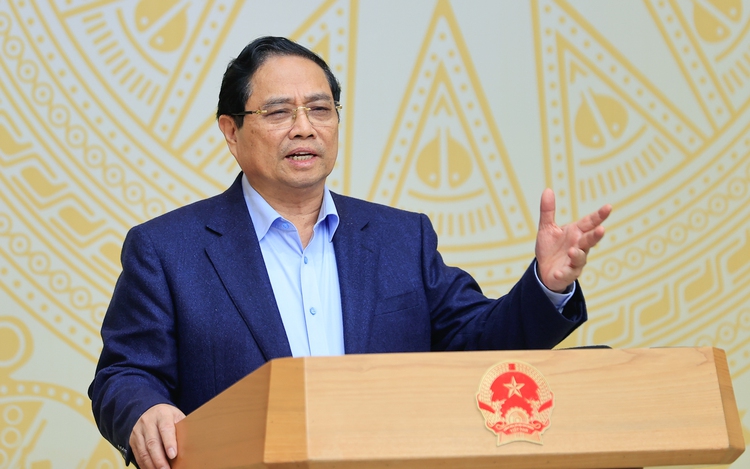
Vietnam’s Prime Minister Pham Minh Chinh speaks at the first meeting of the National Steering Committee overseeing the implementation of the Politburo’s Resolution 79 on state economic development in Hanoi, February 1, 2026. Photo: Vietnam Government Portal
The call was made at the first meeting of the National Steering Committee for the Implementation of the Politburo’s Resolution No. 79-NQ/TW on the Development of the State-owned Economic Sector, held in Hanoi on Sunday.
Clarifying state sector’s role
Participants said the resolution, issued on January 6, for the first time clearly and comprehensively defines the position and role of the state-owned economic sector.
It sets out key guiding principles, reaffirming the sector’s leading role in the socialist-oriented market economy, with responsibility for safeguarding macroeconomic stability and major economic balances, while operating on an equal legal footing with other economic sectors.
State economic resources are to be fully reviewed, inventoried and accounted for, while the sector is expected to play a pioneering role in shaping development and opening new growth paths under stronger leadership from the Communist Party of Vietnam.
Against a backdrop of rising global uncertainty and volatility, participants said timely and effective implementation would be critical to fully leveraging the role of state-owned enterprises (SOEs) in supporting national growth targets.
In his remarks, PM Chinh, also head of the national steering committee, underscored a reform-oriented, action-driven approach, calling for prompt, effective, and decisive implementation.
He instructed relevant agencies to draft and consult on a government resolution outlining an action plan, alongside a National Assembly (NA) resolution on special and exceptional mechanisms and policies for state economic development.
Chinh stressed that the draft to be submitted to the NA must remove long-standing bottlenecks in tapping state resources, while creating conditions to attract high-quality human resources through competitive salary frameworks and personnel policies that encourage initiative, innovation, and accountability.
He also called for a clearer delineation of areas where the state must play a leading role, while refraining from activities that the private sector can perform more efficiently.
Public–private cooperation should be expanded without rigid limits, with state resources providing strategic direction, alongside greater decentralization and stronger inspection, supervision, and power-control mechanisms.
Reforming ownership models, piloting executive hiring
PM Chinh tasked the Ministry of Finance with studying reforms to the state ownership representation model, restructuring state-owned groups and corporations, and further refining tax, fee, and charge policies.
The ministry was also asked to incorporate relevant feedback and urgently finalize draft documents in these areas for submission to the government within this month.
All related ministries and agencies were instructed to review and amend laws on land, the environment, sustainable resource exploitation, underground space management, and housing.
They were also directed to develop mechanisms for recruiting, appointing, and hiring directors and general directors at SOEs.
At the same time, new solutions for public service units will be institutionalized.
Units that are at least self-financing in recurrent expenditures will be granted greater autonomy over organizational structures, salary frameworks, and personnel management based on performance outcomes, similar to that of wholly SOEs.
Investment will be focused on a number of key public service units with strong capacity and competitive potential in basic research and strategic technologies.
The plan also includes piloting the hiring of executive directors and establishing specialized advisory units within large public service entities, while discontinuing management councils.








Max: 1500 characters
There are no comments yet. Be the first to comment.