


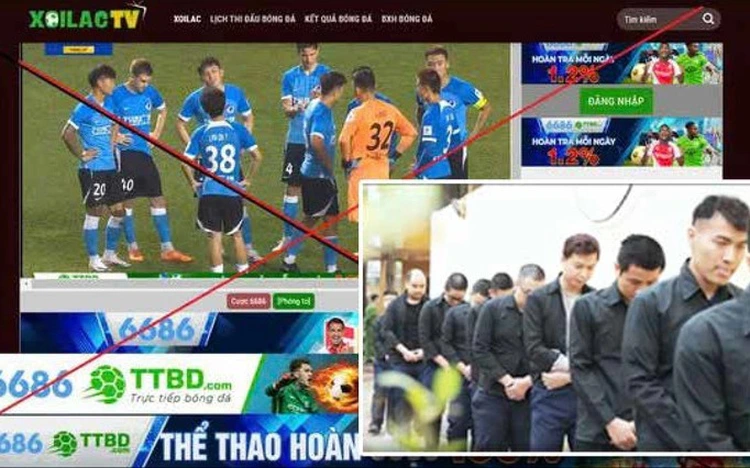
These combined screenshots show the XoilacTV interface used for unauthorized live sports streaming (main image), alongside images of suspects in a copyright infringement case linked to the platform (inset). Photo: Cao Nguyen / Tuoi Tre
The crackdown follows instructions from Deputy Prime Minister Ho Quoc Dung, who has directed ministries and local authorities to launch a nationwide enforcement drive with a stronger focus on copyright and IP violations across sectors.
According to the Ministry of Science and Technology, 2,036 cases suspected of violating IP rights were recorded between May 7 and 30, reflecting the large scale of IP abuse as digital platforms expand rapidly and outpace enforcement capacity.
Online piracy networks persist through domain switching, mirror sites
Online piracy continues across the digital space despite repeated takedown efforts.
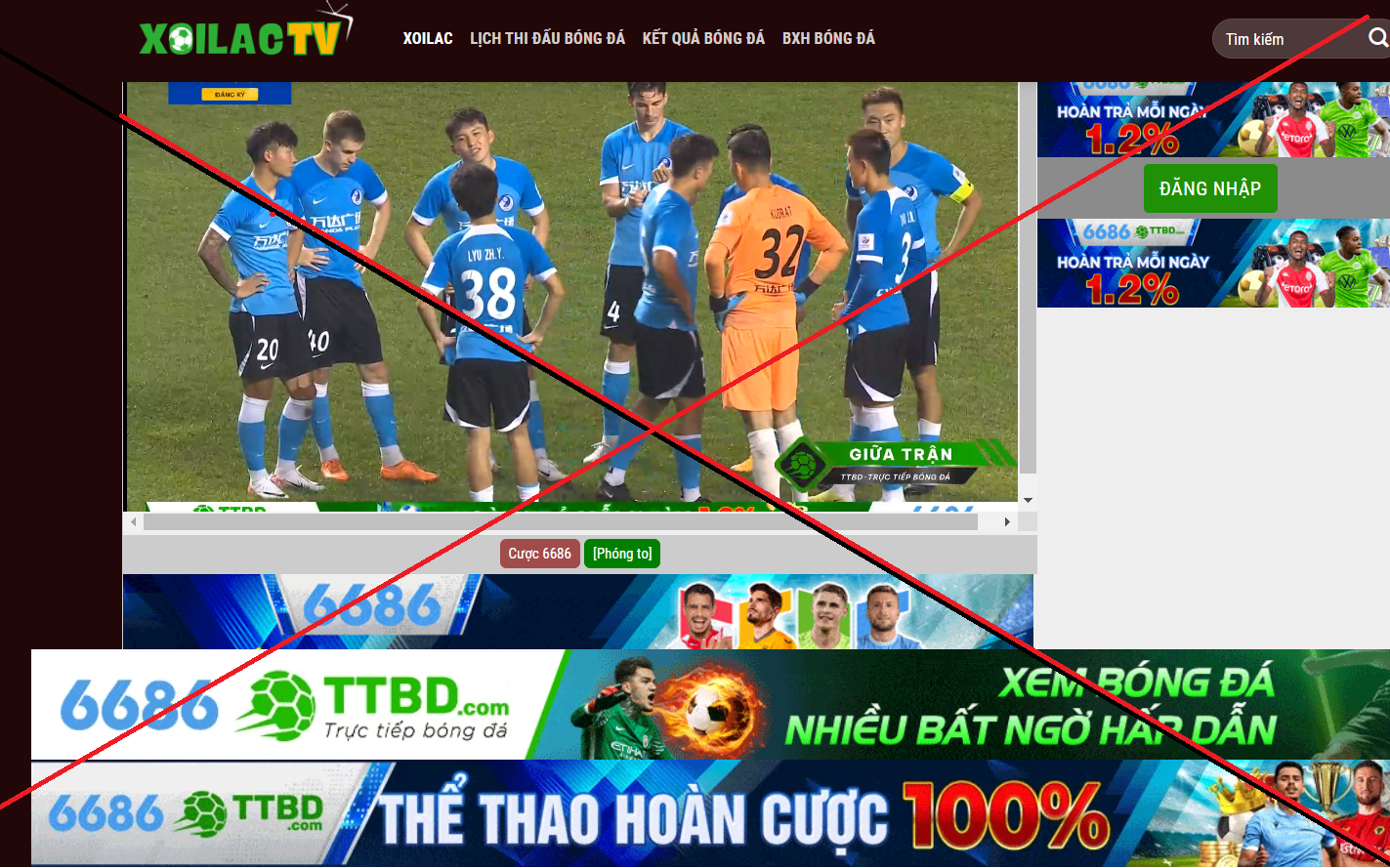
Although Vietnamese authorities have previously dismantled the XoilacTV system, its network continues to re-emerge through multiple mirror domains and variants.
As recorded by Tuoi Tre (Youth) newspaper, sites such as xoilacztu.tv frequently change domain endings to evade detection while continuing to stream major international football competitions without authorization, including the English Premier League, UEFA Champions League, Serie A, and La Liga.
The platform is reported to illegally capture broadcast signals from licensed television networks and retransmit them online, often embedding official logos and graphics without permission.
It also generates revenue through intrusive advertising, including gambling and betting promotions.
A similar pattern is seen in film piracy networks, particularly the ‘phimmoichill’ ecosystem, which operates across multiple domain variants and is considered one of the largest illegal streaming hubs in Vietnam.
The system allegedly scrapes content from licensed platforms such as Netflix, Disney+, Apple TV+, HBO Go, VieON, and FPT Play, reuploads films shortly after release, and distributes them under its own branding.
The network is also linked to other piracy sites through shared databases and quickly shifts domains when being blocked, using social media channels to direct users to new addresses.
Music piracy has also expanded in the digital environment, with the unlicensed use of copyrighted tracks becoming common on short-video platforms such as TikTok, Facebook Reels, and YouTube Shorts.
Unauthorized remixes and ‘lofi’ versions of popular songs are also widely circulated without the consent of rights holders.
Enforcement gaps remain amid rising digital IP violations
Experts say the rapid migration of content industries onto digital platforms has intensified violations of IP rights across multiple sectors, including gaming, online publishing, news media, and digital books.
Speaking to Tuoi Tre, Nguyen Quang Dong, director of the Institute for Policy Studies and Media Development, said copyright infringement has become a long-standing issue driven by the growth of the digital economy, pointing to the illegal streaming of sports and films as well as the unauthorized redistribution of written and audio content.
He noted that although Vietnam’s legal framework on IP has been progressively updated, including the most recent amendments in 2025, enforcement remains the weakest link in the system.
Authorities have in some cases pursued criminal charges against operators of large-scale piracy networks, including those distributing illegal Premier League streams.
However, many illicit platforms continue to operate, often sustained by revenues from gambling, fraud, and other unlawful online services.
From a legal perspective, Phan Vu Tuan of Phan Law Vietnam Law Office said copyright infringement in live performances and digital content distribution is becoming increasingly complex.
Common violations include unauthorized broadcasting, recording and remixing of performances, as well as unlicensed commercial use of music on online platforms.
He emphasized that such activities constitute violations of IP law unless they fall under legally recognized exceptions.
Meanwhile, Vo Xuan Hoai, deputy director of the Vietnam National Innovation Center under the Ministry of Finance, said the issue stems partly from gaps in the legal framework and weak enforcement in the digital space.
Stronger penalties, technology tools, platform accountability needed
Hoai urged stronger financial penalties and improved coordination among agencies, including the Ministry of Culture, Sports and Tourism, the Ministry of Science and Technology, the Ministry of Public Security, and private technology firms.
He also called for greater use of technologies such as artificial intelligence and blockchain to detect and verify copyrighted content online.
He said digital platforms such as YouTube, Facebook, and TikTok should take greater responsibility for proactively identifying and removing infringing content, rather than relying mainly on user complaints.
Beyond enforcement measures, experts say more reasonable pricing of copyrighted content would help expand legal access and reduce incentives for piracy.
The issue also has broader economic implications.
A finance ministry expert warned that widespread violations of IP rights could undermine Vietnam’s efforts to attract high-tech foreign direct investment in sectors such as artificial intelligence, semiconductors, big data, and advanced materials.
Investors from the U.S., Europe, and Japan are particularly sensitive to IP protection, the official said, adding that weak enforcement could deter large-scale research and development projects in Vietnam.
Comparative experiences show stricter approaches in other countries.
Singapore imposes heavy fines and prison terms for copyright violations and has ordered the widespread blocking of illegal streaming sites.
Japan has strengthened its copyright laws since 2021 to criminalize unauthorized distribution, while South Korea has recently expanded legal tools to block piracy websites and increase penalties for digital infringement.
Officials say Vietnam’s challenge now lies in narrowing the gap between legal provisions and real-world enforcement as digital piracy continues to evolve rapidly.








Max: 1500 characters
There are no comments yet. Be the first to comment.