


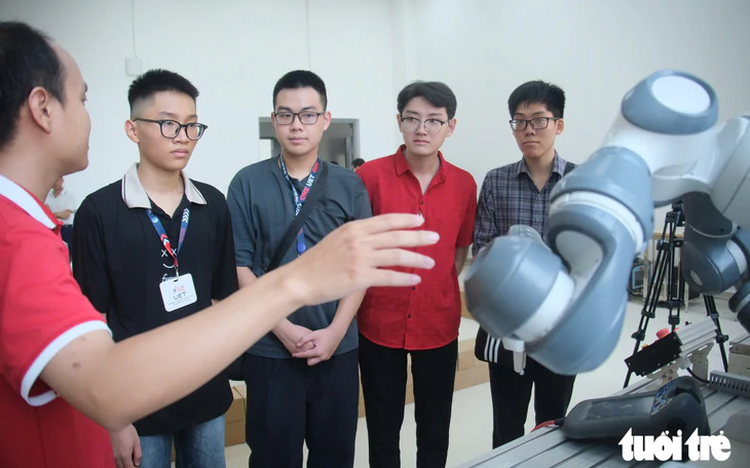
Students at the University of Technology under Vietnam National University, Hanoi work in a laboratory. Photo: Nguyen Bao / Tuoi Tre
The index was released in Switzerland on Tuesday.
The country’s ranking has steadily improved from 59th in 2016 to 43rd this year, a gain of 16 places, according to Vietnam’s Ministry of Science and Technology.
WIPO publishes the Global Innovation Index (GII) annually as a tool for assessing countries’ innovation capabilities. The index reflects how economies develop through science, technology and innovation.
In 2026, Vietnam’s innovation output ranking rose two places from 37th to 35th, helping improve its overall ranking by one place.
Vietnam retained second place among lower-middle-income economies, behind India, which ranked 38th.
Two upper-middle-income economies also ranked above Vietnam: China in 10th place and Malaysia in 34th place. The other economies ranked above Vietnam are high-income, industrialized economies.
Within ASEAN, Vietnam ranked third, behind Singapore and Malaysia and ahead of Thailand.
WIPO recognized Vietnam as one of seven middle-income economies that have improved their rankings most rapidly since 2013, alongside China, India, Türkiye, the Philippines, Morocco and Indonesia.
Vietnam was also one of three economies whose innovation performance significantly exceeded what would be expected based on their level of development, alongside China and India.
For 16 consecutive years, Vietnam has recorded innovation performance above the level expected for its level of development, indicating its effectiveness in turning innovation inputs into outputs.
Among Vietnam’s notable GII results in 2026, high-tech exports and high-tech manufacturing continued to account for significant shares of trade and industrial production, while creative goods production remained among the world’s leading areas of performance, according to the Ministry of Science and Technology.
Innovative startups also made progress, with three billion-U.S.-dollar unicorns and the emergence of startups specializing in science-intensive fields.
Investment in research and development has begun to improve, with policies encouraging businesses to increase R&D investment and attracting new foreign-invested projects in R&D and high technology.
However, despite being prioritized for investment, Vietnam’s spending on education and training remains low compared with other economies. The country also has a limited pool of highly qualified workers, including researchers at research institutes and universities and knowledge workers in businesses.
Infrastructure investment also remains limited, including in transport, energy, digital infrastructure, while ecological sustainability remains another area of concern. Vietnam has yet to attract sufficient venture capital for innovative startups, according to the ministry.



The country also remains weak at absorbing knowledge from foreign businesses, while institutional quality and law enforcement effectiveness remain limited. Innovation outputs, including patents and scientific publications, have not improved significantly in recent years.
Minister of Science and Technology Vu Hai Quan said Vietnam’s two-place rise in innovation output was a notable achievement.
Investment resources for science, technology, innovation and digital transformation have increased significantly, he said.
Vietnam’s policies and legal framework for science, technology, innovation and digital transformation have improved.
The participation of the government, businesses, research institutes and universities has helped lay the foundation for an innovation ecosystem in Vietnam, according to Quan.
More work needed to reach 2030 goal
To achieve its goal of entering the world’s top 40 economies for innovation by 2030 and top 30 by 2045, Vietnam still has much work to do, Quan said.
The country needs to improve the quality of its human resources, particularly highly qualified workers for strategic technology sectors.
It also needs to increase international scientific publications and the number of patents, which are directly linked to innovation capacity, he said.
Businesses must play a greater role in innovation and research and development, Quan said, calling on Vietnamese companies to increase investment in both funding and human resources and gradually adopt technology and digital transformation in their production and business operations.
Such efforts would help improve product quality, increase value and boost labor productivity, he said.








Max: 1500 characters
There are no comments yet. Be the first to comment.