


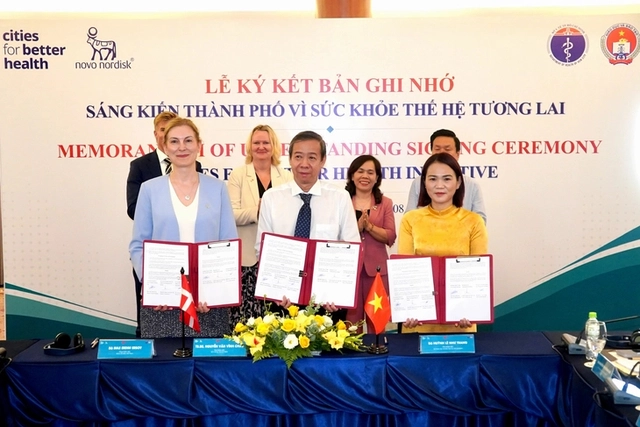
Officials in Ho Chi Minh City and Novo Nordisk Vietnam signed a memorandum of understanding for the “Cities for Better Health – Future Generations” program. Photo: Thu Hien / Tuoi Tre
The figures were presented at a ceremony in Ho Chi Minh City on Friday, where the municipal Department of Health, Department of Education and Training, and Novo Nordisk Vietnam signed a memorandum of understanding to implement the Cities for Better Health program.
According to data from 2010 to 2025, Vietnam was among the 10 countries with the fastest-growing rates of overweight and obesity among children aged 5-19 and ranked fourth globally in the increase of childhood obesity.
The prevalence of childhood obesity in the country increased by 8.7 percent annually over the period, placing Vietnam fourth globally in terms of growth rate, said Associate Professor Huynh Thi Vu Quynh, head of the nephrology and endocrinology department at Children's Hospital 2.
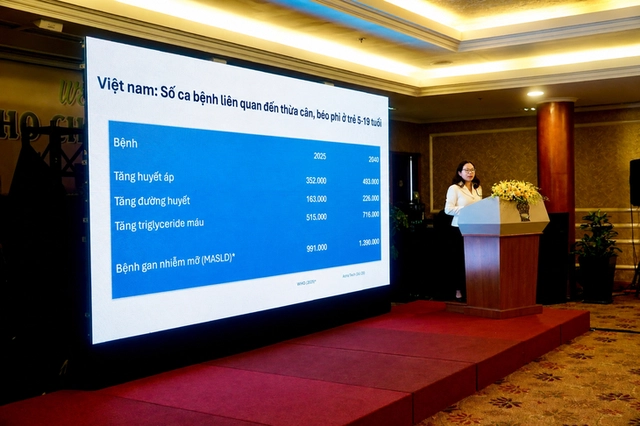
Associate Professor Huynh Thi Vu Quynh, head of the nephrology and endocrinology department at Children's Hospital 2 in Ho Chi Minh City, shared data on health conditions linked to overweight and obesity among children aged 5-19. Photo: Thu Hien / Tuoi Tre
Obesity has become a global health burden, with the World Health Organization describing it as an “epidemic”.
About 352,000 children had high blood pressure, while 991,000 had fatty liver disease associated with metabolic dysfunction. Between 30 percent and 50 percent of these cases were closely linked to overweight and obesity.
Children in urban areas have higher rates of overweight and obesity than those in rural and mountainous areas, partly due to differences in food access, energy intake, physical activity and socioeconomic conditions.
However, many parents still do not consider obesity a medical condition, she said.
Childhood obesity can increase the risk of high blood pressure, abnormal blood sugar, diabetes, fatty liver disease, abnormal blood lipids and cardiovascular disease.
In Ho Chi Minh City, children and adolescents account for about one-quarter of the population of more than 14 million following the city's administrative merger.
Data from the city's health authorities showed that the prevalence of overweight and obesity among children under five declined from 14.7 percent in 2020 to just over 8.1 percent in 2025, based on surveys of more than 3,000 households.
However, excess weight remains a significant issue among school-age children.
More than 98 percent of students received regular health checkups during the 2025-26 school year. Among primary school students, 20.4 percent were overweight and 18.3 percent were obese.
That means roughly two in every 10 primary school students were overweight or obese.
The risk factors are diverse, including sedentary lifestyles, high consumption of sugary foods and drinks, academic pressure and family attitudes toward nutrition.
Addressing childhood obesity requires coordinated action by families, schools and the healthcare sector, alongside improvements to the food and living environment.
Ho Chi Minh City plans to focus on three areas through 2030: standardizing school meals, improving the food environment and promoting physical activity.
The city aims to keep overweight and obesity rates below 14 percent among children under five, below 40 percent among those aged 5-18, and below 35 percent among adults.








Max: 1500 characters
There are no comments yet. Be the first to comment.