


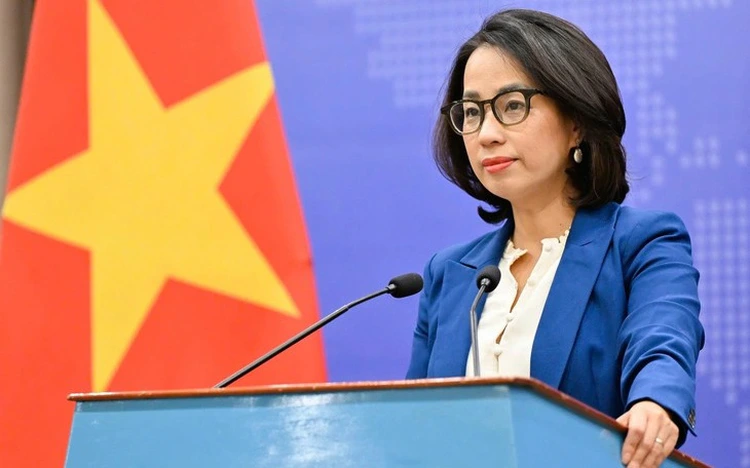
Vietnamese Ministry of Foreign Affairs spokeswoman Pham Thu Hang. Photo: Ministry of Foreign Affairs
The foreign ministry's spokesperson Pham Thu Hang made the statement at a regular press briefing in Hanoi on Thursday, in response to a question from Tuoi Tre (Youth) newspaper reporters about Vietnam’s reaction to the USTR’s June 2 proposal to impose additional tariffs of 10 percent or 12.5 percent on goods from 60 economies, including Vietnam.
The proposed tariffs followed investigations launched on March 12 under Section 301 of the U.S. Trade Act of 1974, which concluded that the targeted economies had failed to impose and effectively enforce bans on imports of goods produced using forced labor.
In response, Hang said the USTR conclusion does not accurately reflect the situation in Vietnam or the country’s efforts to prevent and reduce forced labor.
She reiterated that Vietnam prohibits all forms of forced labor and fully complies with International Labor Organization standards as well as the country’s commitments under free trade agreements.
She said this policy is clearly stipulated in the Vietnamese government’s legal documents, programs, and action plans and is implemented in practice.
Hang noted that Vietnam has participated in ratifying relevant international conventions and treaties to ensure the full implementation of workers’ rights and obligations.
She added that Vietnam had provided full and detailed information to the U.S. during the investigation process.
“On that basis, Vietnam will continue to engage with the U.S. in a constructive and cooperative manner to address remaining differences in line with bilateral and multilateral trade commitments and to safeguard the legitimate interests of workers and businesses,” she said.
Alongside Vietnam, 53 other economies were also identified as having failed to enact or effectively enforce bans on goods produced using forced labor, including Argentina, Australia, Bangladesh, Brazil, Cambodia, China, India, Israel, Japan, Malaysia, Norway, the Philippines, Russia, Saudi Arabia, Singapore, South Korea, Switzerland, Taiwan, Thailand, and the United Kingdom.
Six remaining economies were cited as not effectively enforcing such bans, including Canada, Ecuador, the European Union, Indonesia, Mexico, and Pakistan.
The USTR has also proposed a mechanism that would allow a certain volume of textile imports into the U.S. to benefit from lower tariff rates, although no specific details were provided.
It said certain products would be exempt from the proposed tariff measures, including energy products, rare earths, beef, coffee, pharmaceuticals, and aircraft components.









Max: 1500 characters
There are no comments yet. Be the first to comment.